Popular Courses
MCAT
General Course
CHEM 1302A/B
Western University
General Chemistry
University Study Guides
AP Chemistry Exam Prep Course
AP Exam Prep
CHEM 1A03
McMaster University
CHEM 101
University of Alberta
CHEM 203
University of Calgary
CHM 1311
University of Ottawa
Chemistry
General Course
CHEM 1AA3
McMaster University
DAT
General Course
CHEM 103
University of Alberta
General Chemistry
University Study Guides
CHEM 1E03
McMaster University
ENGG 204
University of Calgary
Chemistry 12
British Columbia High School
CHM135H1
University of Toronto
CHEM 102
University of Alberta
CHEM 120
McGill University
CHEM 1011
Dalhousie University

0:00 / 0:00
Acidic, Basic, and Neutral Salts
Salts are ionic compounds that dissociate (incompletely/completely)
completely
in water!Salts are formed in neutralization reactions (reaction where an acid and base react together)
Example:
NaOH(aq) + HCl(aq) → NaCl(s) + H2O(l)
These reactions are exothermic (and produce a salt and water!)
The resulting pH of a solution will depend on whether an acidic, basic, or neutral salt is made
When deciding if a salt is acidic, basic, or neutral, consider the ions that make up the salt:
If we have the conjugate acid of a strong base, would this be a very weak or decent acid?
- It would be veryweak!
- Soweakthat we can ignore it!!
If we had the conjugate base of a strong acid, would this be a very weak or decent base?
- Veryweak
- Soweakthat we can ignore it!
If we had the conjugate acid of a weak base, would that be a very weak or decent acid?
- Would be adecentacid
If we had the conjugate base of a weak acid, would that be a very weak or decent base?
- Would be adecentbase
Examples:
1) CH3COONa
- Consider the anion we get from this salt:CH3COO-
- This is a conjugatebase(acid/base) of aweak(weak/strong)acid(acid/base) which is:CH3COOH
- Does this contribute to pH? If so, how?
- Yes, it raises the pH
- Consider the cation we get from this salt:Na+
- This is a conjugateacidof astrongbase(NaOH)
- Does this contribute to pH? If so, how?
- No it does not
Therefore, this is a(n)
basic
salt since the resulting pH is basic
. Wize Tip
Being asked if a salt is acidic, basic, or neutral is commonly seen on exams. :)
2) NaNO3
- Consider the cation we get from this salt:Na+
- We already found this does not contribute to pH
- Consider the anion we get from this salt:NO3-
- This is a conjugatebaseof astrongacidwhich is:HNO3
- Does this contribute to pH? If so, how?
- no it does not
Therefore, this is a(n)
neutral
salt since the resulting pH is neutral
. 3) NH4Cl
- Consider the anion we get from this salt:Cl-
- This is a conjugatebase(acid/base) of astrong(weak/strong)acid(acid/base) which is:HCl
- Does it contribute to pH? If so, how?
- No it does not
- Consider the cation we get from this salt:NH4+
- This is a conjugateacid(acid/base) of aweak(weak/strong)base(acid/base) which is:NH3
- Does it contribute to pH? If so, how?
- Yes, it lowers the pH
Therefore, this is a(n)
acidic
salt since the resulting pH is acidic
. 
0:00 / 0:00
Salts (Cntd.)
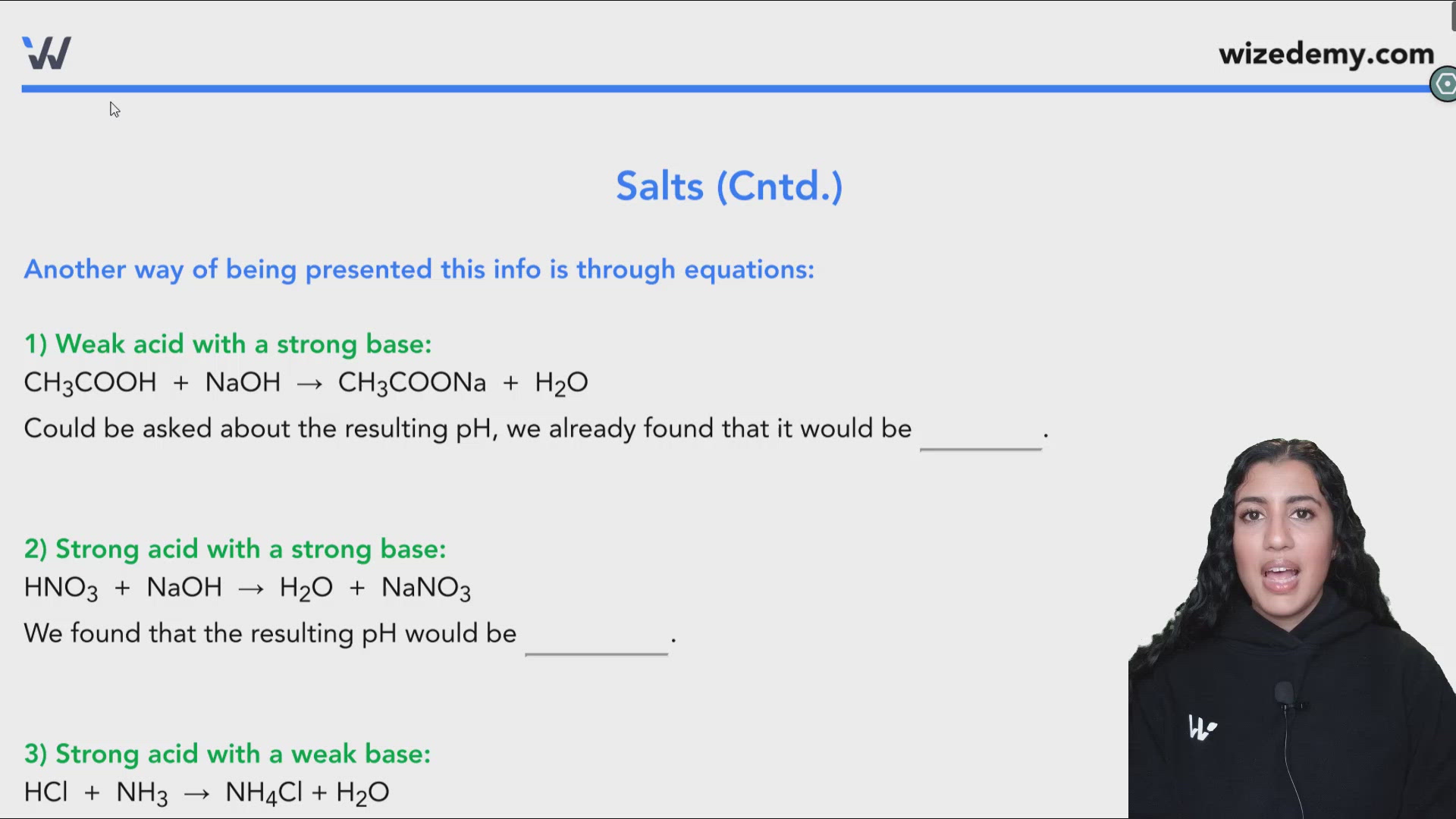
Another way of being presented this info is through equations:
1) Weak acid with a strong base:
CH3COOH + NaOH → CH3COONa + H2O
Could be asked about the resulting pH, we already found that it would be
basic
. 2) Strong acid with a strong base:
HNO3 + NaOH → H2O + NaNO3
We found that the resulting pH would be
neutral
. 3) Strong acid with a weak base:
HCl + NH3 → NH4Cl + H2O
We found that the resulting pH would be
acidic
. 4) There is one last scenario where we could have a weak acid with a weak base
To determine whether the resulting pH is acidic, neutral, or basic, we need to figure out if the weak acid or weak base is stronger!
- If the Ka of the weak acid > Kb of the weak base, the resulting pH is:acidic
- pH would be (</=/>)<7
- If the Kb of the weak base > Ka of the weak acid, the resulting pH is:basic
- pH would be (</=/>)>7
- Finally, if the Ka of the weak acid = Kb of the weak base, the resulting pH is:neutral
0:00 / 0:00
Example: Acidic, Basic, or Neutral Solution
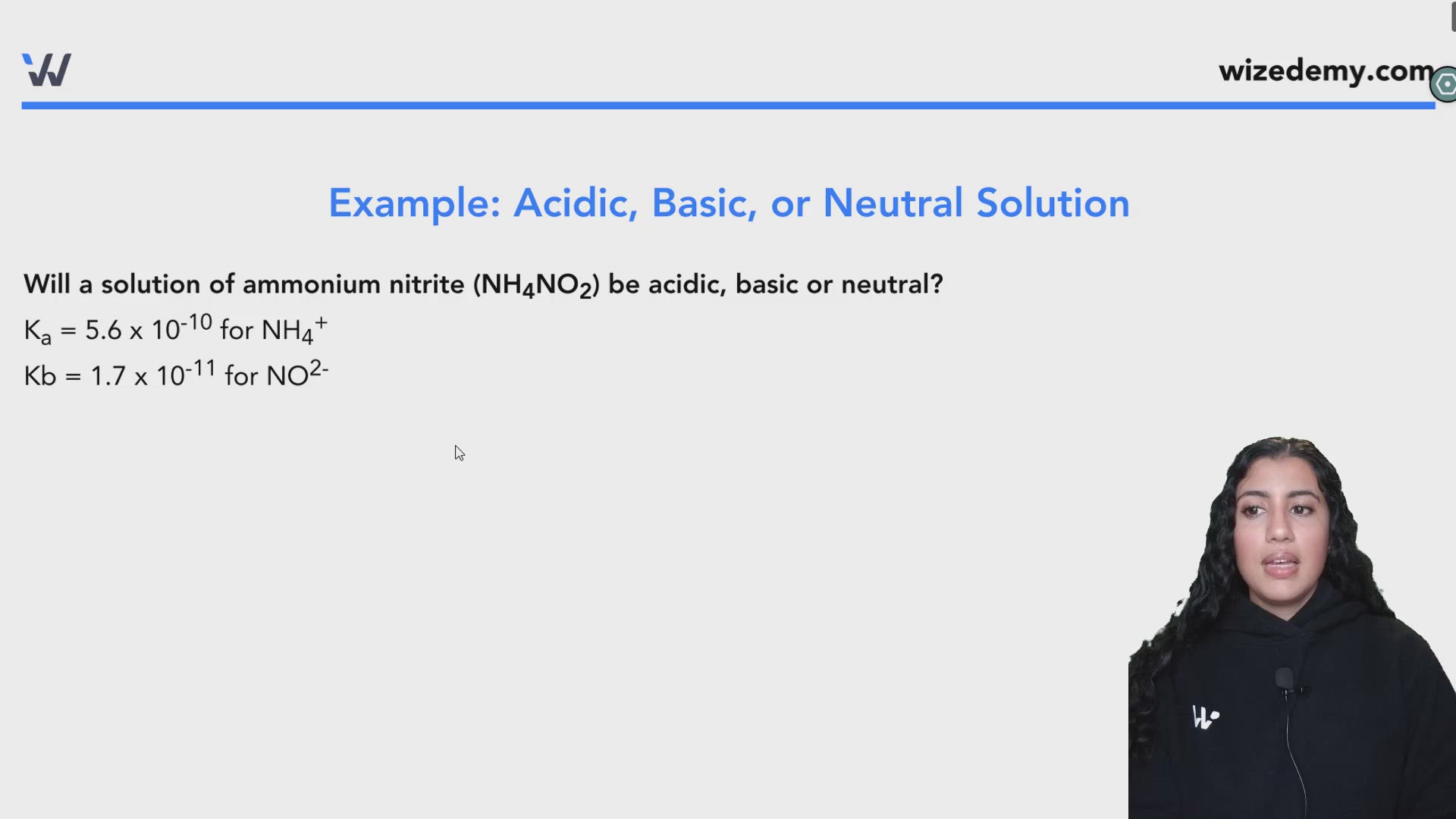
Will a solution of ammonium nitrite (NH4NO2) be acidic, basic or neutral?
Ka = 5.6 x 10⁻¹⁰ for NH4+
Kb = 1.7 x 10⁻¹¹ for NO2-
The cation of the salt is NH4+ (we are given a Ka value)
The anion of the salt is NO2-. (we are given a Kb value)
The value for Ka > Kb. Therefore, the solution will be slightly acidic.
0:00 / 0:00
Example: Salts
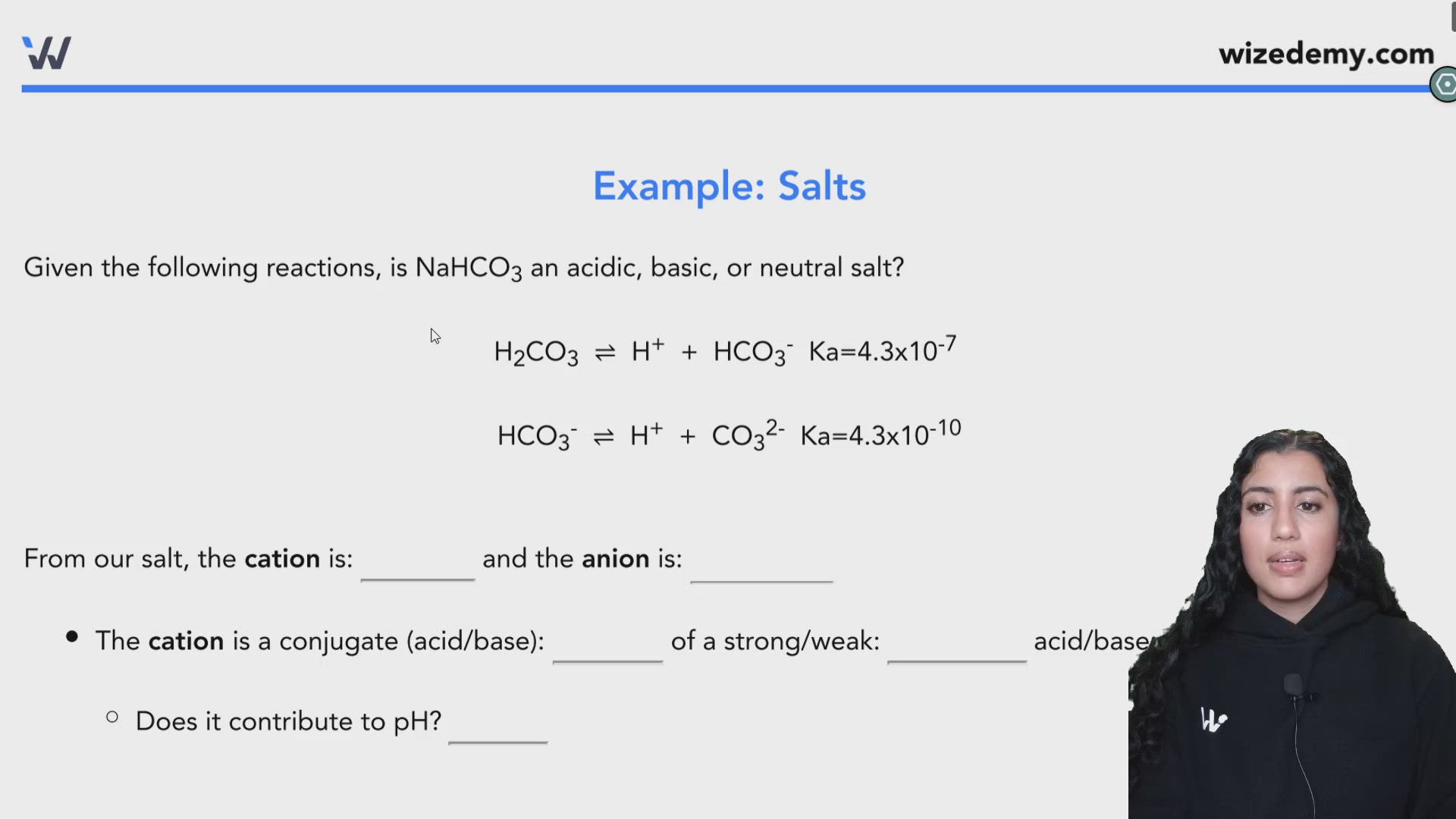
Given the following reactions, is NaHCO3 an acidic, basic, or neutral salt?
H2CO3 ⇌ H+ + HCO3- Ka=4.3x10⁻⁷
HCO3- ⇌ H+ + CO32- Ka=4.3x10⁻¹⁰
From our salt, the cation is:
Na+
and the anion is: HCO3-
- The cation is a conjugate (acid/base):acidof a strong/weak:strongacid/base:base
- Does it contribute to pH?No
Look at the above equations for HCO3-.
In equation 1, HCO3- is acting as an (acid/base):
base
In equation 2, HCO3- is acting as an (acid/base):
acid
To figure out whether HCO3- will cause the pH to be more acidic or basic, we will need to compare the Ka value for HCO3- (when it acts as an acid) to the Kb value for HCO3- (when it acts as a base)
The larger value (Ka or Kb) will help us know how the pH would be affected!
H2CO3 ⇌ H+ + HCO3- Ka=4.3x10⁻⁷
HCO3- ⇌ H+ + CO32- Ka=4.3x10⁻¹⁰
Ka of HCO3- =
4.3x10⁻¹⁰
Kb=?
Kw=Ka(Kb)
Kb=Kw/Ka
Kb=1x10-14/4.3x10-7
Kb~0.25x10⁻⁷
Kb=2.5x10⁻⁸
- Which is larger, Ka or Kb?Kb
- How would HCO3- affect the pH? (lower/neutral/raise):RaisepH
- Therefore the salt is (acidic/neutral/basic):Basic
Practice: Salts
Is an aqueous solution of each of these salts acidic, basic or neutral?
Is KBr an acidic, basic, or neutral salt?
Salts Cheatsheet
Some salts that dissociate completely in water exhibit aicd/base properties. In order to determine if the solution will be acidic or basic, first separate the substance into it’s positive and negative ions.
If neither the cation nor the anion can affect the pH, the solution should be neutral
If only the cation of the salt is acidic, the solution will be acidic (NH4Cl)
If only the anion of the salt is basic, the solution will be basic (NaCN)
If a salt has a cation that is acidic and an anion that is basic:
The pH of the solution is determined by the relative strengths of the acid and the base, based on the Ka and Kb of the ions.
If Ka>Kb, it will be acidic.
If Kb>Ka, it will be basic.