Wize University Chemistry Textbook > Buffers and Titrations
Acid + Base Reactions
Popular Courses
MCAT
General Course
CHEM 1302A/B
Western University
General Chemistry
University Study Guides
AP Chemistry Exam Prep Course
AP Exam Prep
DAT
General Course
CHM 1311
University of Ottawa
Chemistry
General Course
CHEM 1AA3
McMaster University
General Chemistry
University Study Guides
CHM135H1
University of Toronto
CHEM 102
University of Alberta
CHEM 121
Simon Fraser University
CHEM 120
McGill University
CHEM 1011
Dalhousie University
APSC 132
Queen's University
CHEM 112B
Queen's University
CHEM 123
University of Waterloo
CHEM 130
University of British Columbia
CHEM 1100
University of Manitoba
CHEM 1481
Texas A & M University
0:00 / 0:00
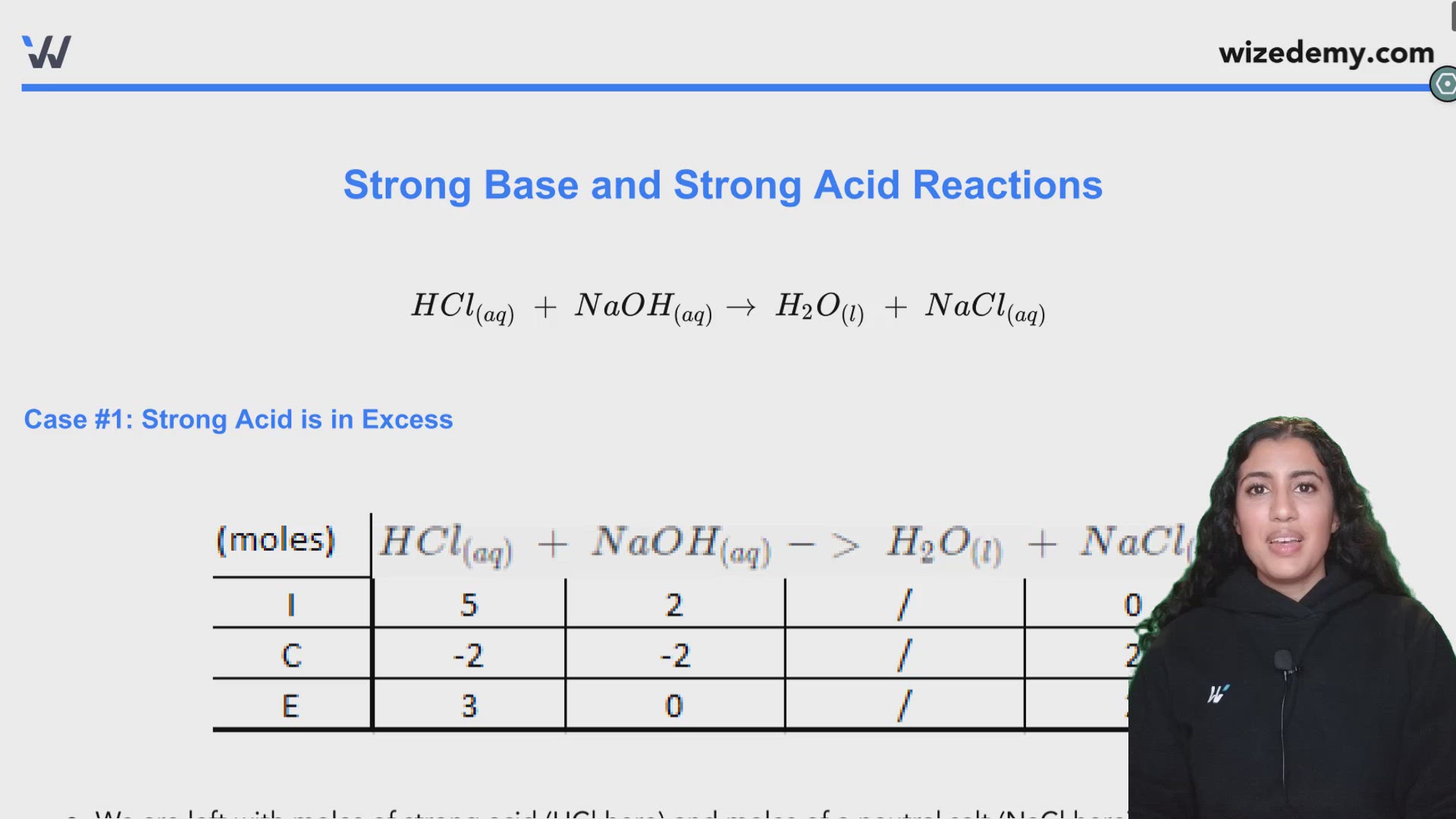
Strong Base and Strong Acid Reactions
Case #1: Strong Acid is in Excess
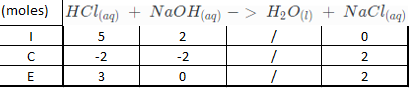
- We are left with moles of strong acid (HCl here) and moles of a neutral salt (NaCl here)
- To determine the pH of the resulting solution, take the moles of HCl we are left with and use it to find moles of H+, then we need to calculate [H+]
- n=cv so c=n/v=moles of H+/total volume of solution
- Then use pH=-log[H+]!
The resulting solution is strongly acidic!
Case #2: Strong Base is in Excess
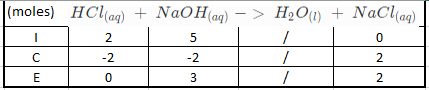
- We are left with moles of strong base (NaOH here) and moles of a neutral salt (NaCl here)
- To determine the pH of the resulting solution, take the moles of NaOH we are left with and use it to find the moles of OH-, then we need to calculate [OH-]
- n=cv so c=moles of OH-/total volume of solution
- Calculate pOH using pOH=-log[OH-], and finally calculate pH using pH+pOH=14
The resulting solution is strongly basic!
Case #3: Reacting the Same Amount of Moles of Strong Acid and Base
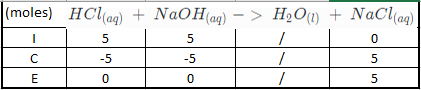
- We are left with no moles of strong acid or strong base. Only the neutral salt is left
- This means the pH=7 (neutral solution)
0:00 / 0:00
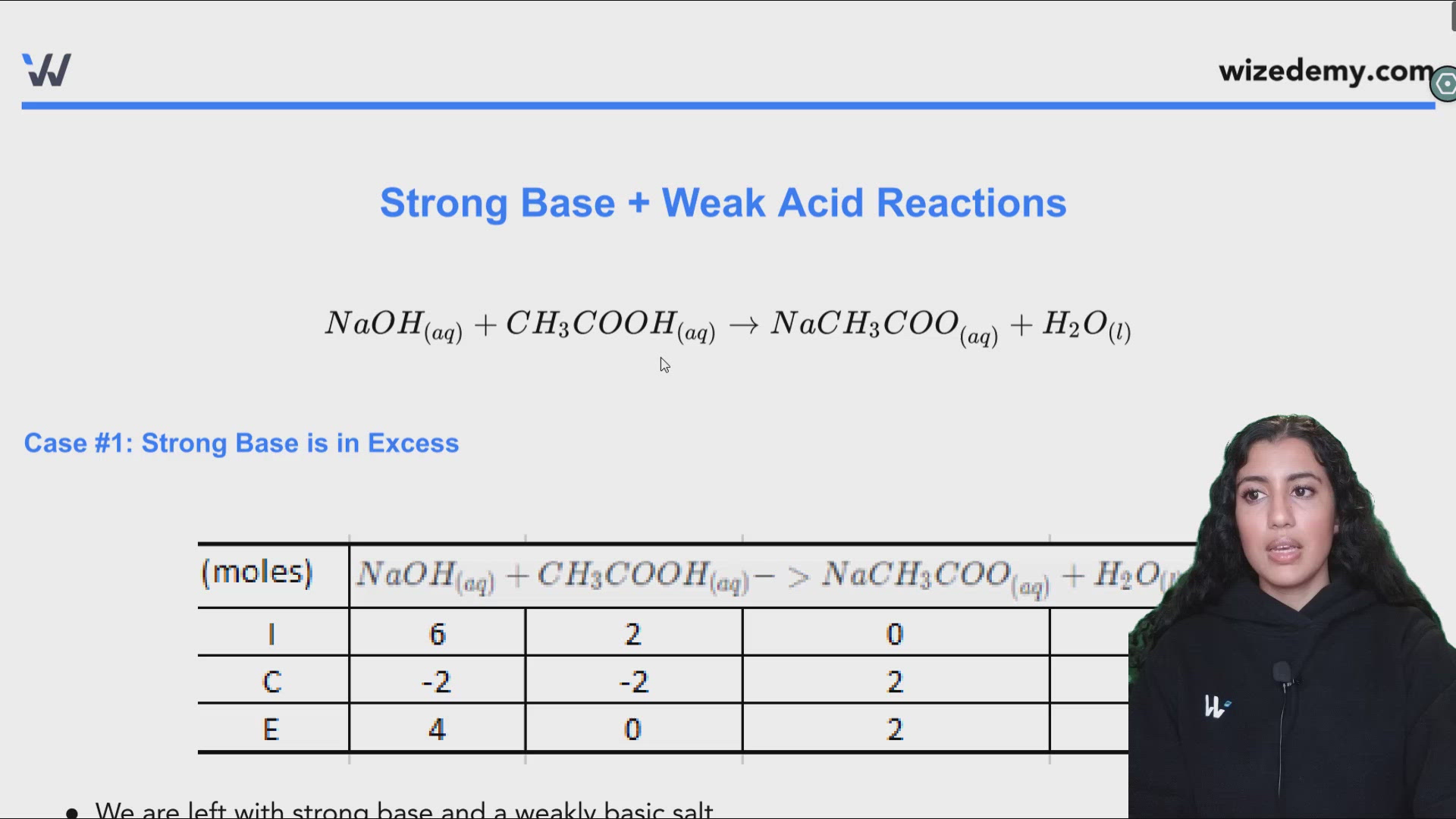
Strong Base + Weak Acid Reactions
Case #1: Strong Base is in Excess
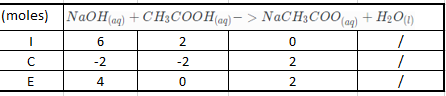
- We are left with strong base and a weakly basic salt
- The resulting solution is strongly basic
- To determine the pH use the moles of strong base to find the moles of OH-, then using n=cv, solve for the concentration of OH-
- [OH-]=moles of OH-/total volume of solution
- Calculate pOH using pOH=-log[OH-], then calculate pH using pH+pOH=14
Case #2: Weak Acid is in Excess

- The resulting solution has weak acid and a weakly basic salt
- Note: We have a conjugate acid (CH3COOH) and its conjugate base (CH3COO-)! These are the requirements for a buffer so we have a buffer solution! We will look at buffers soon :)
Case #3: React the Same Amount of Moles of Strong Base and Weak Acid

- We are only left with a weakly basic salt so the solution is weakly basic.
- To calculate pH of the resulting solution, we would need to consider the weak base:
- After using an ICE table and finding the number of moles of OH- we end up with, we can calculate [OH-] using c=n/v=moles of OH-/total volume of solution
- Then calculate pOH, then finally pH
0:00 / 0:00
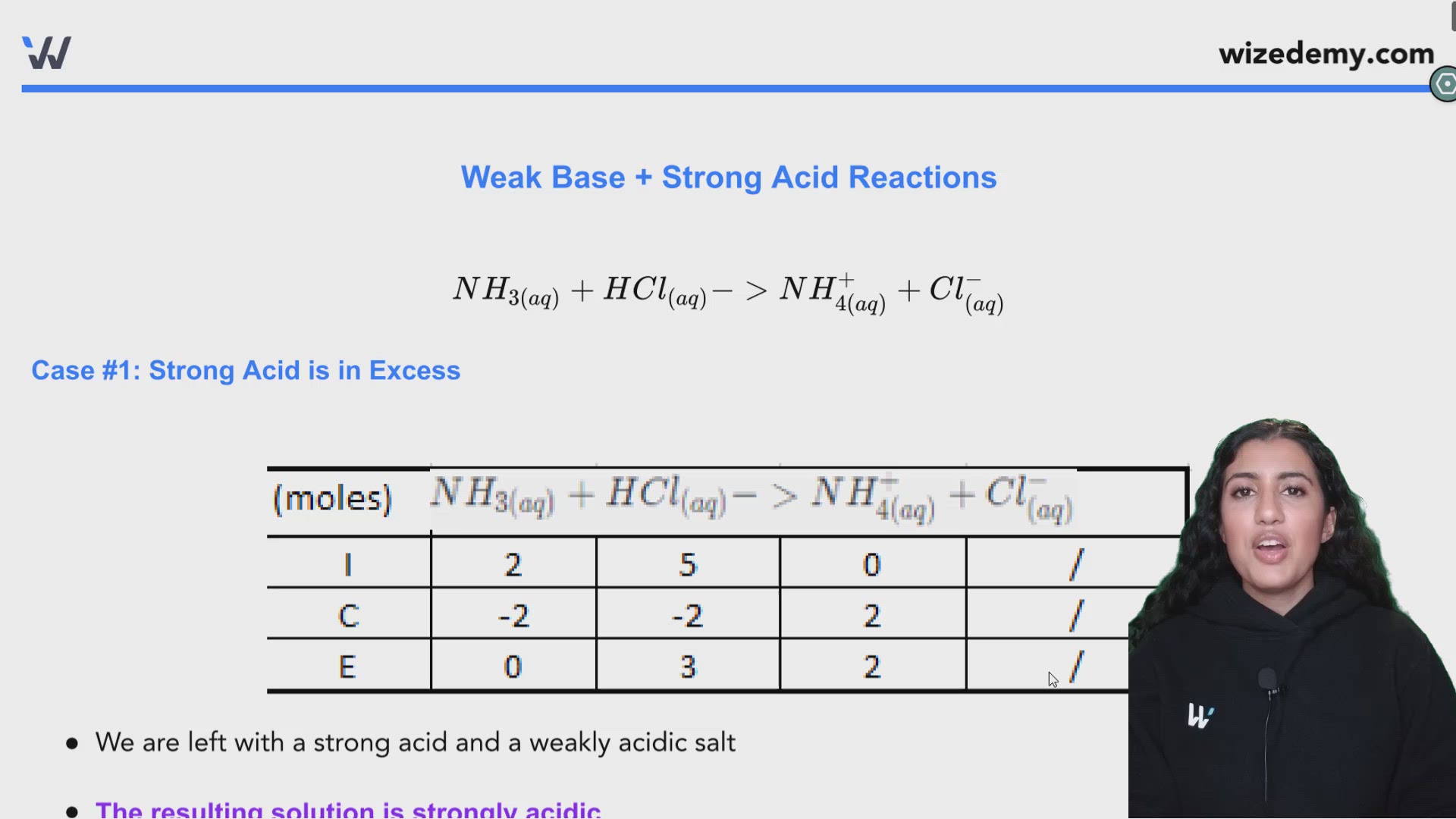
Weak Base + Strong Acid Reactions
Case #1: Strong Acid is in Excess
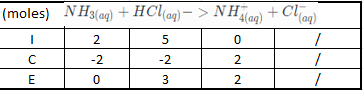
- We are left with a strong acid and a weakly acidic salt
- The resulting solution is strongly acidic
- Determine the pH using moles of strong acid, find the [H+], find the pH
Case #2: Weak Base is in Excess
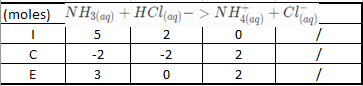
- We are left with a weak base and a weakly acidic salt
- Note: We have a weak base (NH3) and its conjugate acid (NH4+) which are needed to form a buffer!
Case #3: Reacting the Same Amount of Moles of Strong Acid and Weak Base
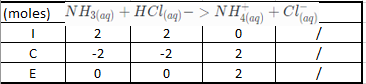
- Here we are left with just the weakly acidic salt so the solution is weakly acidic.
- Calculate pH using the weak acid:
Practice: Calculating pH of a Solution When an Acid and Base React
100 mL of a 0.5 M solution of nitric acid () was added to 75 mL of a 0.37 M solution of sodium benzoate () the conjugate base of benzoic acid (). Calculate the pH of the resulting solution.