Wize University Chemistry Textbook > Buffers and Titrations
Intro to Buffers & Buffers Problem Type 1
Popular Courses
MCAT
General Course
CHEM 1302A/B
Western University
General Chemistry
University Study Guides
AP Chemistry Exam Prep Course
AP Exam Prep
CHEM 203
University of Calgary
DAT
General Course
CHM 1311
University of Ottawa
Chemistry
General Course
CHEM 1AA3
McMaster University
General Chemistry
University Study Guides
CHM135H1
University of Toronto
CHEM 102
University of Alberta
CHY 102
Toronto Metropolitan University
CHEM 120
McGill University
CHEM 1011
Dalhousie University
SC/CHEM 1001 3.00
York University
APSC 132
Queen's University
CHEM 112B
Queen's University
CHY 103
Toronto Metropolitan University
CHEM 123
University of Waterloo
0:00 / 0:00
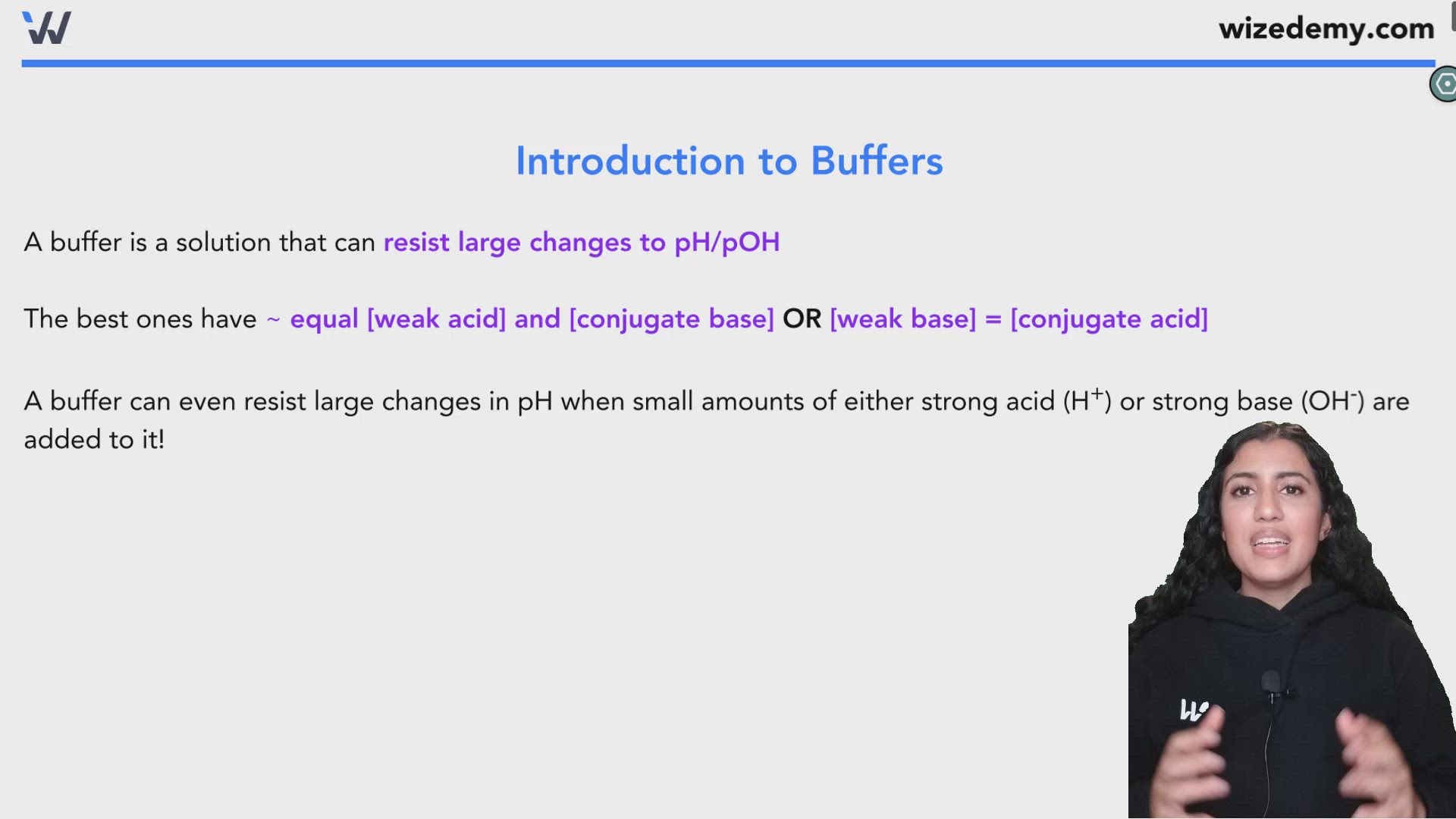
Introduction to Buffers
A buffer is a solution that can resist large changes to pH/pOH
The best ones have ~ equal [weak acid] and [conjugate base] OR [weak base] = [conjugate acid]
A buffer can even resist large changes in pH when small amounts of either strong acid (H+) or strong base (OH-) are added to it!
Example:

Buffer Capacity – the extent to which a buffer can resist changes in pH when an acid or base is added.
- A solution with more weak base, [A-], has a higher buffer capacity for addition of strong acid.
- A solution with more weak acid, [HA], has a higher buffer capacity for addition of strong base.
- When all of HA or A- has been consumed and only one conjugate exists, the mixture is no longer a buffer and therefore the buffering capacity has been exceeded.

0:00 / 0:00
Buffers Problem Type 1
1) Calculate the pH of a buffer solution
You can do this using the way we learned before:
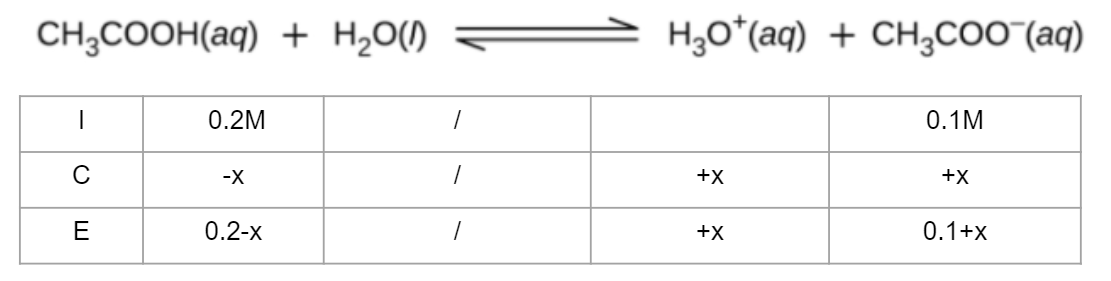
Given Ka you will be able to solve for x, x=[H+], then plug in the [H+] to pH=-log[H+] and solve for pH!
1) Calculate the pH of a buffer solution
The good news is that for buffers we can use equations to make this much simpler!
Henderson-Hassalbalch Equation
pH is the pH of solution
We can get the pKa of the buffer from the Ka of the buffer that will be provided
[A-] is the concentration of the conjugate base part of the buffer
[HA] is the concentration of the weak acid part of the buffer
Wize Tip
When we are given the Ka of the buffer we can solve for pKa and then plug in the concentrations of the weak acid and its conjugate base directly into the HH equation to solve for pH of the buffer solution!
Henderson-Hassalbalch Equation
We said that in a buffer we want ~ equal concentrations of a weak acid and its conjugate base...
Looking at the HH equation, what would happen to that equation if we let [HA]=[A-]?
log1=0 so pH=pKa
Wize Concept
A 1:1 ratio of [A-]: [HA] will always make pH=pKa .
This is why we want to build a buffer with a pKa close to the desired pH
Note: There is another form of the HH equation we can use if the buffer is made of a weak base and its conjugate acid (this one is used much less commonly).
0:00 / 0:00
Example: Buffers Problem Type 1
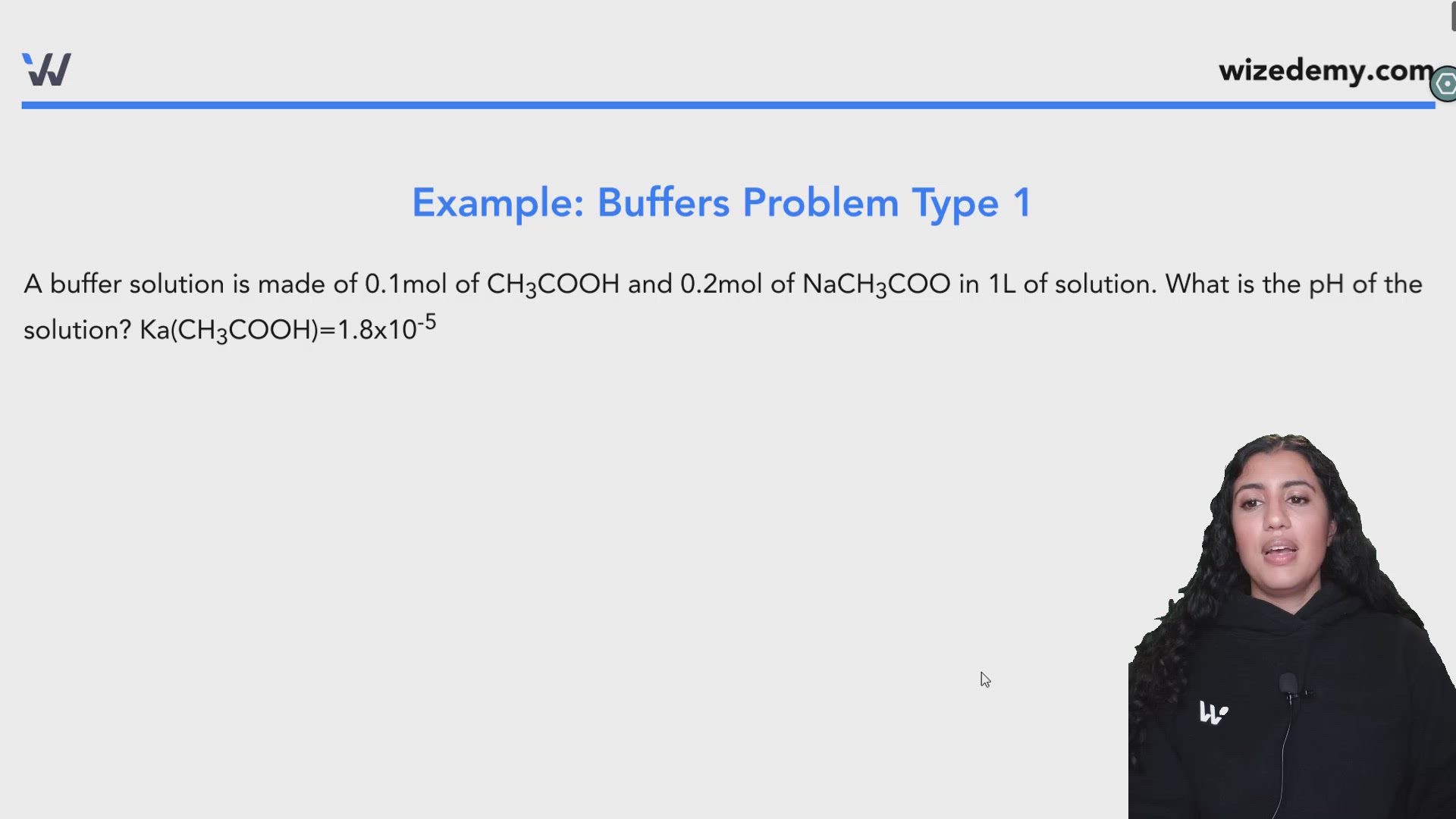
A buffer solution is made of 0.1 mol of CH3COOH and 0.2 mol of NaCH3COO in 1 L of solution. What is the pH of the solution? Ka(CH3COOH) = 1.8 × 10⁻⁵
pH=?
pKa=?
[A-]=[CH3COO-]
[HA]=[CH3COOH]
1) Use this equation to solve for pKa: pKa=-log(Ka)
pKa=-log(1.8x10⁻⁵)
pKa=4.74
2) Use n=cv to solve for [A-] and {HA]
n=cv
c=n/v
[A-]=0.2mol/1L=0.2M
[HA]=0.1mol/1L=0.1M
Note: NaCH3COO → Na+ + CH3COO-
3) Plug everything in and solve for the pH of the buffer solution!
pH=4.74 + log(0.2/0.1)
pH=4.74 + log(2)
pH=5.04!