Wize University Chemistry Textbook > Buffers and Titrations
Buffers Problem Type 2
Popular Courses
MCAT
General Course
CHEM 1302A/B
Western University
General Chemistry
University Study Guides
AP Chemistry Exam Prep Course
AP Exam Prep
CHEM 203
University of Calgary
DAT
General Course
Chemistry
General Course
CHEM 1AA3
McMaster University
General Chemistry
University Study Guides
CHM135H1
University of Toronto
CHEM 102
University of Alberta
CHEM 120
McGill University
APSC 132
Queen's University
CHEM 112B
Queen's University
CHEM 130
University of British Columbia
CHEM 1100
University of Manitoba
CHEM 1481
Texas A & M University
CHEM 122
Simon Fraser University
CHMA10H3
University of Toronto
SC/CHEM 1100 4.00
York University
0:00 / 0:00
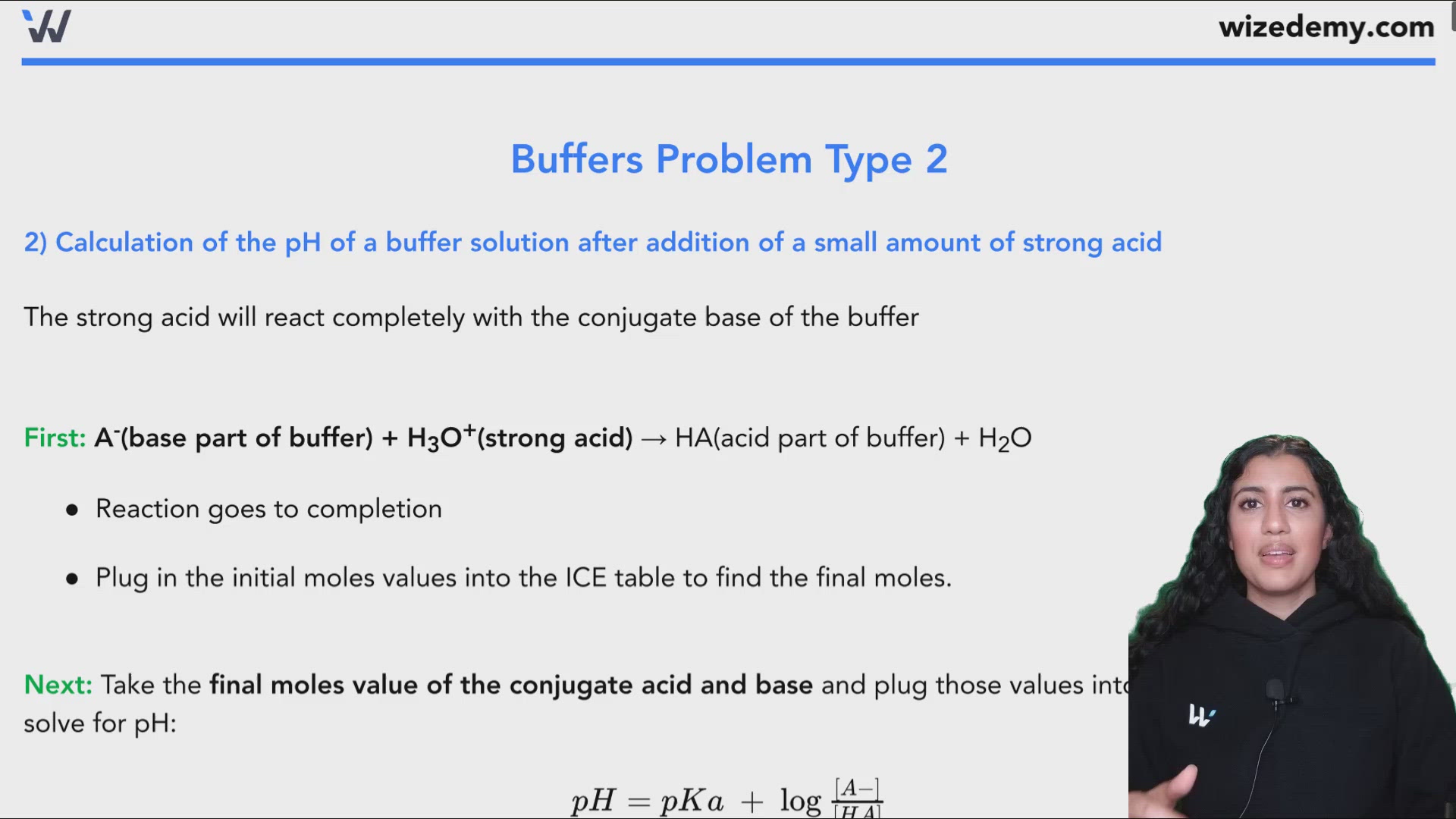
Buffers Problem Type 2
2) Calculation of the pH of a buffer solution after addition of a small amount of strong acid
The strong acid will react completely with the conjugate base of the buffer
First: A-(base part of buffer) + H3O+(strong acid) → HA(acid part of buffer) + H2O
- Reaction goes to completion
- Plug in the initial moles values into the ICE table to find the final moles.
Next: Take the final moles value of the conjugate acid and base and plug those values into the HH equation to solve for pH:
0:00 / 0:00
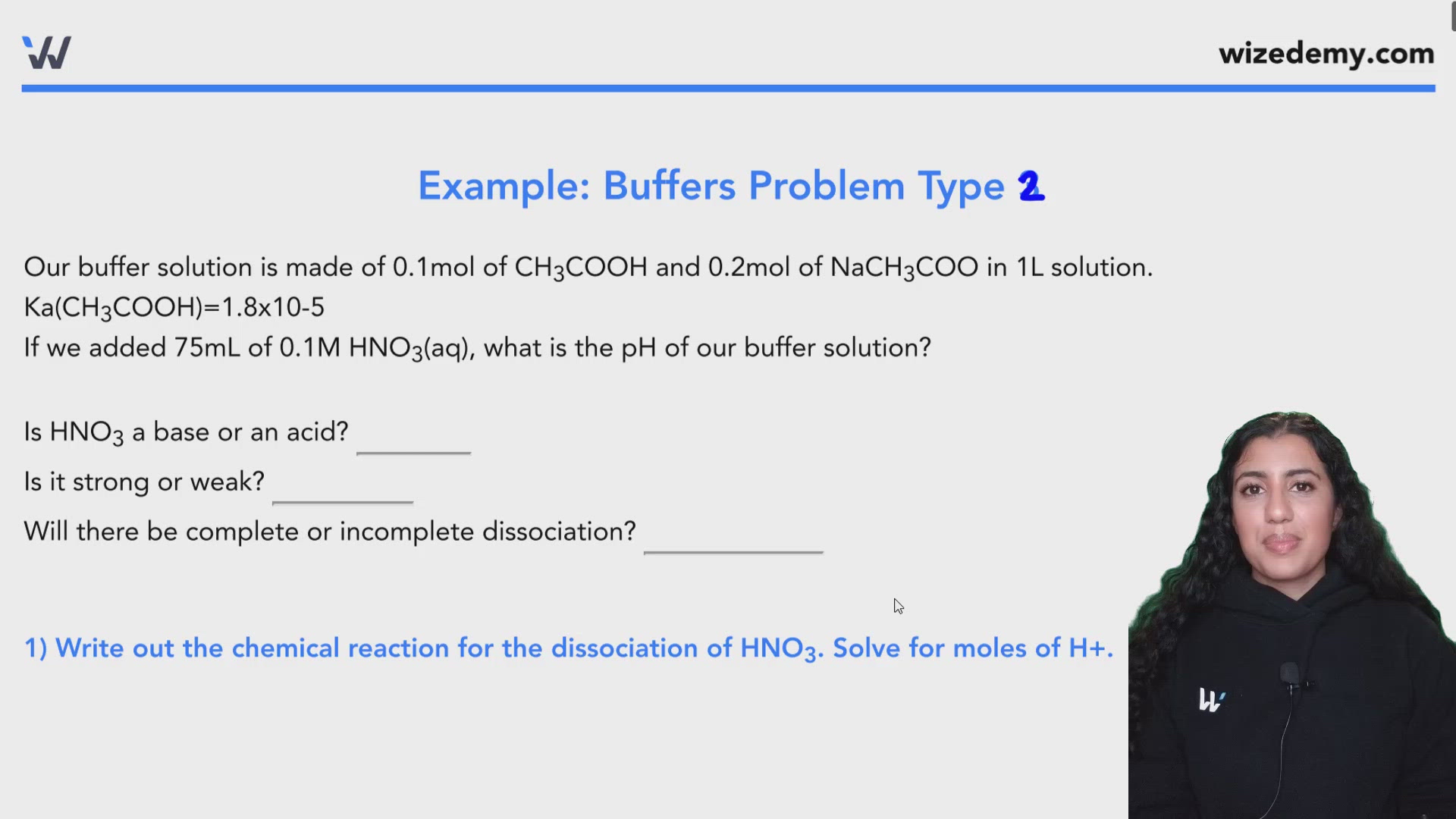
Example: Buffers Problem Type 2
Our buffer solution is made of 0.1mol of CH3COOH and 0.2mol of NaCH3COO in 1L solution. Ka(CH3COOH)=1.8x10⁻⁵
If we added 75mL of 0.1M HNO3(aq), what is the pH of our buffer solution?
Is HNO3 a base or an acid?
Acid
Is it strong or weak?
Strong
Will there be complete or incomplete dissociation?
Complete
1) Write out the chemical reaction for the dissociation of HNO3. Solve for moles of H+.
HNO3 → H+ + NO3-
V=75mL
c=0.1M
n=cv
n=(0.1)(0.075)
n=7.5x10⁻³ moles n=7.5x10⁻³ moles for H+ as well since there is a 1:1 ratio
2) Write the chemical reaction that shows how the buffer would react with these added [H+] ions:
CH3COO- + H3O+ → CH3COOH + H2O
I 0.2mol 7.5x10⁻³ mol 0.1mol
C -7.5x10⁻³ mol -7.5x10⁻³ mol +7.5x10⁻³ mol
E 0.1925mol 0 0.1075 mol
3) You can plug in the final moles values of A- and HA in the Henderson Hassalbalch equation to solve for pH:
pKa=-log(Ka)=4.74
pH=4.74 + log(0.1925mol/0.1075mol)
pH=4.74 + log(1.79)
pH=4.99