Wize University Chemistry Textbook > Buffers and Titrations
Buffers Problem Type 3
Popular Courses
MCAT
General Course
CHEM 1302A/B
Western University
General Chemistry
University Study Guides
AP Chemistry Exam Prep Course
AP Exam Prep
CHEM 203
University of Calgary
DAT
General Course
Chemistry
General Course
CHEM 1AA3
McMaster University
General Chemistry
University Study Guides
CHM135H1
University of Toronto
CHEM 102
University of Alberta
CHEM 120
McGill University
APSC 132
Queen's University
CHEM 112B
Queen's University
CHEM 130
University of British Columbia
CHEM 1100
University of Manitoba
CHEM 1481
Texas A & M University
CHEM 122
Simon Fraser University
CHMA10H3
University of Toronto
SC/CHEM 1100 4.00
York University
0:00 / 0:00
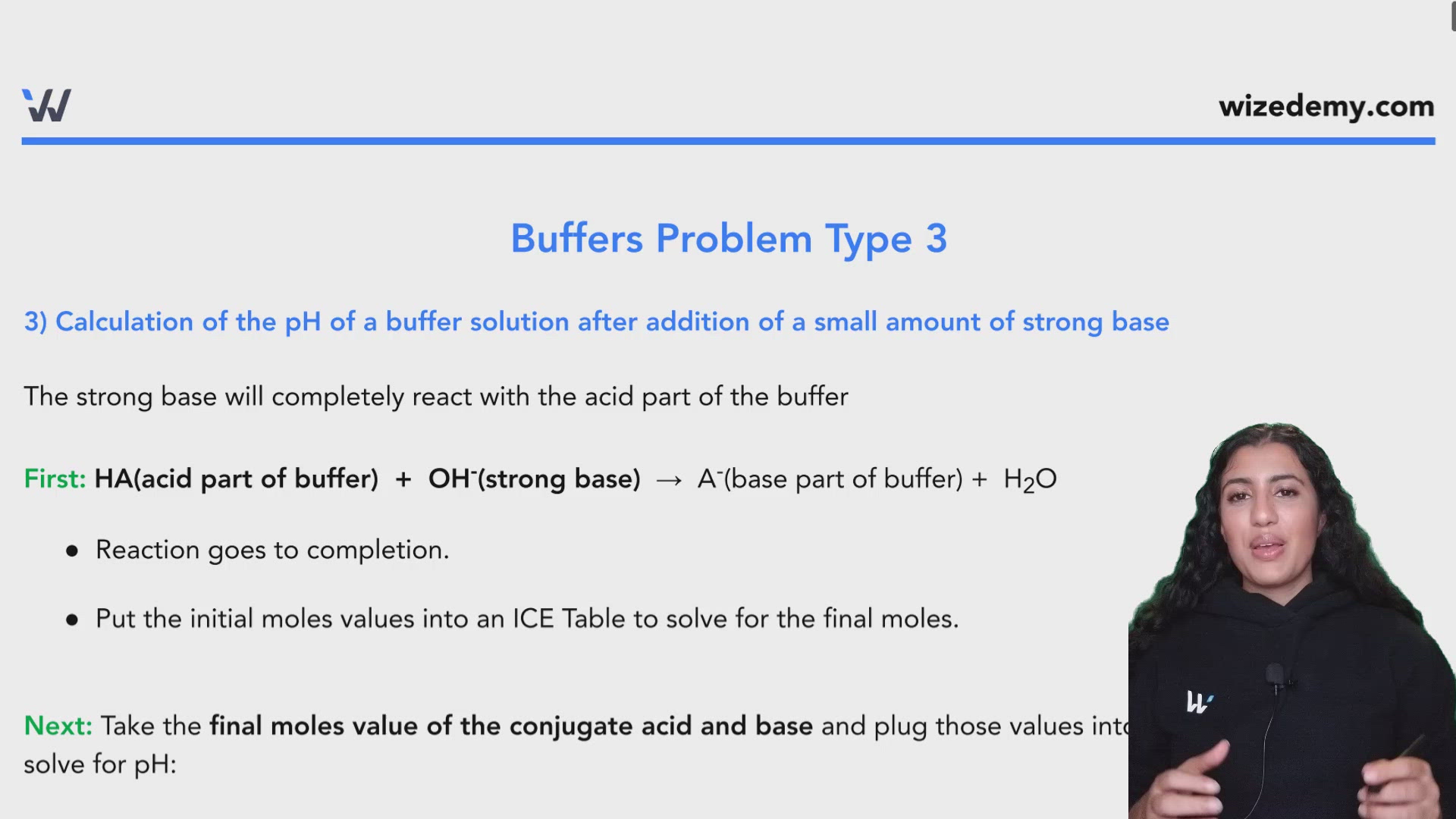
Buffers Problem Type 3
3) Calculation of the pH of a buffer solution after addition of a small amount of strong base
The strong base will completely react with the acid part of the buffer
First: HA(acid part of buffer) + OH-(strong base) → A-(base part of buffer) + H2O
- Reaction goes to completion.
- Put the initial moles values into an ICE Table to solve for the final moles.
Next: Take the final moles value of the conjugate acid and base and plug those values into the HH equation to solve for pH:
0:00 / 0:00
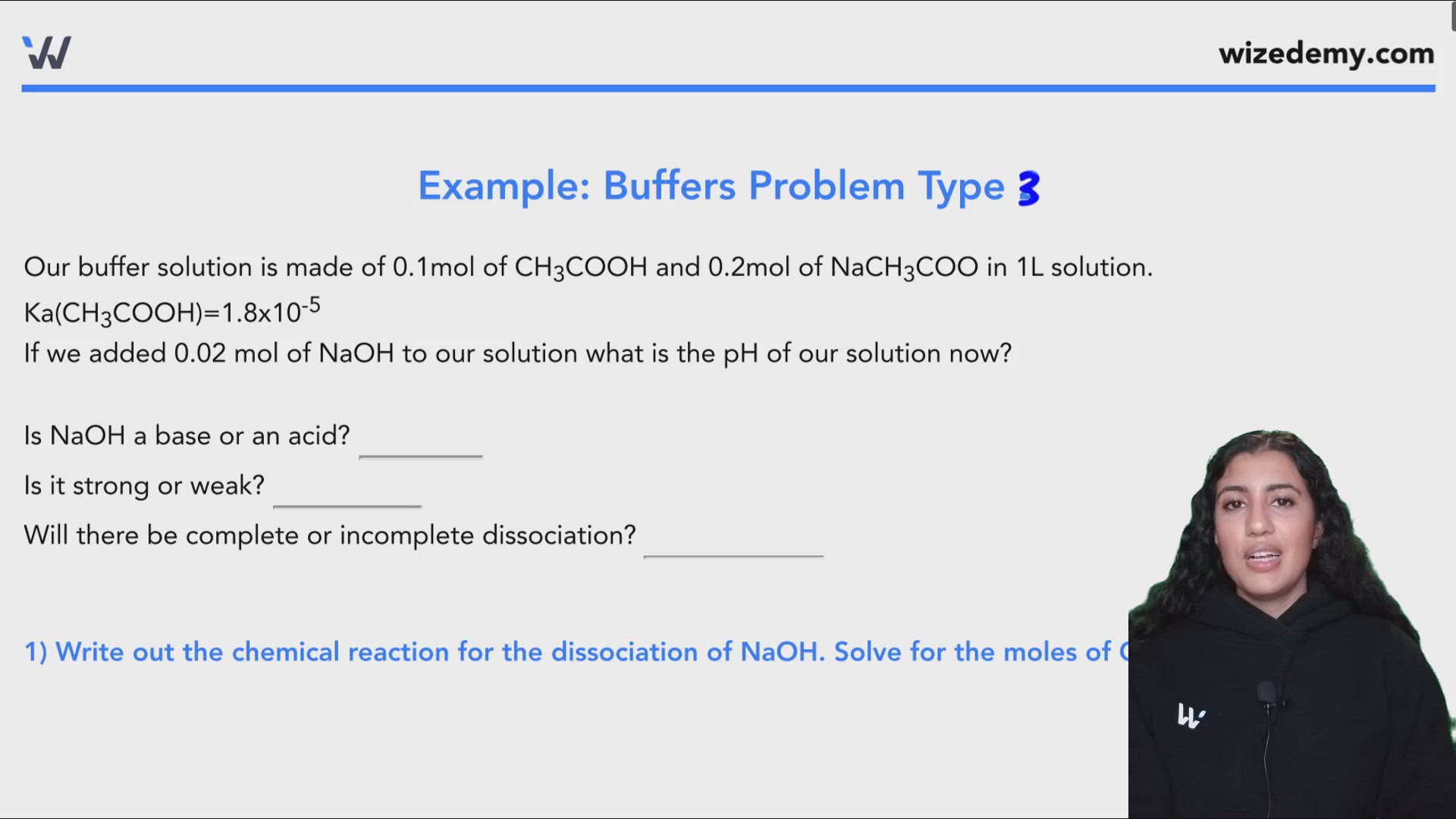
Example: Buffers Problem Type 3
Our buffer solution is made of 0.1mol of CH3COOH and 0.2mol of NaCH3COO in 1L solution. Ka(CH3COOH)=1.8x10⁻⁵
If we added 0.02 mol of NaOH to our solution what is the pH of our solution now?
Is NaOH a base or an acid?
Base
Is it strong or weak?
Strong
Will there be complete or incomplete dissociation?
Complete
1) Write out the chemical reaction for the dissociation of NaOH. Solve for the moles of OH-.
NaOH --> Na+ + OH-
0.02 mol 0.02 mol
2) Write the chemical reaction that shows how the buffer would react with these added OH- ions:
CH3COOH + OH- --> CH3COO- + H2O
I 0.1mol 0.02mol 0.2mol
C -0.02mol -0.02mol +0.02mol
E 0.08mol 0 0.22mol
3) Plug in the final moles values into the Henderson Hassalbalch equation to solve for pH:
CH3COOH + H2O eqm CH3COO- + H3O+
0.08mol 0.22mol
(we are able to plug in moles since the unit moles will cancel out)
pH=?, Ka=1.8x10⁻⁵, [A-]=0.22M, [HA]=0.08M
pKa=-log(Ka)
pKa=-log(1.8x10⁻⁵)
pKa=4.74
pH=4.74 + log(0.22/0.08)
pH=4.74 + log(2.75)
pH=5.2
Wize Tip
For buffer problems you can try to see if your answer makes logical sense!
In the last problem we did, we found that the pH of the buffer before we added any strong base was 5.04 and now we just found that the pH of the buffer solution after adding a strong base rose to 5.2. It makes sense that the pH rose because a strong base has a higher pH!
Practice: Calculate the pH of a Buffer Solution
A buffer is prepared by adding 0.021 moles of HI to 250 mL of 0.71 M of (CH3)2NH(aq). What is the pH of this buffer? Kb(Me2NH(aq)) = 5.4 × 10⁻⁴
Assume there is no change in volume.