Popular Courses
MCAT
General Course
CHEM 1302A/B
Western University
General Chemistry
University Study Guides
AP Chemistry Exam Prep Course
AP Exam Prep
CHEM 203
University of Calgary
DAT
General Course
Chemistry
General Course
CHEM 1AA3
McMaster University
General Chemistry
University Study Guides
CHM135H1
University of Toronto
CHEM 102
University of Alberta
CHEM 120
McGill University
APSC 132
Queen's University
CHEM 112B
Queen's University
CHEM 130
University of British Columbia
CHEM 1100
University of Manitoba
CHEM 1481
Texas A & M University
CHEM 122
Simon Fraser University
CHMA10H3
University of Toronto
SC/CHEM 1100 4.00
York University
0:00 / 0:00
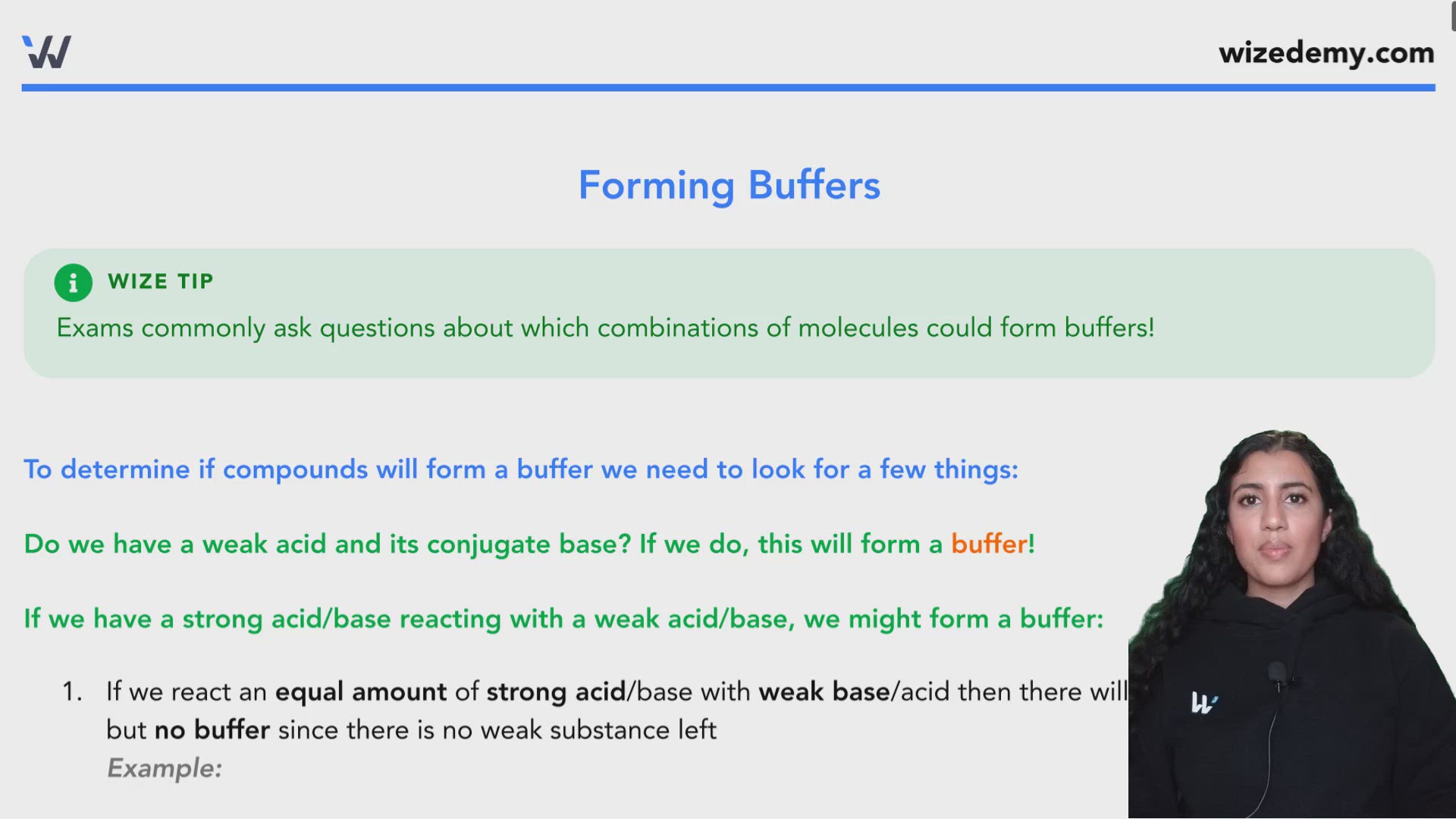
Forming Buffers
Wize Tip
Exams commonly ask questions about which combinations of molecules could form buffers!
To determine if compounds will form a buffer we need to look for a few things:
Do we have a weak acid and its conjugate base? If we do, this will form a buffer!
If we have a strong acid/base reacting with a weak acid/base, we might form a buffer:
- If we react an equal amount of strong acid/base with weak base/acid then there will be a chemical reaction but no buffer since there is no weak substance left Example:
- If we react a strong acid/base in excess with a weak base/acid and of the strong substance then there will be a chemical reaction but no buffer because there is excess of the strong substance and no weak substance left Example:
- If we react a strong acid/base with a weak base/acid and have less of the strong substance then there will be a chemical reaction and there will be a buffer since the strong substance will completely react, leaving us with the weak substance and its conjugate=buffer Example:
There are 2 methods of preparing buffers:
- If sources of both HA and A- are readily available, then an appropriate amount of each component can be measured out to give the buffer solution.
- If only one of the conjugate acid-base pair is available (i.e. either HA or A–), a controlled amount of a strong acid or a strong base can be added to the solution of the available reagent which will result in the formation of HA and A– needed to achieve the desired buffer ratio.
0:00 / 0:00
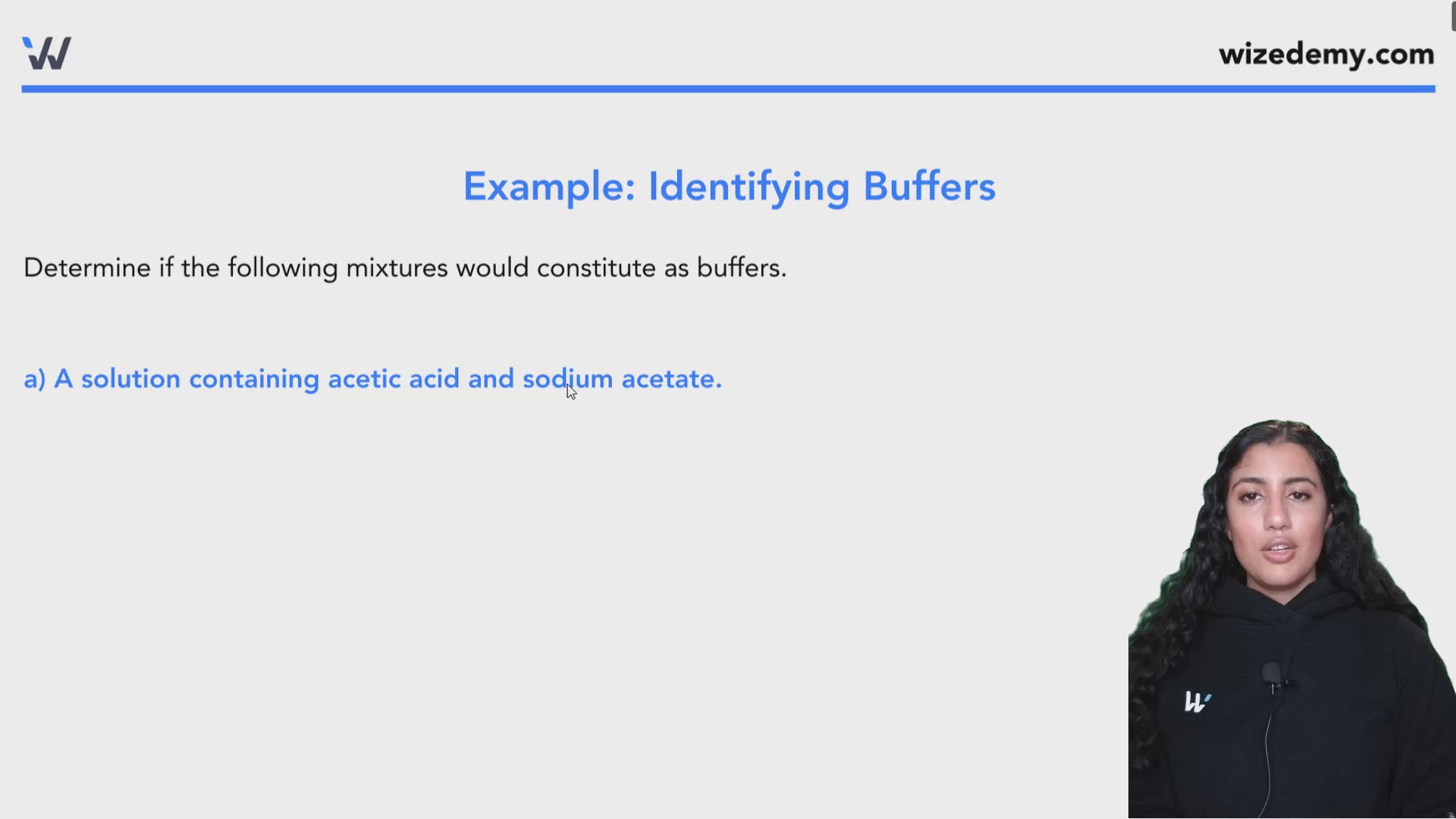
Example: Identifying Buffers
Determine if the following mixtures would constitute as buffers.
a) A solution containing acetic acid and sodium acetate.
Acetic acid (CH3COOH) and acetate (CH3COO-) are a conjugate acid/base pair, and therefore a mixture of the two would constitute as a buffer.
b) A solution containing hydrocyanic acid and ammonia.
While hydrocyanic acid (HCN) and ammonia (NH3) are a weak acid and weak base, respectively, they are NOT conjugates of each other, and therefore this mixture would NOT constitute as a buffer.
0:00 / 0:00
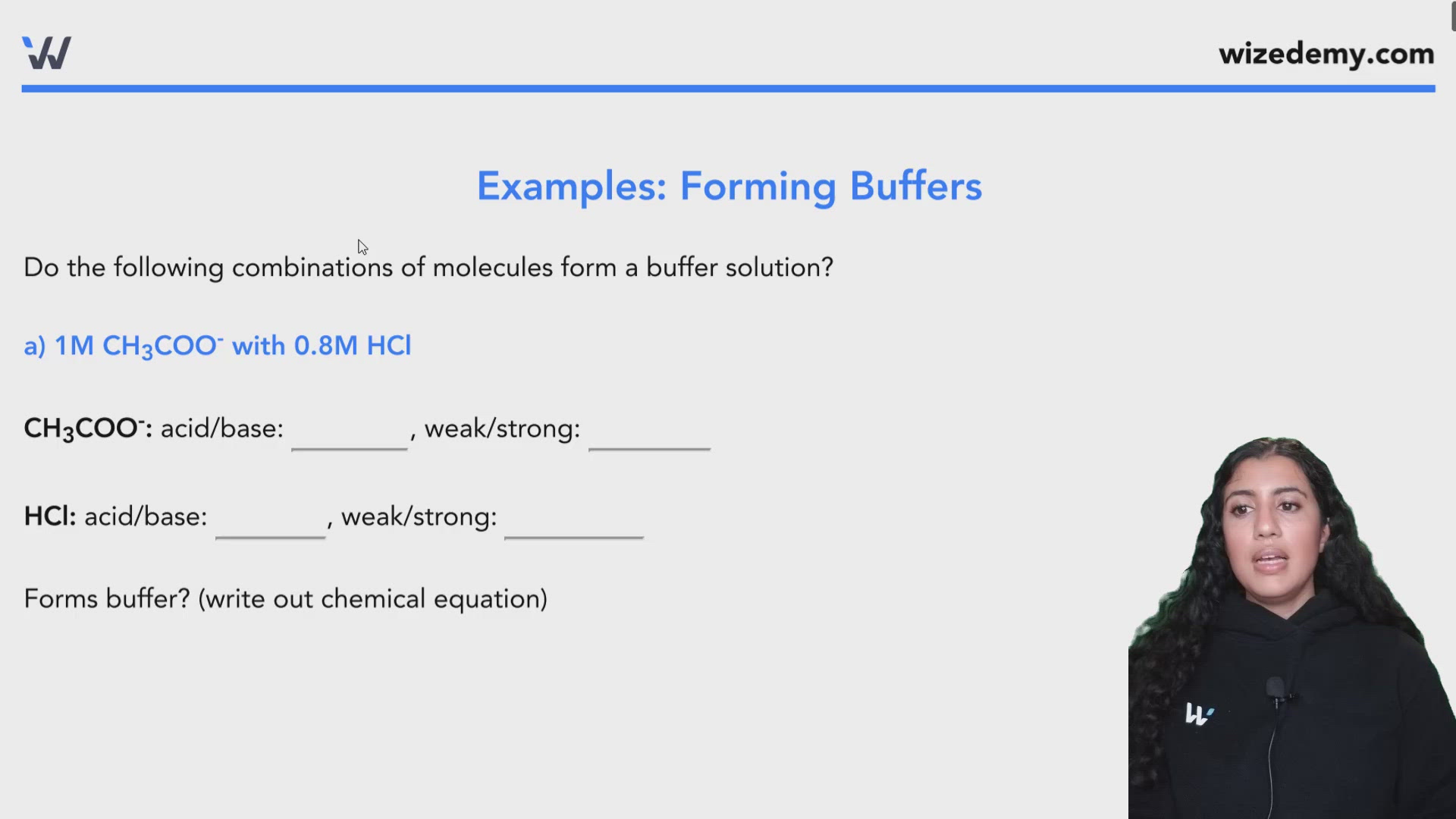
Examples: Forming Buffers
Do the following combinations of molecules form a buffer solution?
a) 1M CH3COO- with 0.8M HCl
CH3COO-: acid/base:
base
, weak/strong: weak
HCl: acid/base:
acid
, weak/strong: strong
Forms buffer? (write out chemical equation)
CH3COO- + H3O+ → CH3COOH + H2O
I 1mol 0.8mol 0 /
C -0.8 -0.8 +0.8 /
E 0.2M 0 0.8M /
Since we have both the weak acid and its conjugate base present, we can form a buffer!
Do the following combinations of molecules form a buffer solution?
b) 2M HCl and 1M HBr
HCl: acid/base:
acid
, weak/strong: strong
HBr: acid/base:
acid
, weak/strong: strong
Would this combination form a buffer?
No, two acids cannot form a buffer. To have a buffer we would need a weak acid and its conjugate base present (or vice versa)
Do the following combinations of molecules form a buffer solution?
c) 1M NH3 and 0.8M NH4+
NH3: acid/base:
base
, weak/strong: weak
NH4+: acid/base:
acid
, weak/strong: weak
Would this combination form a buffer?
Yes, because here we have a weak base and its conjugate acid present.