Wize University Chemistry Textbook > Buffers and Titrations
Buffer Range Problems
Popular Courses
MCAT
General Course
General Chemistry
University Study Guides
CHEM 203
University of Calgary
DAT
General Course
Chemistry
General Course
General Chemistry
University Study Guides
CHM135H1
University of Toronto
CHEM 102
University of Alberta
CHEM 120
McGill University
CHEM 112B
Queen's University
CHEM 130
University of British Columbia
CHEM 1100
University of Manitoba
CHEM 1481
Texas A & M University
CHEM 122
Simon Fraser University
CHEM 206
Concordia University
CHMA10H3
University of Toronto
SC/CHEM 1100 4.00
York University
CHM 2045
University of Florida
CHEM 1035
Virginia Tech
CHEM 1001
Carleton University

0:00 / 0:00
Effective Buffer Range
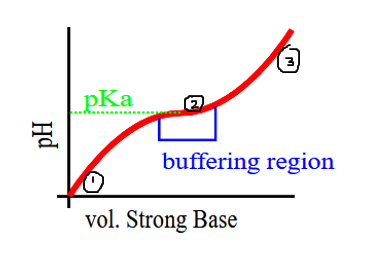
Effective buffer range: is the range of pH values where a buffer has the capacity to act as a buffer

Just focus on understanding 💡 the diagram, we will cover this in more detail when we talk about titrations :)
- Only weak acid is present. We cannot form a buffer with only weak acid present
- More and more strong base is added. We will eventually have added enough strong base to form a buffer:
- If we keep adding strong base (and raising the pH), eventually we will run out of weak acid. There will no longer be a buffer and the pH shoots up!
To calculate the effective buffer range (in pH), use this equation:
Example:
What is the effective buffer range for a buffer that has a pKa of 2?
pKa+1=2+1=3
pKa-1=2-1=1
Therefore, between pH=1 and pH=3, this buffer will have the capacity to act as a buffer!
What about if you are given a pKb and asked for the buffer range?
You can use the same equation (pKa +/- 1), just solve for pKa first.
These other equations may come in handy as well:
Practice: Buffer Range
If we are told that the Kb for the base in our base buffer is 6.3 × 10⁻⁵ what is the buffer pH range?