Wize University Chemistry Textbook > Buffers and Titrations
Preparing Buffers with Desired pH
Popular Courses
MCAT
General Course
CHEM 1302A/B
Western University
General Chemistry
University Study Guides
AP Chemistry Exam Prep Course
AP Exam Prep
Chemistry
General Course
CHEM 1AA3
McMaster University
DAT
General Course
General Chemistry
University Study Guides
CHM135H1
University of Toronto
CHEM 102
University of Alberta
CHEM 120
McGill University
APSC 132
Queen's University
CHEM 112B
Queen's University
CHEM 130
University of British Columbia
CHEM 1100
University of Manitoba
CHEM 1481
Texas A & M University
CHEM 206
Concordia University
CHMA10H3
University of Toronto
SC/CHEM 1100 4.00
York University
CHM 2045
University of Florida
0:00 / 0:00
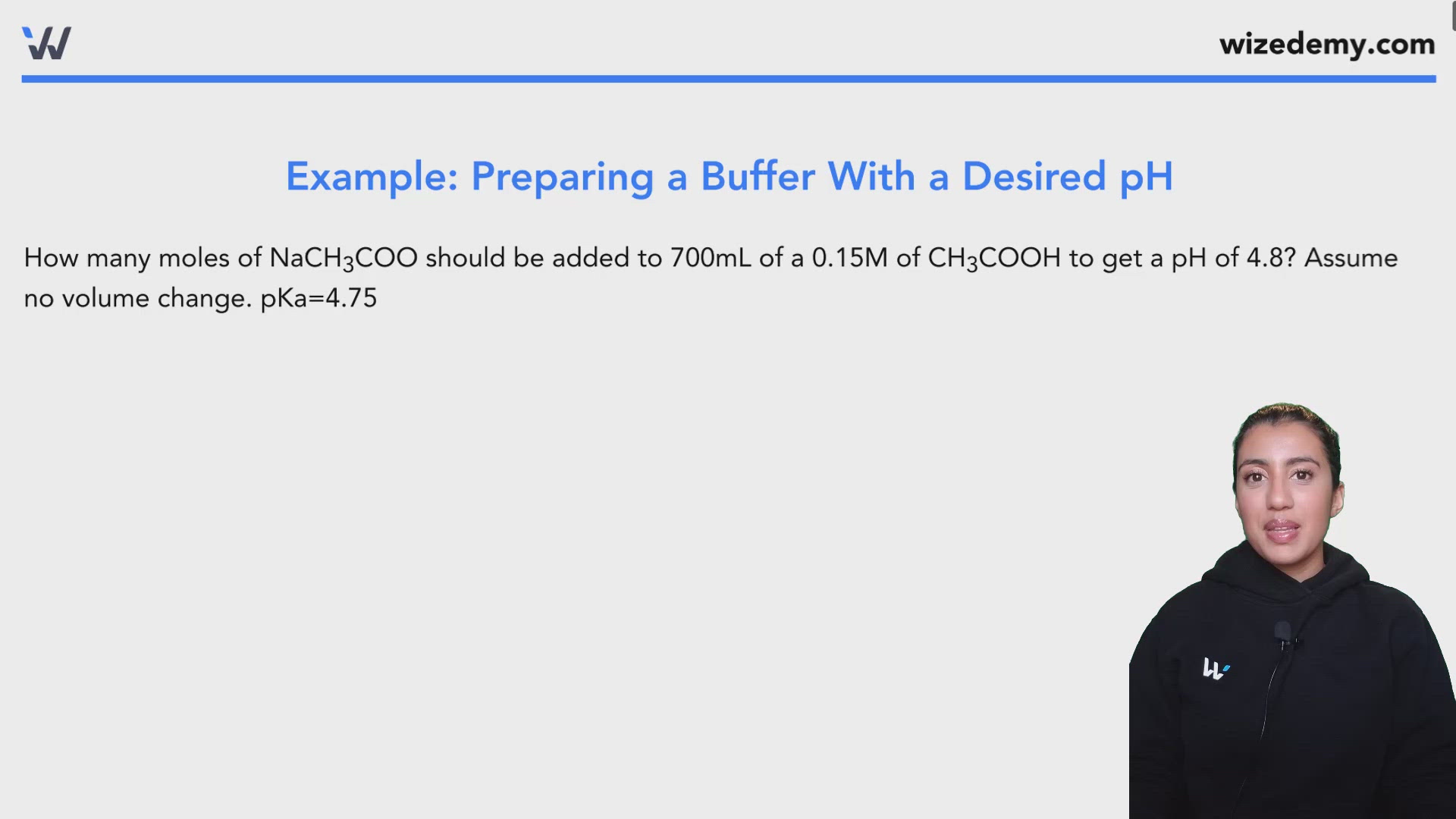
Example: Preparing a Buffer With a Desired pH
How many moles of NaCH3COO should be added to 700 mL of a 0.15 M of CH3COOH to get a pH of 4.8? Assume no volume change. pKa = 4.75
moles of NaCH3COO?
V=700mL (CH3COOH)
c=0.15M (CH3COOH)
pH=4.8
pKa=4.75
Use Henderson Hassalbalch equation:
pH=pKa + log ([conj base]/[conj acid])
4.8=4.75 + log[CH3COO-]/[CH3COOH]
We can solve for moles of CH3COOH and plug that value in so we can solve for the moles of CH3COO-
n=cv
n=0.15M(0.7L)
n=0.105 moles
0.05=log[CH3COO-]/0.105
10^0.05=[CH3COO-]/0.105
CH3COO-= 0.1178 moles ~ 0.12 moles