Wize High School Grade 12 Chemistry Textbook > Rates of Reactions
Collision Theory & Activated Complex Theory

0:00 / 0:00
Collision Theory
Collision theory has to do with the 3 necessary steps for a reaction to occur that we looked at earlier:
Recall:
1) We need to have a physical collision between reactants and products
2) Reactants need to collide with the correct orientation
3) Reactants also need to have sufficient energy to overcome the energy barrier, called activation energy

Collision Theory: according to this theory, a reaction only occurs when 2 particles collide with the correct orientation and with sufficient energy to overcome the activation energy barrier
Rate = frequency of collisions x fraction of collisions that are effective
- This shows that if we can increase the frequency of collisions, it results in an (increase/decrease) in rate:increase
- It also shows that if we increase the fraction of collisions that are effective, it results in an (increase/decrease) in rate:increase
Understanding Activity:
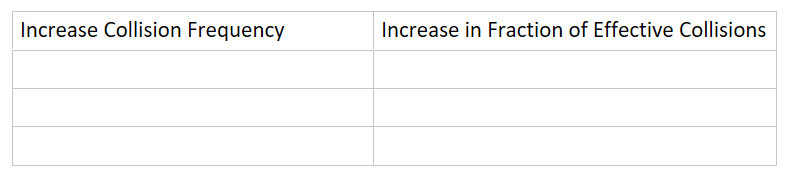
Fill in the following table with the factors that affect rate (nature of reactant, concentration of reactant, surface area, catalyst, temperature)
Hint: One factor increases both the frequency of collisions and fraction of effective collisions!

0:00 / 0:00
Collision Theory

- the fraction of molecules (f) that collide with a kinetic energy that is equal to or higher than Ea for a reaction is shown by the shaded areas under each curve
- the fraction increases as T increases

0:00 / 0:00
Catalysts
Catalysis General Information
- A catalyst is a species which is not consumed in the reaction but changes the RATE of the reaction
- A catalyst can increase the rate of a reaction by lowering the activation energy
- Activation Energy (Ea): Is the minimum amount of energy that the reacting species must possess to undergo the specified reaction.

- Since the catalyst lowers Ea for a reaction, does it speed up just the forward, backward, or forward and backward reaction?
- Both!
- Speeds up the forward and reverse reaction for that step equally.
- Will the equilibrium constant change when we add a catalyst?
- No!
- Would the change in enthalpy be affected by a catalyst? If so, how? (Draw where we could see deltaH or deltaG on the above plot)
- No!
- **This is a reminder that catalysts have to do with kinetics/thermodynamics:kineticsso they don't affect equilibrium constants, Gibb's Free Energy, reaction enthalpy, equilibrium concentrations, etc, which have to do with kinetics/thermodynamics:thermodynamics
0:00 / 0:00
Transition State Theory
aka Activated Complex Theory

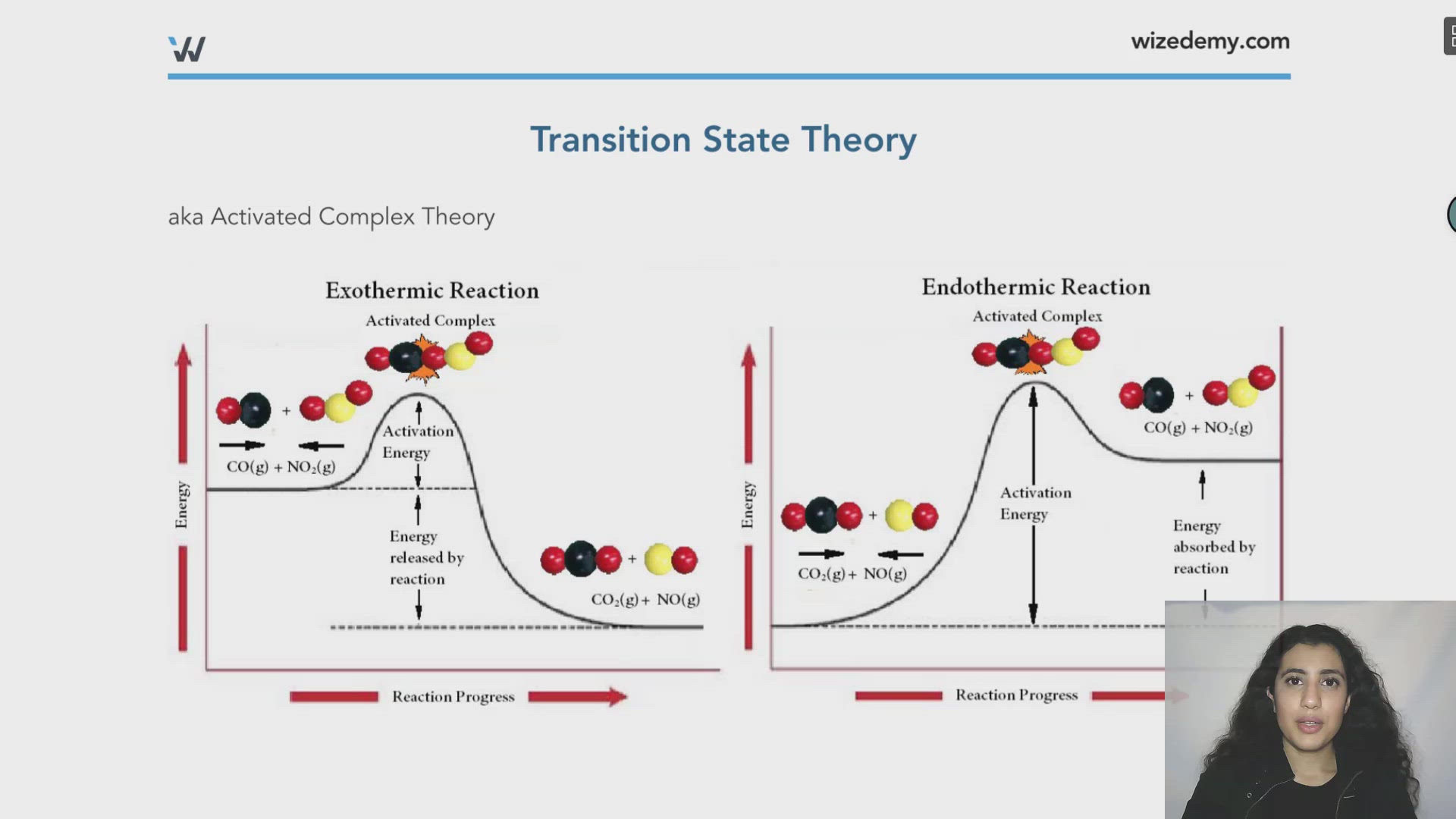
- Activated Complex/Transition State=maximum energy
- Once energy has increased enough to reach this activated complex, energy then decreases as products are formed
- Must have enough energy to overcome the activation barrier in order to react and form products!
- Note: the activated complex cannot by isolated (it's hypothetical!)
- Transition state is a hypothetical state where we are halfway between reactants and products (bonds are about to be broken and formed)
- The barrier height=Ea
- Catalysts only lower the energy of the transition state!
- A note on enthalpy:
- ΔH > 0 = endothermic (energy needs to be added/absorbed for the reaction to occcur)
- ΔH < 0 = exothermic (energy is released in the reaction)
Wize Concept
Note that to increase the rate of the reaction we would LOWER the activation energy (reduce the energy barrier the reactant molecules need to get over)
What does this do to the transition state complex?
If we lower Ea, then the energy of the transition state complex is also LOWERED, making it MORE STABLE.
So know that lowering Ea and stabilizing the transition state means the exact same thing, and both would INCREASE the rate of the reaction.
Also note that changing the Ea and TS stability has no effect on thermodynamics! It only has to do with kinetics and the reaction rate!
Which of the following represents the activation energy for the forward reaction in this potential energy diagram?
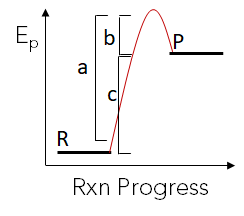
Which of the following represents the activation energy for the reverse reaction in this potential energy diagram?
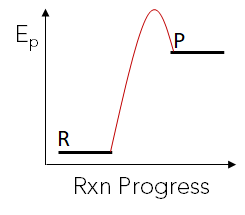
In the following energy diagram describing a chemical reaction, the forward reaction is (1)________, and the reverse reaction is (2)________.