Wize High School Grade 12 Chemistry Textbook > Acids and Bases
Solubility Product Constant, Ksp

0:00 / 0:00
Solubility and Ksp
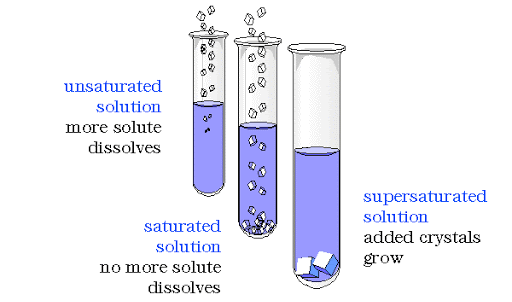
- Recall that a saturated solution is one that has the maximum quantity of solute dissolved. It is at this point that an equilibrium forms between the solid and the dissolved ions.
- Ex: AgCl(s) ⇌ Ag+(aq) + Cl-(aq)
- Increasing temperature can cause the solubility to increase
Ksp= The solubility product constant
- It is the equilibrium constant (K) that is specifically for saturated solutions
Write the Ksp expression for the above reaction in equilibrium:
Ksp=[Ag+][Cl-]
Watch Out!
Remember that solids or liquids are never included in any K expression!
For these solids, we can write out ICE tables similar to how we did earlier:
Let's say the Ksp=1.8x10⁻¹⁰ for the AgCl(s) at 25oC and we start with 0.2M of AgCl(s). We could be asked to find the concentrations for the ions at equilibrium.
1) Create an ICE Table
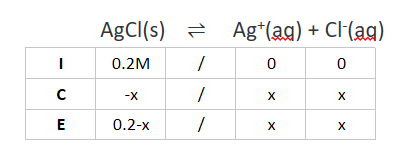
2) Write out a Ksp expression and solve for x:
Ksp=[Ag+][Cl-]
1.8x10-10=x2
x=1.34x10⁻⁵ M = [Ag+]=[Cl-]
Wize Tip
If you are ever asked to solve for the "molar solubility" or "solubility" of a salt, they are asking you to solve for x like we just did!
Solubility is referring to how much of a solid dissolves to give a saturated solution (at equilibrium)
The solubility of copper(II) arsenate, Cu3(AsO4)2, in pure water is 3.7×10⁻⁸ M. Calculate the value of Ksp for copper(II) arsenate from this data.
0:00 / 0:00
Q vs K to Predict Solubility
Recall:
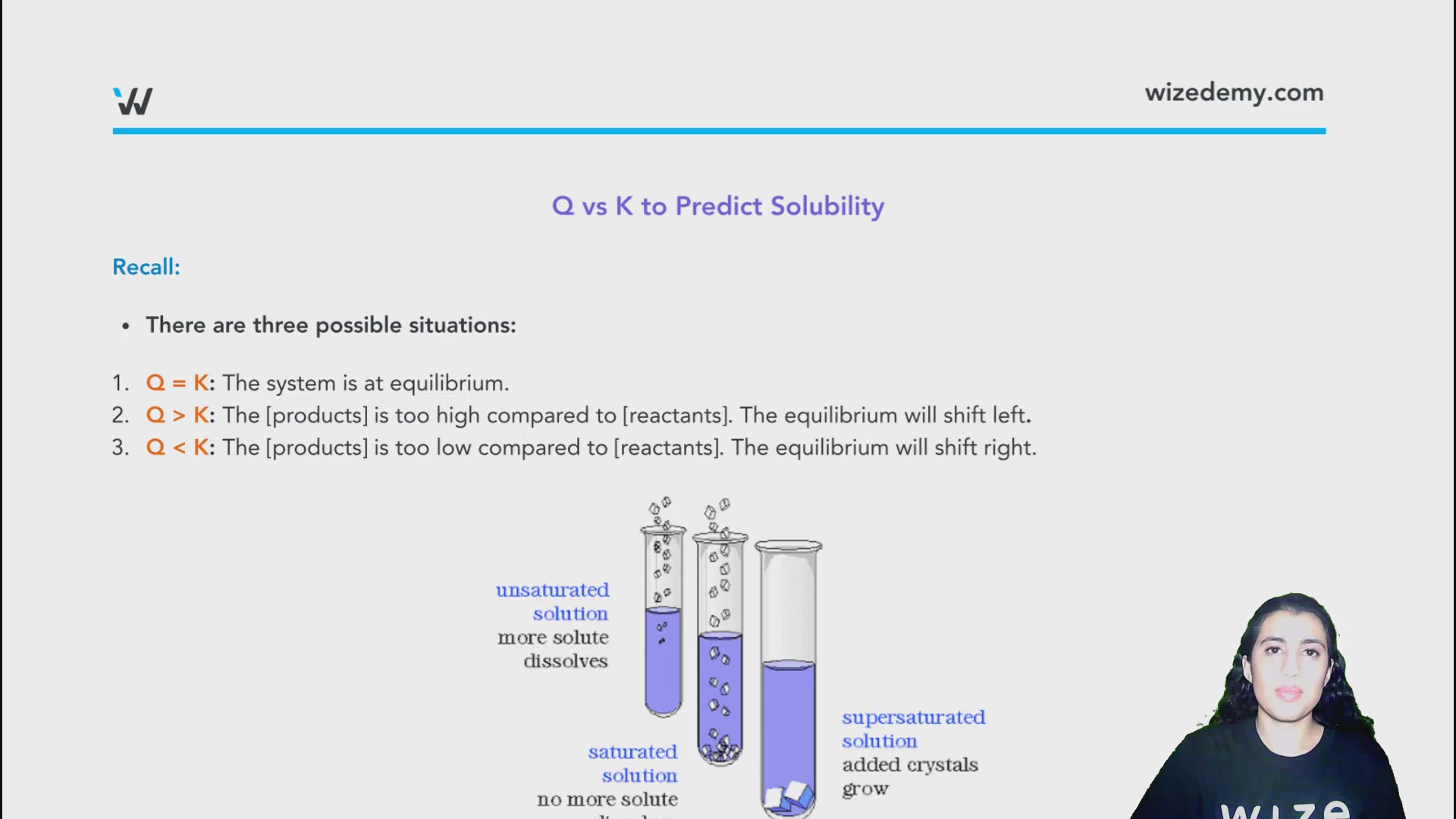
- There are three possible situations:
- Q = K: The system is at equilibrium.
- Q > K: The [products] is too high compared to [reactants]. The equilibrium will shift left.
- Q < K: The [products] is too low compared to [reactants]. The equilibrium will shift right.

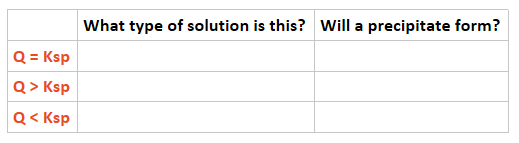
When asked to predict solubility, we should be able to identify whether a solution is unsaturated, saturated, or supersaturated!

0:00 / 0:00
Solubility Chart
- The following table is a table that many teachers use (on a test this would be provided to you!!)
- We can use it to figure out if a precipitate is likely to form or not
- Then if we think a precipitate is likely to form, we will solve for Q and compare it to Ksp for that salt and if Q>Ksp we can confirm that a precipitate will form!!

Wize Concept
If a combination of ions is highly soluble, it means that no precipitate will form
If a combination of ions is has low solubility, it means a precipitate MIGHT form, but to see if a precipitate will form we need to make sure Q>K!
Let's see if we understand this table...
Decide whether the following salts could form a precipate or not:
1) NaCl
2) AgCl
3) AgI
4) NaNO3