Popular Courses
English (Senior)
US High School
Grade 12 English
Canada High School
AP English Language and Composition Exam Prep Course
AP Exam Prep
AP English Literature and Composition Exam Prep Course
AP Exam Prep
English (Junior)
US High School
Grade 11 English
Canada High School
Intro to English
University Study Guides
English & Composition
University Study Guides
0:00 / 0:00
Online Research
The first place to start for research is online.
- There are helpful and risky ways of conducting online research.
- The first thing is to check the validity of the online site.
Validity
Questions to ask of the site:
- does it have a published date?
- does it have an author's name?
- are there references?
- is it associated with a university/think tank/government?
- is it a blog?
Wize Tip
Another way to check the validity of material you find online is called "lateral reading." What this means is that you should search to see if you find the same information in more than one reputable site.
Watch Out!
For sites that cannot be verified as having a link to a reliable and trusted real-life source, they should be taken as suspect and only used to fuel ideas, not to reference facts.
0:00 / 0:00
Citing Research
Proper citation is key to avoiding plagiarism.
- By citing properly, you showcase your abilities to participate in the genre of academic writing.
- There are two key places for citations:
- paraphrases
- direct quotations
Wize Tip
In both cases, you want to integrate the content from someone else into the grammar of your own sentences and provide a citation.
0:00 / 0:00
Citation Formats
There are different citation formats, and you want to make sure that you've found out from your instructor which format they prefer.
This section provides you with an overview of the main citation formats you will find most often:
- Modern Language Association (MLA);
- American Psychological Association (APA);
- Chicago Manual of Style; and
- Harvard Referencing Style.
0:00 / 0:00
Quotations
The most important thing to remember about integrating quotations is to frame them within the sentence structure of your own writing.
Rather than plop the quotation randomly into the text, it must be set up:
- who says it?
- where does it fall in the text?
- etc.
Example: Let's have a look at the following poem by Lord Byron, and then think about how to integrate quotations from the poem into your own writing:
She Walks in Beauty
She walks in beauty, like the night
Of cloudless climes and starry skies;
And all that’s best of dark and bright
Meet in her aspect and her eyes;
Thus mellowed to that tender light
Which heaven to gaudy day denies.
One shade the more, one ray the less,
Had half impaired the nameless grace
Which waves in every raven tress,
Or softly lightens o’er her face;
Where thoughts serenely sweet express,
How pure, how dear their dwelling-place.
And on that cheek, and o’er that brow,
So soft, so calm, yet eloquent,
The smiles that win, the tints that glow,
But tell of days in goodness spent,
A mind at peace with all below,
A heart whose love is innocent!
Analysis
- Let's say that you want to point out that the poem opens with a simile (see chapter 3 for more details on poetry and poetic devices).
Wize Concept
A simile is an explicit comparison between two things.
- In the poem above, the opening simile compares the unnamed "she" who "walks in beauty" to "the night.
- If that's an insight you want to make about the poem, then you need to include the quotation into the grammar of your own sentence: Example: ♦ The poem opens with a simile. "She walks in beauty, like the night." WRONG! ♦ The poem opens with a simile, suggesting that the "she" who "walks in beauty" does so "like the night." CORRECT
Watch Out!
See how the first example just plops the quotation without any context? The second weaves the quotation into your own grammar.
0:00 / 0:00
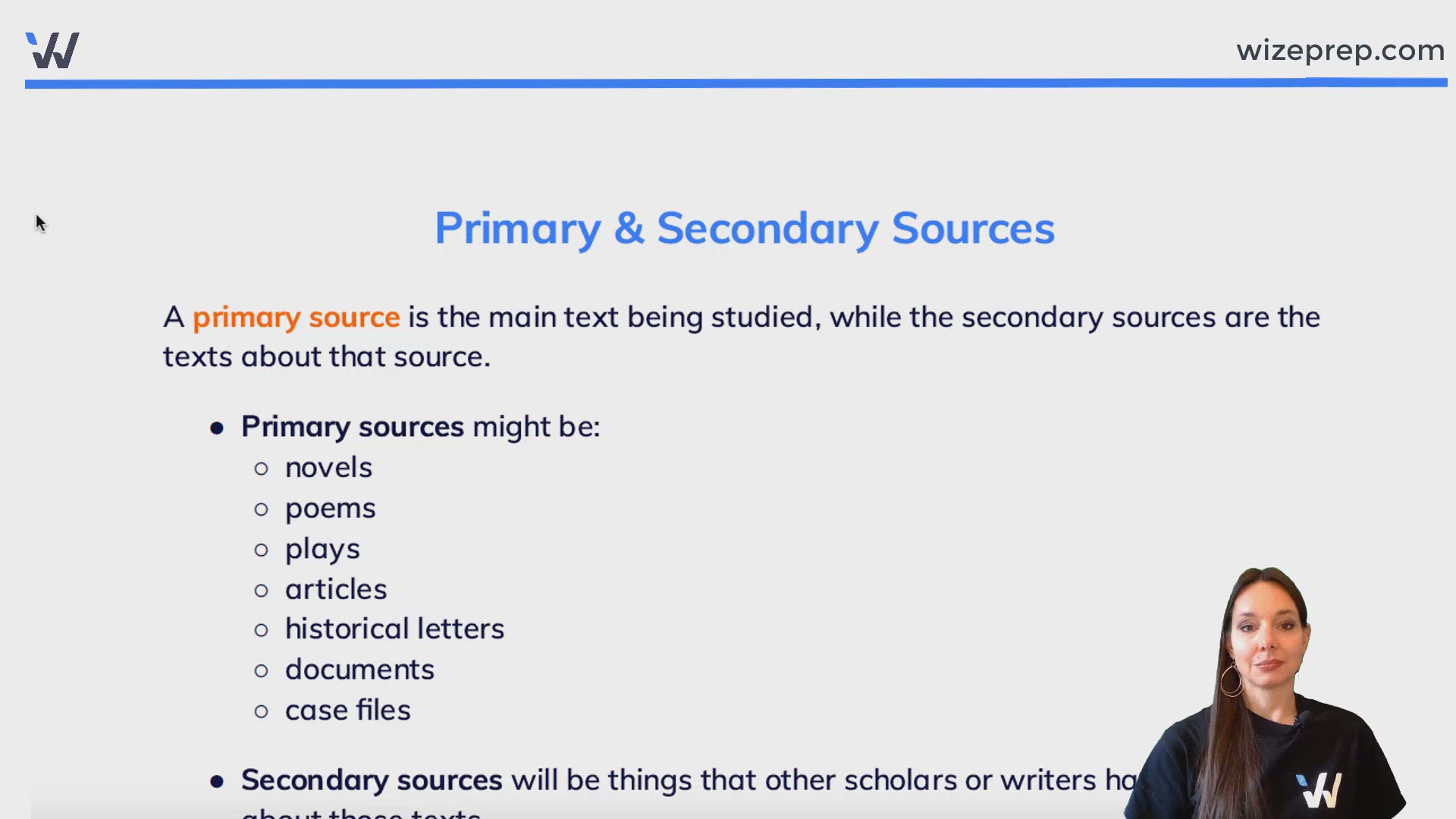
Primary & Secondary Sources
A primary source is the main text being studied, while the secondary sources are the texts about that source.
- Primary sources might be:
- novels
- poems
- plays
- articles
- historical letters
- documents
- case files
- Secondary sources will be things that other scholars or writers have written about those texts.
In other words...
- If a poem (like the one in the last lesson about quotations) is a primary source, then any articles or books written about that poem are secondary sources.
- So for instance, if you are writing an essay, and you've found a quotation by someone about Byron's poem, you might write something like:
According to literary scholar, Lindy Ledohowski, the poem "She Walks in Beauty" by Lord Byron objectifies the woman in the poem. She writes that the poem's speaker "sees the woman he describes as a mere collection of objects rather than a complete, human entity."
- In this example, Lindy Ledohowski is the SECONDARY SOURCE, but in the next example, we see the poem itself operating as a PRIMARY SOURCE.
- For instance, if you look at the poem itself, you will be quoting from a primary source, saying something like:
The poem uses words such as "serenely sweet," "pure," "goodness," and "innocence," suggesting that the speaker's love for his beloved is based on a sense of her being chaste or virginal.
0:00 / 0:00
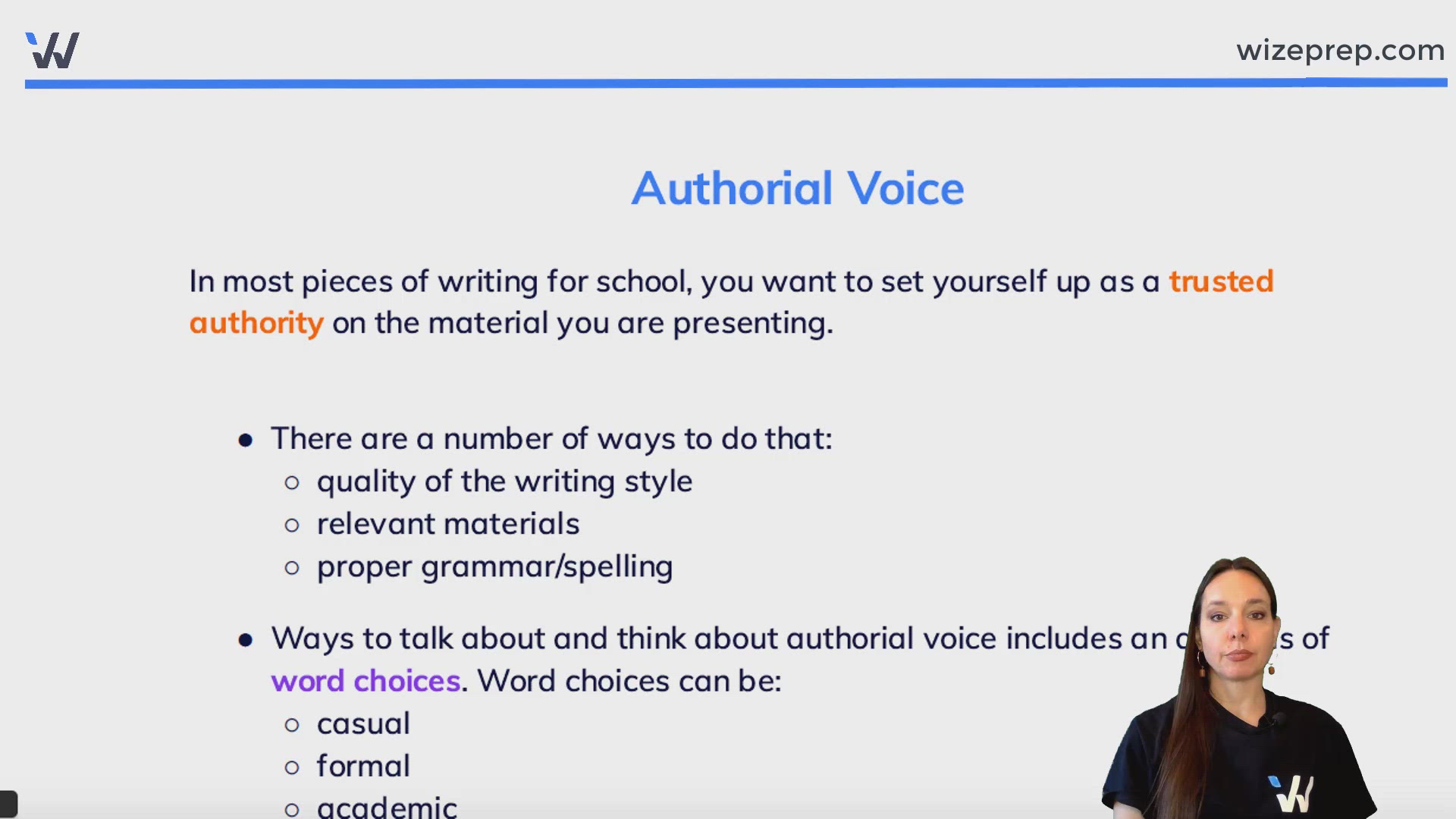
Authorial Voice
In most pieces of writing for school, you want to set yourself up as a trusted authority on the material you are presenting.
- There are a number of ways to do that:
- quality of the writing style
- relevant materials
- proper grammar/spelling
- Ways to talk about and think about authorial voice includes an analysis of word choices. Word choices can be:
- casual
- formal
- academic
- slang
- colloquial/regional
- bombastic
- flowery
- etc.