Create a free account to get started

Unlock full course notes by signing up

  • Video lessons taught by top educators
  • Practice questions with guided solutions
  • Written review notes for reference
  • Expert answers anytime from course tutors

Exponent Quotient Rule for Dividing Powers

Whenever we divide powers with the same base, we can use the exponent quotient rule as a short-cut.


 am÷an=am−n \Large\boxed{~a^{\bcth{m}}\div a^{\bcfi{n}}=a^{\bcth m-\bcfi{n}}~}


Remember that fractions is the same thing as division, so we have another way of writing out the exact same exponent quotient rule.

 aman=am−n \Large\boxed{~\dfrac{a^{\bcth{m}}}{a^{\bcfi{n}}}=a^{\bcth{m}-\bcfi{n}}~}

Note:

For now, just to keep things simply, we'll only focus on the questions where mm is bigger than nn. But the exponent quotient rule is actually also true for questions where mm is the same or smaller than nn!


Why does this work?

aman\Large{\dfrac{a^{\bcth{m}}}{a^{\bcfi{n}}}}


=a×a×...×a×a⏞m timesa×a×...×a⏟n times=\Large{ \dfrac {\overbrace{a\times a\times...\times a\times a}^{\bcth{m~\text{times}}}} {\underbrace{a\times a\times...\times a}_{\bcfi{n~\text{times}}}} }


Since aa=1\dfrac{a}{a}=1, for every aa in numerator, it cancels out with an aa in the denominator, and we'll only be left with some aa's on the numerator:


=a×a×...a×a×...a×a...×a⏞m−n times1=\Large{ \dfrac {\cancel a\times\cancel a\times...} {\cancel a\times\cancel a\times...} \dfrac{\overbrace{a\times a...\times a}^{\bcth{m}-\bcfi{n}~\text{times}}}{1} }


=am−n=\Large{a^{\bcth m-\bcfi{n}}}


Create a free account to get started

Unlock full course notes by signing up

  • Video lessons taught by top educators
  • Practice questions with guided solutions
  • Written review notes for reference
  • Expert answers anytime from course tutors

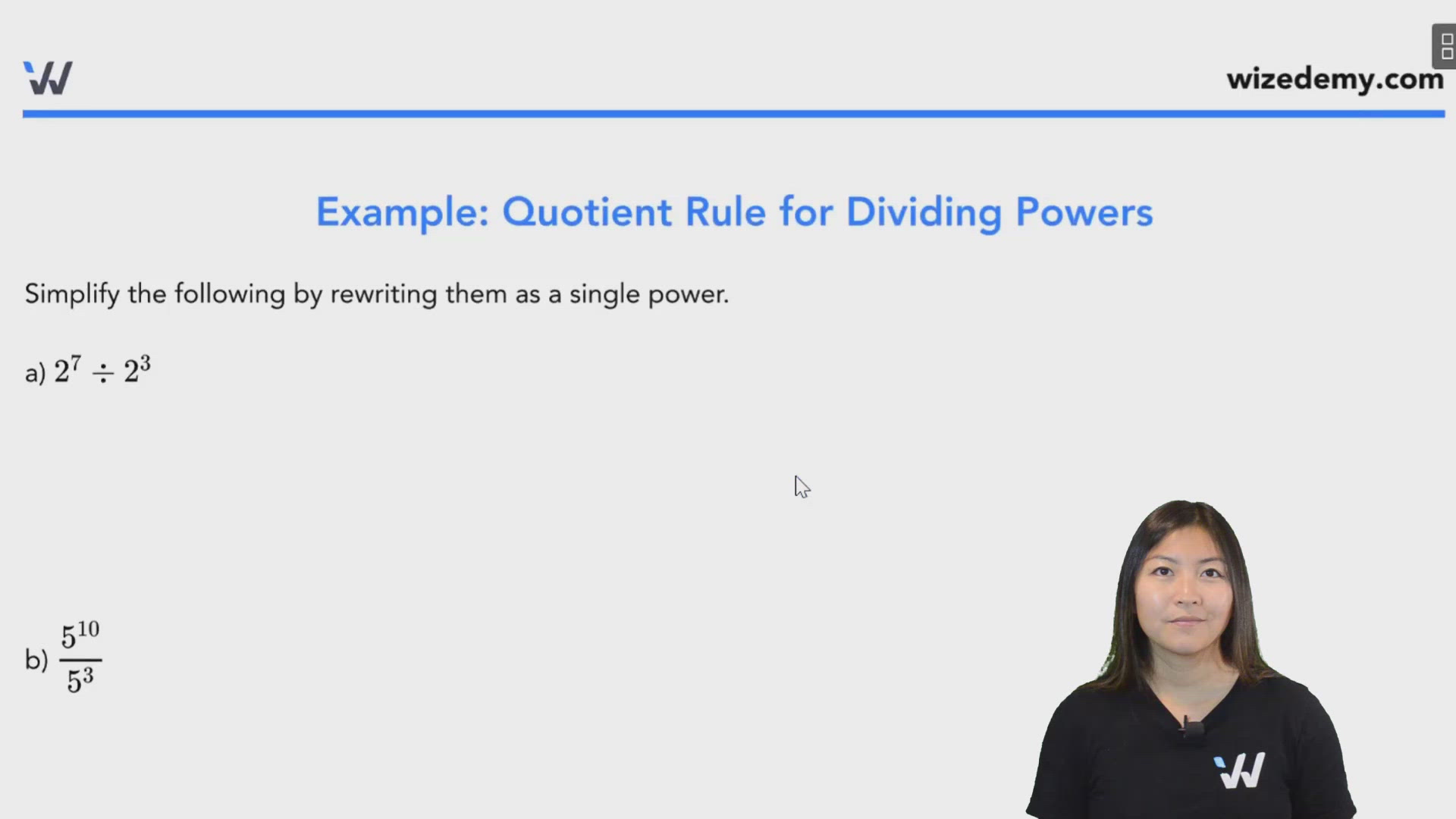
Example: Quotient Rule for Dividing Powers

Simplify the following by rewriting them as a single power.


a) 27÷232^7\div2^3


Since we are dividing two powers with the same base 2, we can use the exponent quotient rule:

=27−3=2^{7-3}

=24=2^{4}


b) 51053\dfrac{5^{10}}{5^3}


Since we are dividing two powers with the same base 5, we can use the exponent quotient rule:

=510−3=5^{10-3}

=57=5^{7}


c) (25)8(25)3\dfrac{\left(\dfrac{2}{5}\right)^8}{\left(\dfrac{2}{5}\right)^3}


Since we are dividing two powers with teh same base 25\dfrac{2}{5}, we can use the exponent quotient rule:

=(25)8−3=\left(\dfrac{2}{5}\right)^{8-3}

=(25)5=\left(\dfrac{2}{5}\right)^5

Practice: Quotient Rule for Dividing Powers

Evaluate the following without using a calculator.


a) 215÷2112^{15}\div2^{11}


b) 5957\dfrac{5^{9}}{5^7}


c) −318(−3)15\dfrac{-3^{18}}{(-3)^{15}}

Your answers

Create a free account to get started

Unlock full course notes by signing up

  • Video lessons taught by top educators
  • Practice questions with guided solutions
  • Written review notes for reference
  • Expert answers anytime from course tutors

Practice: Quotient Rule for Dividing Powers

Simplify.

a) (−3.5)7x7y4(−3.5)4x2y\dfrac{(-3.5)^7x^7y^4}{(-3.5)^4x^2y}

b) (x6)5×(6x)3\left(\dfrac{x}{6}\right)^5\times\left(\dfrac{6}{x}\right)^3


Your answers

Create a free account to get started

Unlock full course notes by signing up

  • Video lessons taught by top educators
  • Practice questions with guided solutions
  • Written review notes for reference
  • Expert answers anytime from course tutors