Create a free account to get started

Unlock full course notes by signing up

  • Video lessons taught by top educators
  • Practice questions with guided solutions
  • Written review notes for reference
  • Expert answers anytime from course tutors

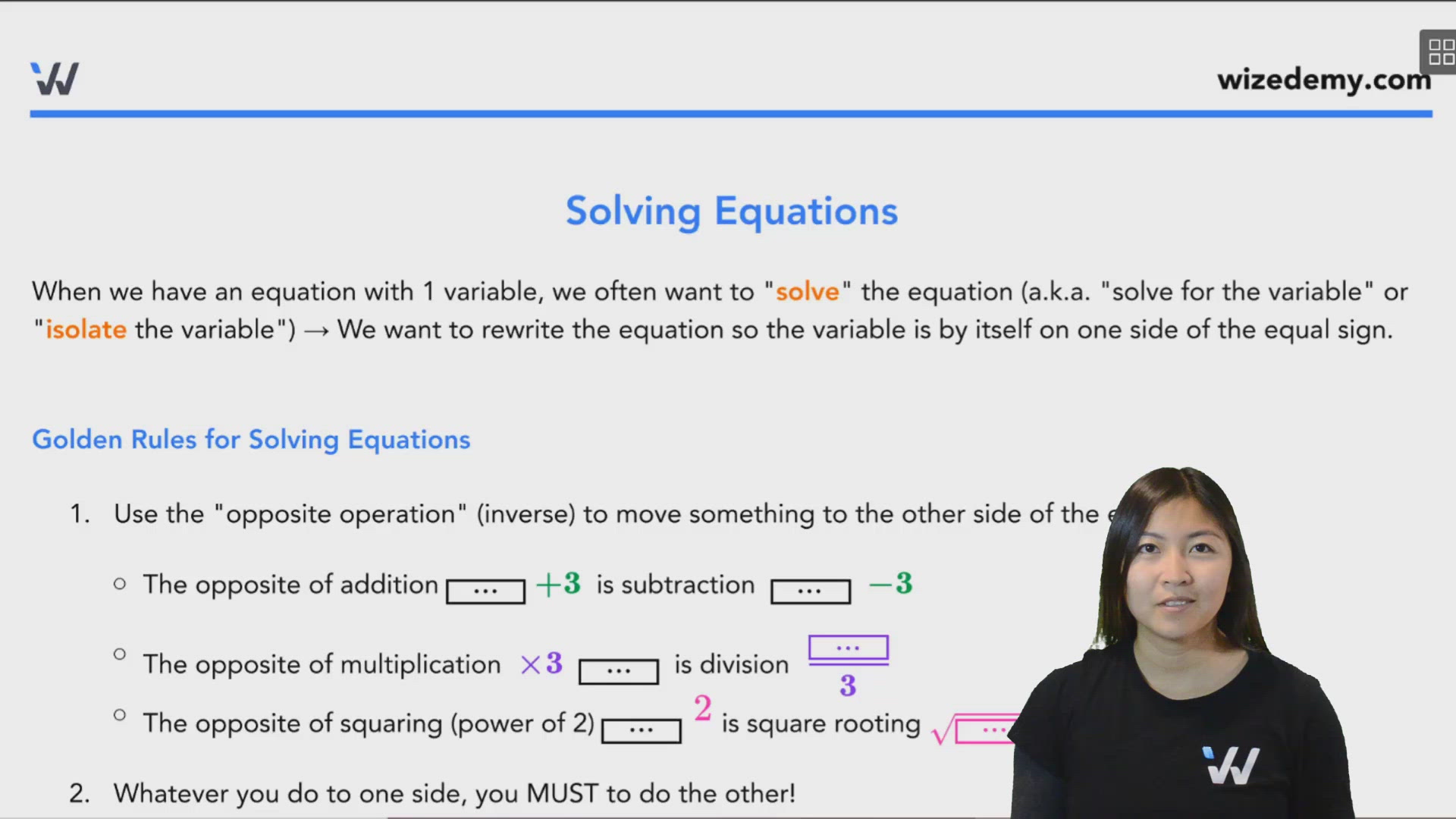
Solving Equations

When we have an equation with 1 variable, we often want to "solve" the equation (a.k.a. "solve for the variable" or "isolate the variable") → We want to rewrite the equation so the variable is by itself on one side of the equal sign.


Golden Rules for Solving Equations

  1. Use the "opposite operation" (inverse) to move something to the other side of the equation
  • The opposite of addition   ...   +3\boxed{~~...~~}~\bcth{+3} is subtraction   ...    −3\boxed{~~...~~}~~\bcth{-3}
  • The opposite of multiplication ×3    ...  \bm{\colorFive{\times 3}}~~\boxed{~~...~~} is division   ...  3\bcfi{\dfrac{\boxed{~~...~~}}{3}}
  • The opposite of squaring (power of 2)   ...    2\boxed{~~...~~}^{~~\large{\colorTwo2}} is square rooting   ...  \colorTwo {\sqrt {\boxed{~~...~~}}}
  1. Whatever you do to one side, you MUST do to the other!
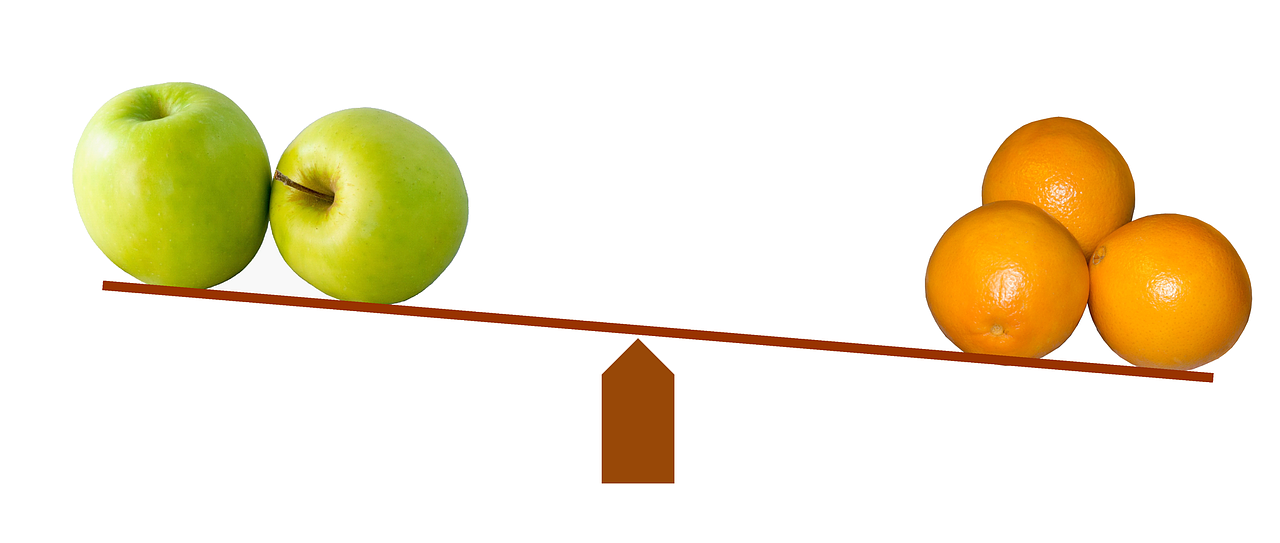

Image illustrating Solving Equations


Create a free account to get started

Unlock full course notes by signing up

  • Video lessons taught by top educators
  • Practice questions with guided solutions
  • Written review notes for reference
  • Expert answers anytime from course tutors

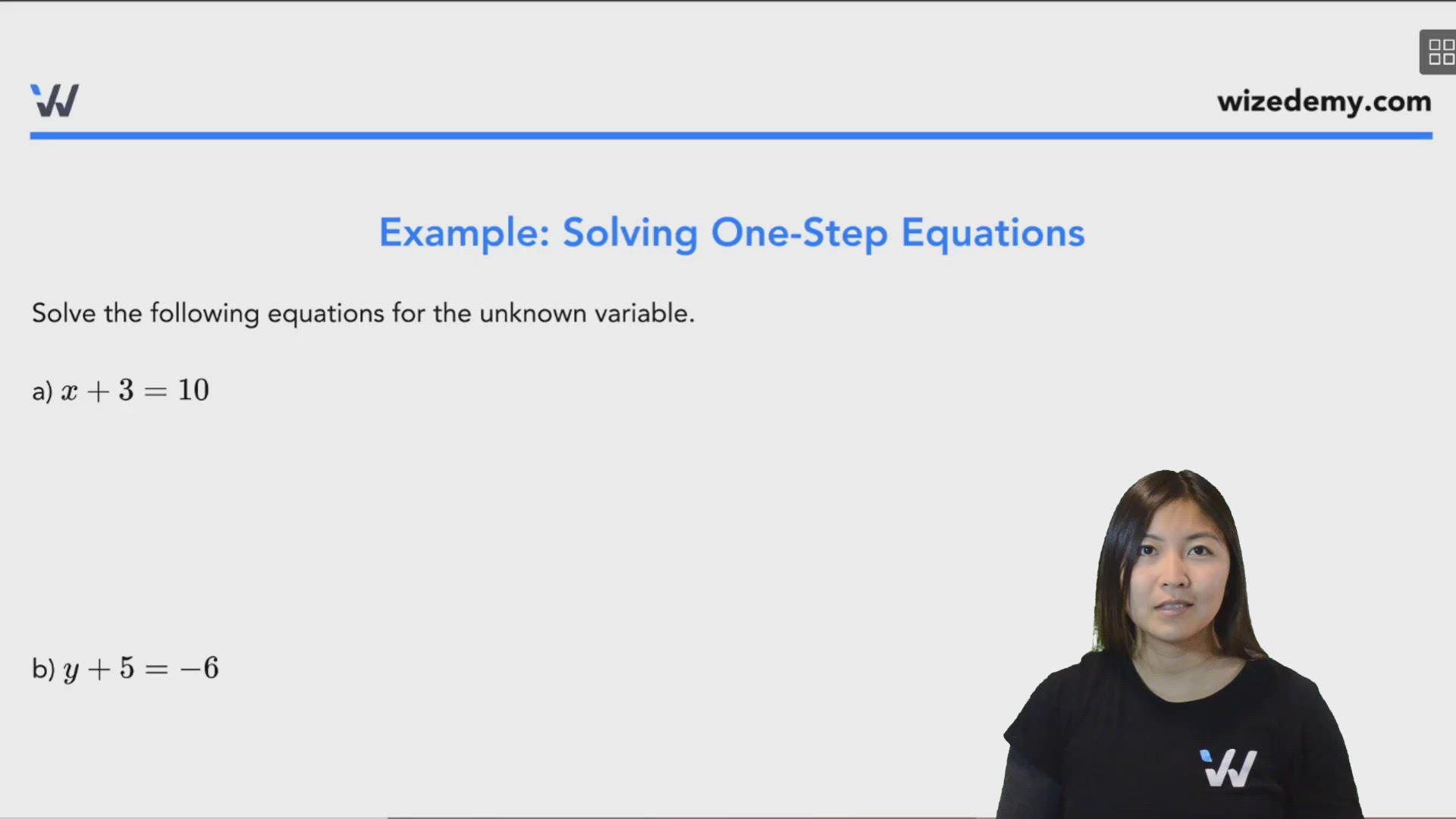
Example: Solving One-Step Equations

Solve the following equations for the unknown variable.


a) x+3=10x+3=10


x  +3 =10 −3−3x=7\begin{array}{rcr} x~~\cancel{+3}~&=&10\\ \scriptsize{~\colorTwo{\cancel{-3}}}&&\scriptsize{\colorTwo{-3}}\\[0.5em] x&=&7 \end{array}


b) y+5=−6y+5=-6


y  +5=−6 −5−5y=−11\begin{array}{rcr} y~~\cancel{+5}&=&-6\\ \scriptsize{~\colorTwo{\cancel{-5}}}&&\scriptsize{\colorTwo{-5}}\\[0.5em] y&=&-11 \end{array}


c) x−7=0x-7=0


x  −7=0 +7+7x=7\begin{array}{rcr} x~~\cancel{-7}&=&0\\ \scriptsize{~\colorTwo{\cancel{+7}}}&&\scriptsize{\colorTwo{+7}}\\[0.5em] x&=&7 \end{array}


d) t+(−1)=−6t+(-1)=-6


t  +(−1)=−6 −(−1)−(−1)t=−5\begin{array}{rcr} t~~\cancel{+(-1)}&=&-6\\ \scriptsize{~\colorTwo{\cancel{-(-1)}}}&&\scriptsize{\colorTwo{-(-1)}}\\[0.5em] t&=&-5 \end{array}


e) 3x=153x=15


3x3=153x=5\begin{array}{rcr} \dfrac{\cancel3x}{\scriptsize\colorTwo{\cancel3}}&=&\dfrac{15}{\scriptsize\colorTwo3}\\[1em] x&=&5 \end{array}


f) −4a=16-4a=16


−4a−4=16−4a=−4\begin{array}{rcr} \dfrac{\cancel{-4}a}{\scriptsize\colorTwo{\cancel{-4}}}&=&\dfrac{16}{\scriptsize\colorTwo{-4}}\\[1em] a&=&-4 \end{array}


g) x2=−5\dfrac{x}{2}=-5


x2   ×2=−5   ×2x=−10\begin{array}{rcr} \dfrac{x}{\cancel2}~~~\scriptsize{\colorTwo{\cancel{\times2}}}&=&-5~~~\scriptsize{\colorTwo{\times2}}\\[1em] x&=&-10 \end{array}


h) −x3=6-\dfrac{x}{3}=6


−x3   ×−3=6   ×−3x=−18\begin{array}{rcr} \cancel-\dfrac{x}{\cancel3}~~~\scriptsize{\colorTwo{\cancel{\times -3}}}&=&6~~~\scriptsize{\colorTwo{\times-3}}\\[1em] x&=&-18 \end{array}


i) −110x=−7-\dfrac{1}{10}x=-7


−110x   ×−10=−7   ×−10x=70\begin{array}{rcr} \cancel{-\dfrac{1}{{10}}}x~~~\scriptsize{\colorTwo{\cancel{\times-10}}}&=&-7~~~\scriptsize{\colorTwo{\times-10}}\\[1em] x&=&70 \end{array}


j) x=3\sqrt{x}=3


x=3(x)2=32x=9\begin{array}{rcl} \sqrt{x}&=&3\\ \left(\sqrt{x}\right)^{\colorTwo 2}&=&3^{\colorTwo 2}\\ x&=&9 \end{array}

Practice: Solving One-Step Equations

Solve the following equations.


a) x−10=−4x-10=-4


b) −5z=30-5z=30


c) n+9=1n+9=1


d) b5=−7\dfrac{b}{5}=-7


e) r=10\sqrt{r}=10

Your answers

Create a free account to get started

Unlock full course notes by signing up

  • Video lessons taught by top educators
  • Practice questions with guided solutions
  • Written review notes for reference
  • Expert answers anytime from course tutors