Create a free account to get started

Unlock full course notes by signing up

  • Video lessons taught by top educators
  • Practice questions with guided solutions
  • Written review notes for reference
  • Expert answers anytime from course tutors

Rate of Change & Slope of a Line

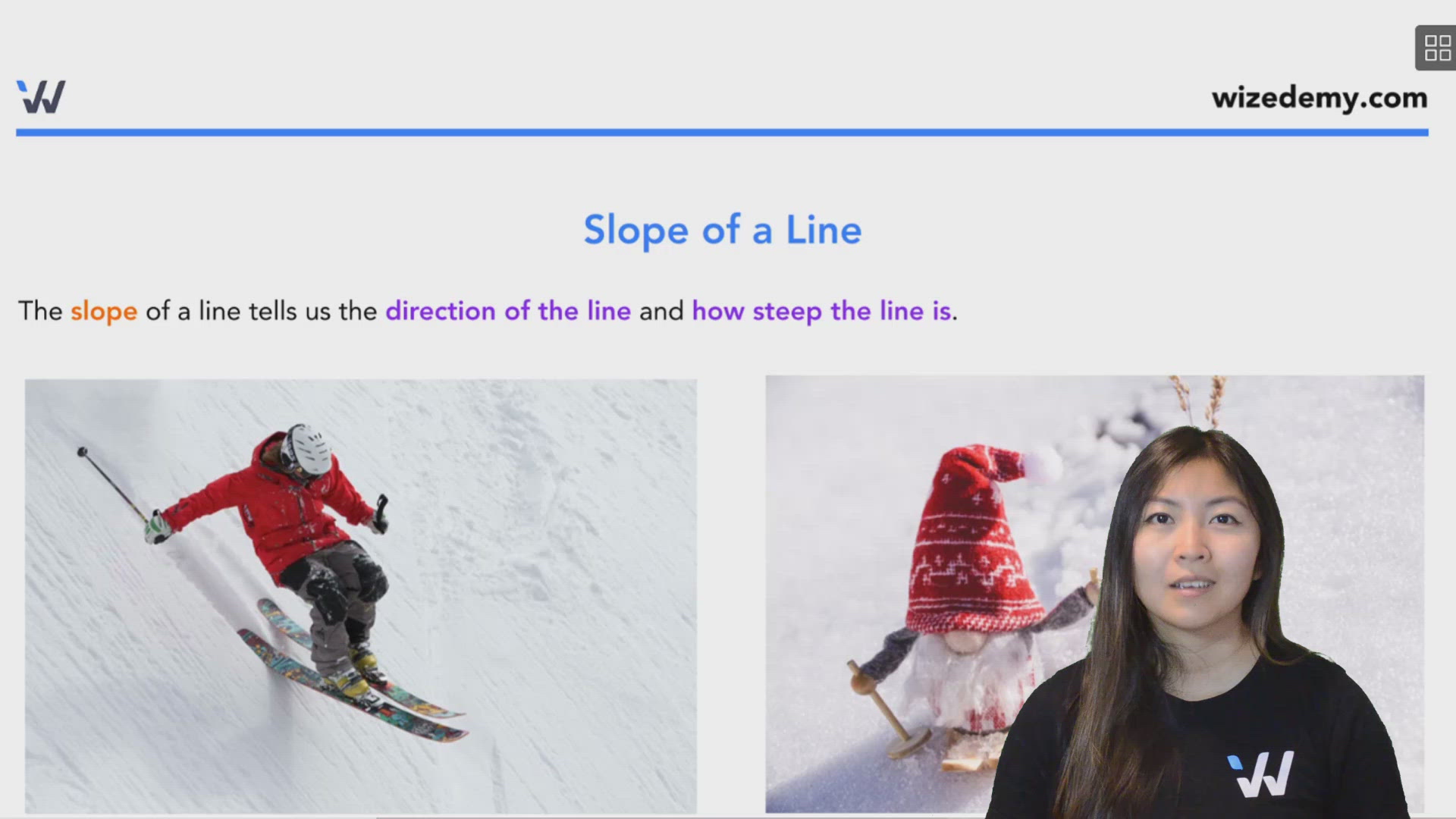
The slope of a line tells us the direction of the line and how steep the line is.
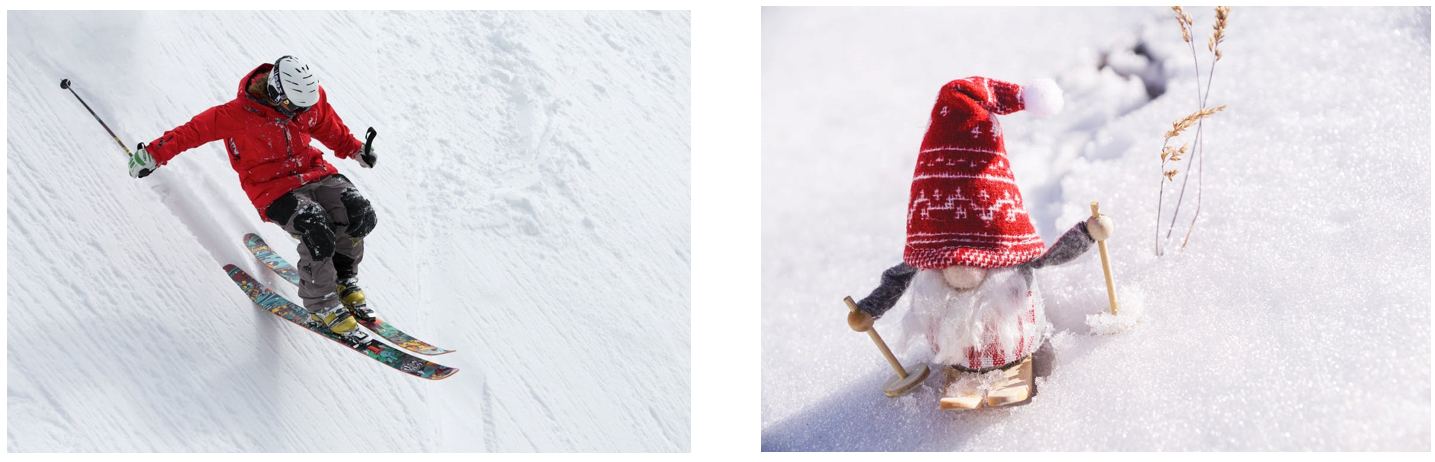

Image illustrating Slope of a Line


Direction of the line

  • If the slope is positive, the line goes up and to the right
  • If the slope is negative, the line goes down and to the right
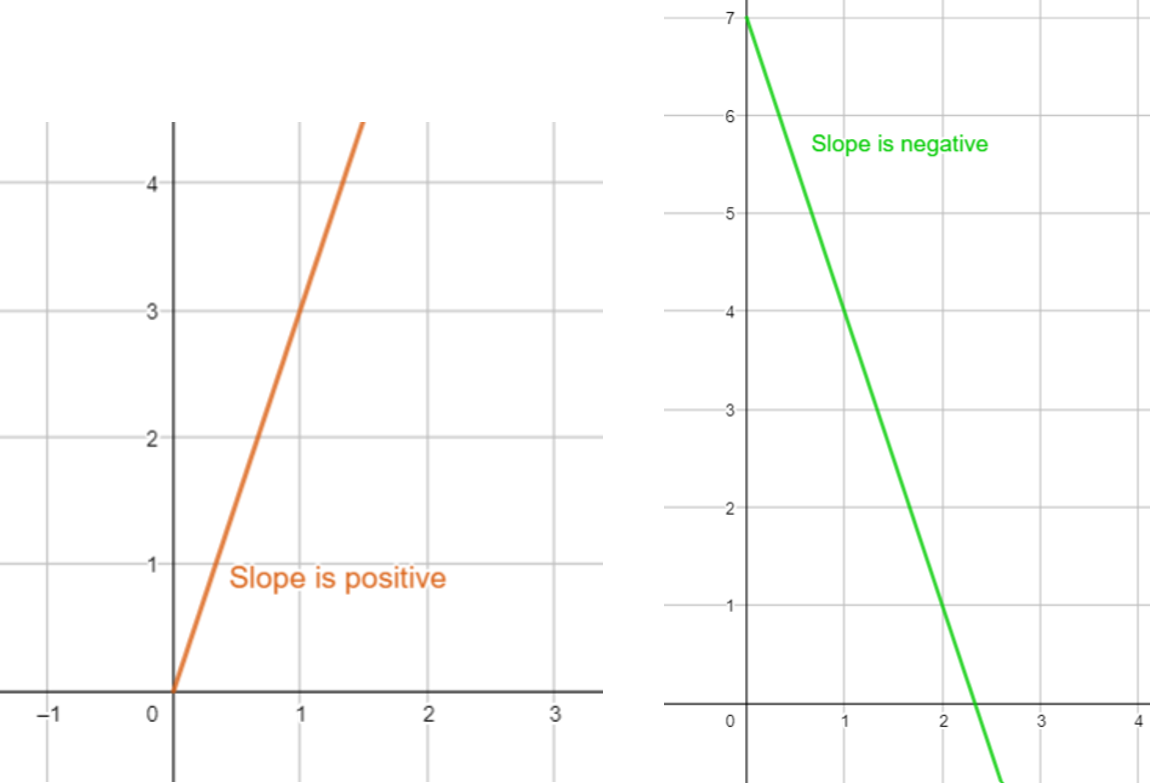

Image illustrating Slope of a Line


Steepness of the line

  • The largest the value of the slope, the steeper it is
  • The smaller the value fo the slope, the more shallow it is
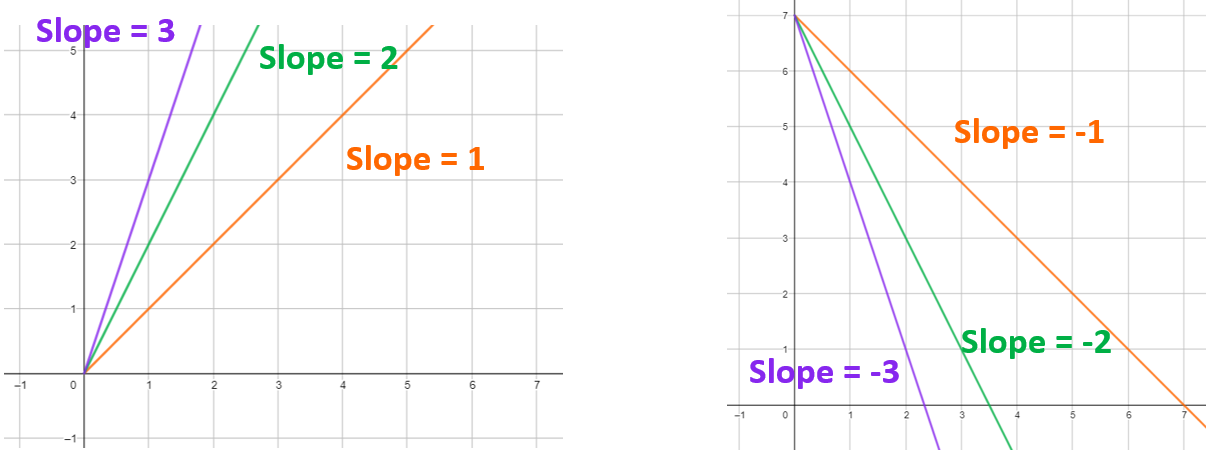

Image illustrating Slope of a Line


How to Determine the Slope

You can use these steps to determine the slope of a line given its graph:

  1. You pick any two points on the line -- one of the points is going to be more left and the other is going to be more right.
  2. The run\text{run} is the number of xx (horizontal) units you need to take to go from the leftmost point to the right most point.
  3. The rise\text{rise} is the number of yy (vertical) units you need to take to go from the leftmost point to the right most point.
  4. Calculate and interpret slope like this slope=riserun\boxed{\text{slope}=\dfrac{\text{rise}}{\text{run}}}


Example

The slope of the following line is slope=riserun=42=2\text{slope}=\dfrac{\text{rise}}{\text{run}}=\dfrac{4}{2}=2
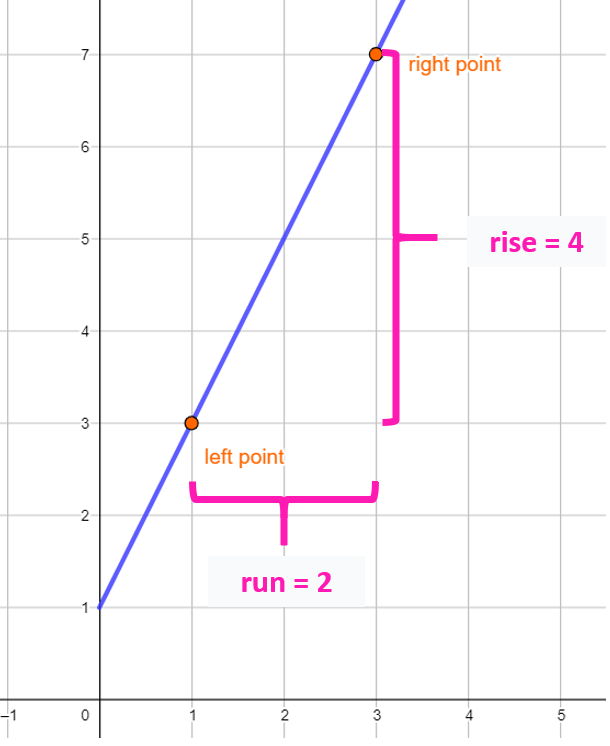
Image illustrating Slope of a Line


Slope and First Differences

Slope also represents the rate of change of a line -- the change in one variable relative to the change in the other variable.


We can calculate the slope of a line by finding the first differences in the table of values.


Example

Find the slope of the line that has the follow tabling of values


  x    y  013123233343\begin{array}{|c|c|} \hline ~~x~~&~~y~~\\ \hline\\ 0&13\\\\ \hline\\ 1&23\\\\ \hline\\ 2&33\\\\ \hline\\ 3&43\\\\ \hline \end{array}

Since the first difference is 10, the slope is 10.
Practice: Slope of a Line

Answer the following questions about the slope of the line.


Which line has the largest slope?


Illustration for practice question: Which line has the largest slope?


Choose an answer

Create a free account to get started

Unlock full course notes by signing up

  • Video lessons taught by top educators
  • Practice questions with guided solutions
  • Written review notes for reference
  • Expert answers anytime from course tutors

Create a free account to get started

Unlock full course notes by signing up

  • Video lessons taught by top educators
  • Practice questions with guided solutions
  • Written review notes for reference
  • Expert answers anytime from course tutors

Finding the Slope of a Line

Finding the Slope from the equation of a line

  • Rewrite the equation into y=mx+by=mx+b
  • The coefficient (number) in front of xx is the slope →   Slope=m  \large\boxed{~~\colorFour{\text{Slope}=m~~}}


Example 1

Find the slope of the line y=3−2xy=3-2x.


Rearranging the right hand side of the equation, we get y=−2x+3y=\bct {-2}x+3.


So, the slope m=−2\boxed{m=-2}.

Finding the Slope Between 2 Points on a line

  • Label the points (x1,y1)(x_1,y_1) and (x2,y2)(x_2,y_2)
  • Use the formula   Slope = RiseRun = y2−y1x2−x1  \large\boxed{\colorFour{~~\text{Slope}~=~\dfrac{\text{Rise}}{\text{Run}}~=~\dfrac{y_2-y_1}{x_2-x_1}~~}}


Example 2

Calculate the slope between the points (2,−3)(2,-3) and (−1,−4)(-1,-4).


Label the points:     x1y1(   2,−3   )\begin{array}{ccc} ~~~~~\colorTwo{x_1}&&\colorTwo{y_1}\\ (~~~2&,&-3~~~) \end{array} and      x2y2(   −1,−4   )\begin{array}{ccc} ~~~~~\colorTwo{x_2}&&\colorTwo{y_2}\\ (~~~-1&,&-4~~~) \end{array}


Then use the formula: Slope=(−4)−(−3)(−1)−(2)Slope=−4+3−1−2Slope=−1−3Slope=13\begin{array}{rcl} \text{Slope}&=&\dfrac{(-4)-(-3)}{(-1)-(2)}\\\\ \text{Slope}&=&\dfrac{-4+3}{-1-2}\\\\ \text{Slope}&=&\dfrac{-1}{-3}\\\\ \text{Slope}&=&\dfrac{1}{3} \end{array}


So, the slope is m=13\boxed{m=\dfrac{1}{3}}.

Finding the Slope From a Graph

  • Find 2 "nice" points on the graph, where the x and y coordinates are integer values → look for where the line crosses the corners of the grid lines
  • Label the points (x1,y1)(x_1,y_1) and (x2,y2)(x_2,y_2)
  • Use the formula   Slope = RiseRun = y2−y1x2−x1  \large\boxed{\colorFour{~~\text{Slope}~=~\dfrac{\text{Rise}}{\text{Run}}~=~\dfrac{y_2-y_1}{x_2-x_1}~~}}


Example 3

Find the slope of the following line.
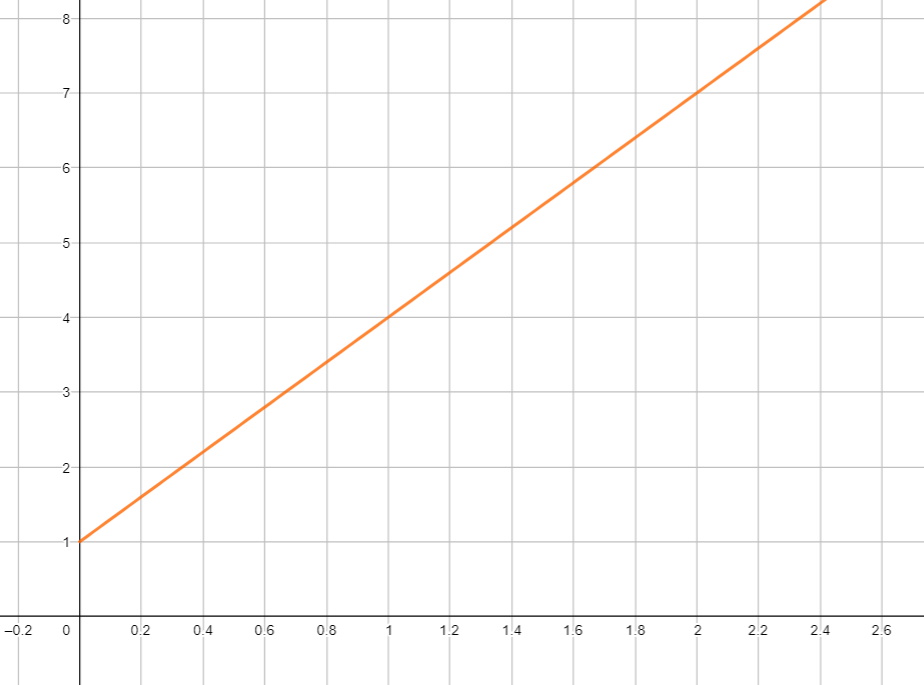
Image illustrating Finding the Slope of a Line


Two "nice" points on the line are      x1y1(   1,4   )\begin{array}{ccc} ~~~~~\colorTwo{x_1}&&\colorTwo{y_1}\\ (~~~1&,&4~~~) \end{array} and      x2y2(   2,7   )\begin{array}{ccc} ~~~~~\colorTwo{x_2}&&\colorTwo{y_2}\\ (~~~2&,&7~~~) \end{array}.


Then use the formula: Slope=(7)−(4)(2)−(1)Slope=31Slope=3\begin{array}{rcl} \text{Slope}&=&\dfrac{(7)-(4)}{(2)-(1)}\\\\ \text{Slope}&=&\dfrac{3}{1}\\\\ \text{Slope}&=&3 \end{array}


So, the slope is m=3\boxed{m=3}.

Practice: Finding the Slope of a Line

Find the slope of the following lines.


a) The line with equation x−2y=3x-2y=3


b) The line that passes through (0,−3)(0,-3) and (−2,5)(-2,5)


c)

Illustration for practice question: Practice: Finding the Slope of a Line


Your answers

Create a free account to get started

Unlock full course notes by signing up

  • Video lessons taught by top educators
  • Practice questions with guided solutions
  • Written review notes for reference
  • Expert answers anytime from course tutors

Practice: Slope of a Line

a) Find the coordinates of another point on the line that passes through the point (3,−4)(3, -4) and has a slope of −23-\dfrac{2}{3}


b) A line has slope −14-\dfrac{1}{4} and passes through the point (−3,0)(-3, 0). Find the y-coordinate of the point on the line that has an x-coordinate of 5.

Your answers

Create a free account to get started

Unlock full course notes by signing up

  • Video lessons taught by top educators
  • Practice questions with guided solutions
  • Written review notes for reference
  • Expert answers anytime from course tutors

Create a free account to get started

Unlock full course notes by signing up

  • Video lessons taught by top educators
  • Practice questions with guided solutions
  • Written review notes for reference
  • Expert answers anytime from course tutors

Example: Slope of a Line

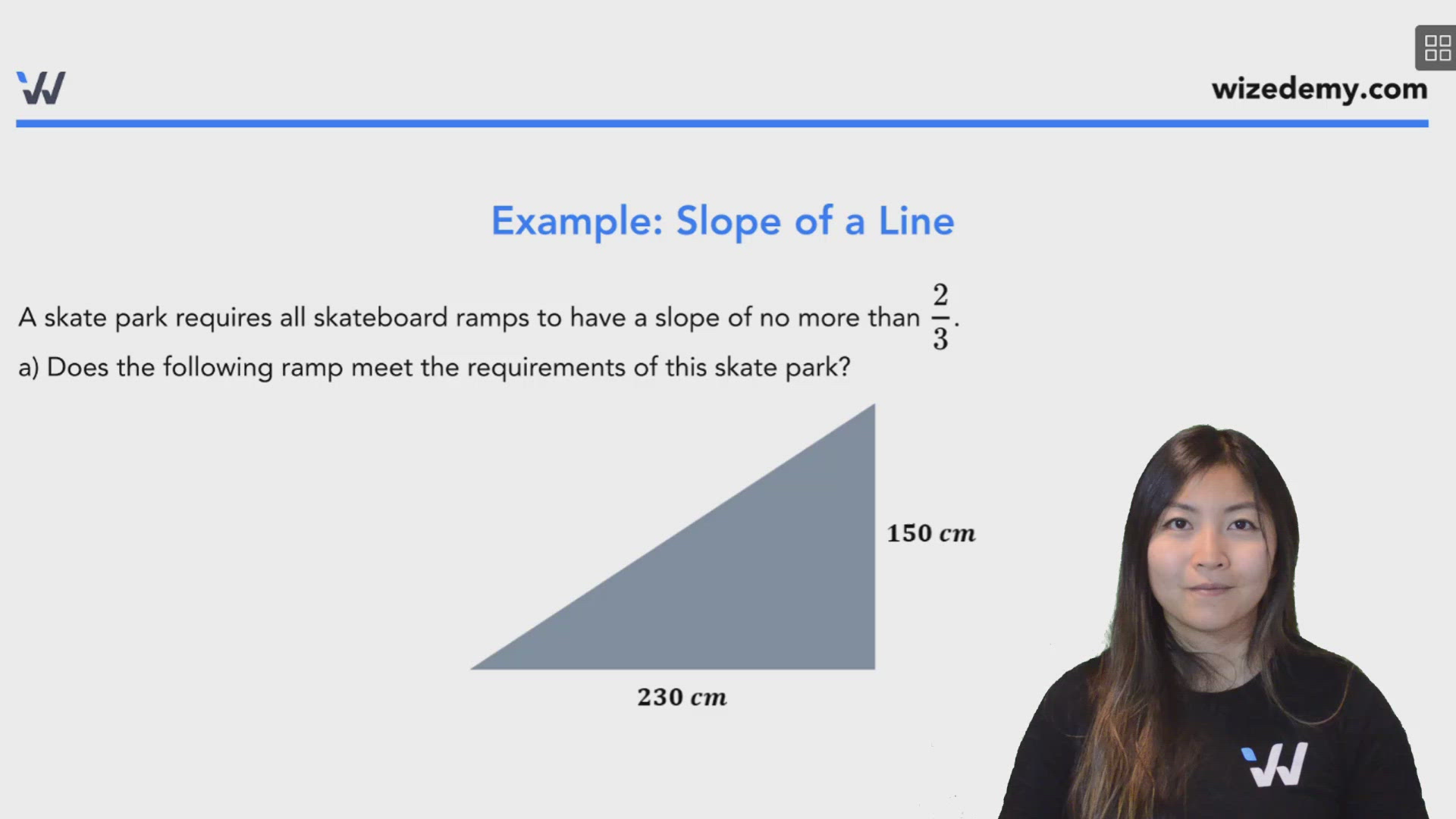
A skate park requires all skateboard ramps to have a slope of no more than 23\dfrac{2}{3}.

a) Does the following ramp meet the requirements of this skate park?
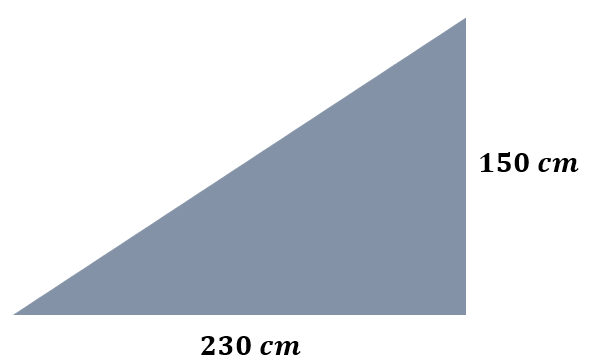
Image illustrating Example


Slope=RiseRunSlope=\dfrac{Rise}{Run}


Slope=150230Slope=\dfrac{150}{230}


Simplifying this, we see that the slope of this ramp is 15/2315/23 or approximately 0.6520.652.


The park's requirement is that the slope be less than or equal to 2/32/3 or approximately 0.6670.667, so this ramp does meet the park's requirements.

b) If a ramp has a base of 90cm90cm, find the maximum height of this ramp that will still meet the requirements of this skate park.


Slope=RiseRun23=Rise9023×90=Rise60=Rise\begin{array}{rcl} Slope&=&\dfrac{Rise}{Run}\\\\ \dfrac{2}{3}&=&\dfrac{Rise}{90}\\\\ \dfrac{2}{3}\times90&=&Rise\\\\ 60&=&Rise \end{array}


Therefore, the maximum height of the ramp is 60cm.

Practice: Slope of a Line

A diver's depth under water changes at a constant rate of −2-2m/s. If this diver is 6m6m under water 1 second after she started her dive, what is her depth under water 10 seconds after she started her dive?

Your answers

Create a free account to get started

Unlock full course notes by signing up

  • Video lessons taught by top educators
  • Practice questions with guided solutions
  • Written review notes for reference
  • Expert answers anytime from course tutors