
Parallel & Perpendicular Lines
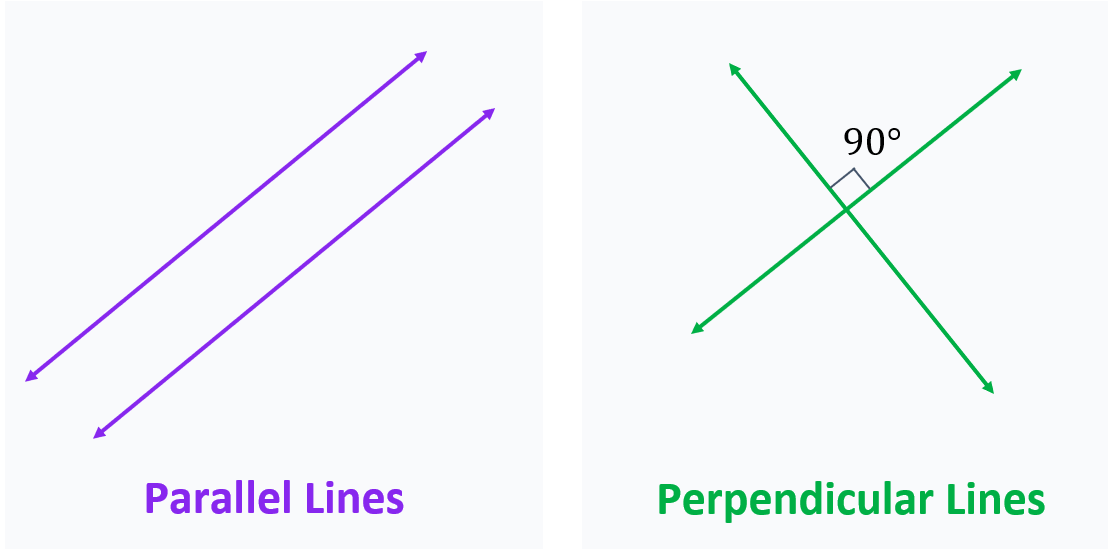
When we are given the equation of two lines, we can determine if the lines are parallel or perpendicular by looking at the slopes of the lines.
Parallel Lines
Two lines are parallel if they have the same slope.
(If two lines have the same slope, then they are parallel)
Example
Show that the lines and are parallel.
The line has a slope .
Rearranging the line into slope y-intercept form:
We see that this line also has a slope of .
Therefore, the lines are parallel.
Perpendicular Lines
Two lines are perpendicular if their slopes are negative reciprocals of one another.
(If two lines have negative reciprocal slopes, then they are perpendicular)
Example
Write the equation of a line that is perpendicular to .
The slope of the line is . The negative reciprocal of this number is .
So, any line that perpendicular to must have a slope of . One example would by .
There are many possible answers because there are many lines that are perpendicular to , we just have to change the y-intercept value and we have another line that is perpendicular to the given line.