
Solving Compound Inequalities

Compound Inequalities
Two inequalities can be combined with each other to form a compound inequality. For these there is a common expression that allows all parts to be compared with each other.
Solving works much the same as a regular linear equality. Try and keep in mind the following:
- What ever you do to one piece, you must do to all the pieces
- If you multiply or divide by a negative number, both inequality symbols flip
Example:
Solve
ANSWER:
We can first combine the inequalities into a compound inequality.
From here we work to isolate the variable.
So is a number between -4 and 1. Note that the -4 is included in the solution, but 1 is not. We can also express the answer as an interval:
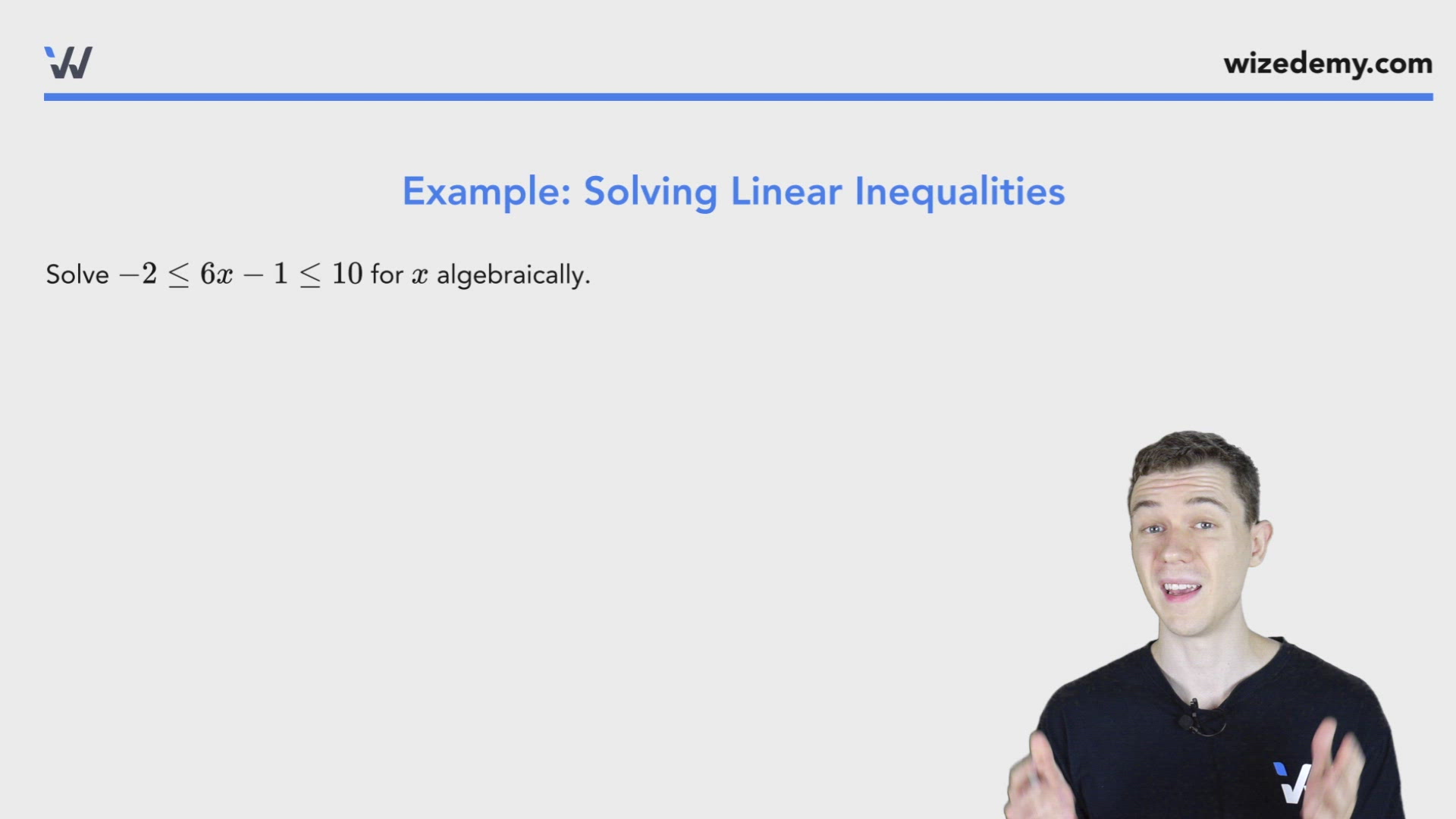
Example: Solving Linear Inequalities
Solve for algebraically.