Create a free account to get started

Unlock full course notes by signing up

  • Video lessons taught by top educators
  • Practice questions with guided solutions
  • Written review notes for reference
  • Expert answers anytime from course tutors

The Idea behind Common Factoring

Let's say you have the following 3 pencil cases:
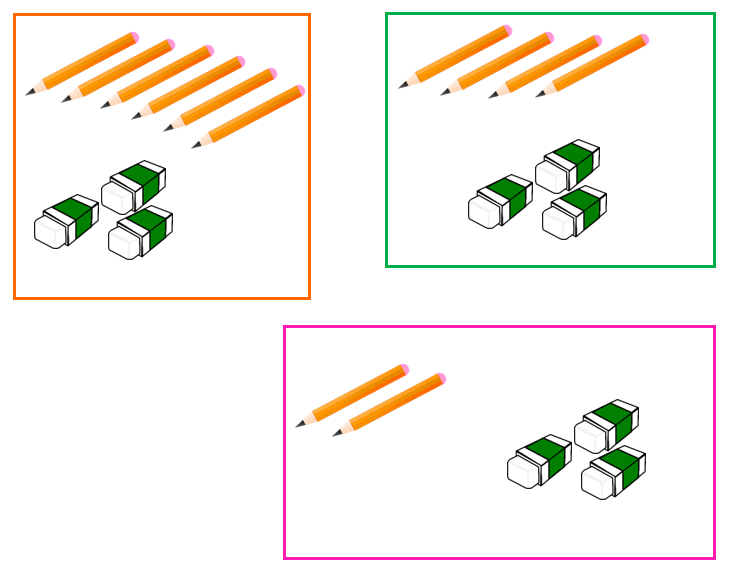
Image illustrating Warm Up


It's clear that there are items in common (the same) between all 3 pencil cases. How can we simplify this picture using numbers?
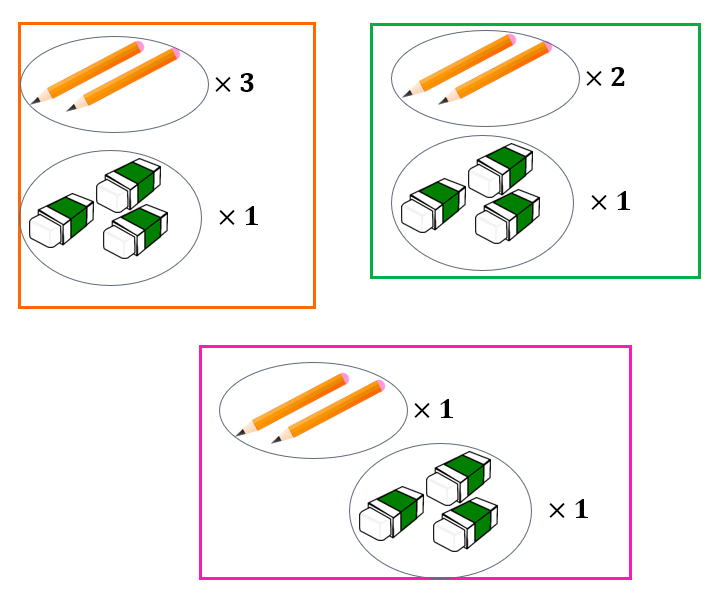
Image illustrating Warm Up


Factoring with Numbers

Given any number nn, its factors are divisors of nn (meaning numbers that "go into nn very nicely").


*Note: We usually only consider integer factors!


Example 1

Given the number 24, its factors are -1, 1, -2, 2, -3, 3, -4, 4, -6, 6, -8, 8, -12, 12, -24, and 24.


So, we can rewrite 24 as follows

  • 24=24=________
  • 24=24=________
  • 24=24=________
  • 24=24=________
  • 24=24=________
  • 24=24=________
  • ...


Example 2

Identify the greatest common factor between the following terms, then rewrite the expression by dividing out the greatest common factor.


a) 5+25=5+25=________


b) 6βˆ’15=6-15=________


c) 8βˆ’20=8-20=________


d) βˆ’8βˆ’20=-8-20=________


Create a free account to get started

Unlock full course notes by signing up

  • Video lessons taught by top educators
  • Practice questions with guided solutions
  • Written review notes for reference
  • Expert answers anytime from course tutors

Common Factoring

When given a polynomial, we can use common factoring to "take out" (divide out) any common terms.


How to common factor?

  1. Identify the greatest common factor between all of the terms β†’ GCF\colorbox{yellow}{GCF}
  2. Divide the entire polynomial by this greatest common factor β†’ leftΒ overΒ polynomialΒ afterΒ dividingΒ theΒ GCF\colorbox{aqua}{left over polynomial after dividing the GCF}
  3. Rewrite the polynomial in factored form β†’ GCF(leftΒ overΒ polynomialΒ afterΒ dividingΒ theΒ GCF)\colorbox{yellow}{GCF}(\colorbox{aqua}{left over polynomial after dividing the GCF})


Example 1

Identify the greatest common factor between the following terms, then factor each polynomial.


a) 3xβˆ’63x-6


1. Greatest common factor: 3\colorbox{yellow}{$3$}.


2. Dividing each term by 33: 3x3+βˆ’63=xβˆ’2\dfrac{3x}{\bct 3}+\dfrac{-6}{\bct 3}=\colorbox{aqua}{$x-2$}


3. The factored form: 3xβˆ’6=3(xβˆ’2)3x-6=\colorbox{yellow}{$3$}(\colorbox{aqua}{$x-2$})


Check: Β Β Β Β Β 3(xβˆ’2)=3(x)+3(βˆ’2)=3xβˆ’6Β Β βœ“\begin{aligned} &~~~~~3(x-2)\\ &=3(x)+3(-2)\\ &=3x-6~~\checkmark \end{aligned}


b) βˆ’3xβˆ’6-3x-6


Greatest common factor: βˆ’3\colorbox{yellow}{$-3$}.


Dividing each term by βˆ’3-3: βˆ’3xβˆ’3+βˆ’6βˆ’3=x+2\dfrac{-3x}{\bct {-3}}+\dfrac{-6}{\bct{-3}}=\colorbox{aqua}{$x+2$}


The factored form: βˆ’3xβˆ’6=βˆ’3(x+2)-3x-6=\colorbox{yellow}{$-3$}(\colorbox{aqua}{$x+2$})


Check: Β Β Β βˆ’3(x+2)=βˆ’3(x)βˆ’3(2)=βˆ’3xβˆ’6Β Β βœ“\begin{aligned} &~~~-3(x+2)\\ &=-3(x)-3(2)\\ &=-3x-6~~\checkmark \end{aligned}


c) 3x2βˆ’63x^2-6


Greatest common factor: 3\colorbox{yellow}{$3$}.


Dividing each term by 33: 3x23+βˆ’63=x2βˆ’2\dfrac{3x^2}{\bct {3}}+\dfrac{-6}{\bct {3}}=\colorbox{aqua}{$x^2-2$}


The factored form: 3x2βˆ’6=3(x2βˆ’2)3x^2-6=\colorbox{yellow}{$3$}(\colorbox{aqua}{$x^2-2$})


Check: Β Β Β Β Β 3(x2βˆ’2)=3(x2)+3(βˆ’2)=3x2βˆ’6Β Β βœ“\begin{aligned} &~~~~~3(x^2-2)\\ &=3(x^2)+3(-2)\\ &=3x^2-6~~\checkmark \end{aligned}


d) βˆ’3x2βˆ’6-3x^2-6


Greatest common factor: βˆ’3\colorbox{yellow}{$-3$}.


Dividing each term by βˆ’3-3: βˆ’3x2βˆ’3+βˆ’6βˆ’3=x2+2\dfrac{-3x^2}{\bct {-3}}+\dfrac{-6}{\bct {-3}}=\colorbox{aqua}{$x^2+2$}


The factored form: βˆ’3x2βˆ’6=βˆ’3(x2+2)-3x^2-6=\colorbox{yellow}{$-3$}(\colorbox{aqua}{$x^2+2$})


Check: Β Β Β Β βˆ’3(x2+2)=βˆ’3(x2)βˆ’3(2)=βˆ’3x2βˆ’6Β Β βœ“\begin{aligned} &~~~~-3(x^2+2)\\ &=-3(x^2)-3(2)\\ &=-3x^2-6~~\checkmark \end{aligned}


Example 2

Factor the following polynomials


a) 3x2βˆ’6x3x^2-6x


Greatest common factor: 3x\colorbox{yellow}{$3x$}.


Dividing each term by 3x3x: 3x23x+βˆ’6x3x=xβˆ’2\dfrac{3x^2}{\bct {3x}}+\dfrac{-6x}{\bct {3x}}=\colorbox{aqua}{$x-2$}


The factored form: 3x2βˆ’6x=3x(xβˆ’2)3x^2-6x=\colorbox{yellow}{$3x$}(\colorbox{aqua}{$x-2$})


Check: Β Β Β Β Β 3x(xβˆ’2)=3x(x)+3x(βˆ’2)=3x2βˆ’6xΒ Β βœ“\begin{aligned} &~~~~~3x(x-2)\\ &=3x(x)+3x(-2)\\ &=3x^2-6x~~\checkmark \end{aligned}


b) βˆ’3x2βˆ’6x-3x^2-6x


Greatest common factor: βˆ’3x\colorbox{yellow}{$-3x$}.


Dividing each term by βˆ’3x-3x: βˆ’3x2βˆ’3x+βˆ’6xβˆ’3x=x+2\dfrac{-3x^2}{\bct {-3x}}+\dfrac{-6x}{\bct {-3x}}=\colorbox{aqua}{$x+2$}


The factored form: βˆ’3x2βˆ’6x=βˆ’3x(x+2)-3x^2-6x=\colorbox{yellow}{$-3x$}(\colorbox{aqua}{$x+2$})


Check: Β Β Β Β βˆ’3x(x+2)=βˆ’3x(x)βˆ’3x(+2)=βˆ’3x2βˆ’6xΒ Β βœ“\begin{aligned} &~~~~-3x(x+2)\\ &=-3x(x)-3x(+2)\\ &=-3x^2-6x~~\checkmark \end{aligned}


Practice: Greatest Common Factors

Identify the greatest common factors between the following terms.


a) 14x14x and 77


b) 2525 and βˆ’25x-25x


c) 4x24x^2 and 88


d) 12x212x^2 and βˆ’4x-4x


e) βˆ’24x-24x and βˆ’9x2-9x^2

Your answers

Create a free account to get started

Unlock full course notes by signing up

  • Video lessons taught by top educators
  • Practice questions with guided solutions
  • Written review notes for reference
  • Expert answers anytime from course tutors

Create a free account to get started

Unlock full course notes by signing up

  • Video lessons taught by top educators
  • Practice questions with guided solutions
  • Written review notes for reference
  • Expert answers anytime from course tutors

Example: Common Factoring

Factor the following polynomials

a) 3x2βˆ’6x+93x^2-6x+9


1. Greatest common factor: 3\colorbox{yellow}{$3$}.


2. Dividing each term by 33: 3x23+βˆ’6x3+93=x2βˆ’2x+3\dfrac{3x^2}{\bct 3}+\dfrac{-6x}{\bct 3}+\dfrac{9}{\bct 3}=\colorbox{aqua}{$x^2-2x+3$}


3. The factored form: 3x2βˆ’6x+9=3(x2βˆ’2x+3)3x^2-6x+9=\colorbox{yellow}{$3$}(\colorbox{aqua}{$x^2-2x+3$})


Check: Β Β Β Β Β 3(x2βˆ’2x+3)=3(x2)+3(βˆ’2x)+3(3)=3x2βˆ’6x+9Β Β βœ“\begin{aligned} &~~~~~3(x^2-2x+3)\\ &=3(x^2)+3(-2x)+3(3)\\ &=3x^2-6x+9~~\checkmark \end{aligned}


b) βˆ’3x2βˆ’6x+9-3x^2-6x+9


1. Greatest common factor: βˆ’3\colorbox{yellow}{$-3$}.


2. Dividing each term by βˆ’3-3: βˆ’3x2βˆ’3+βˆ’6xβˆ’3+9βˆ’3=x2+2xβˆ’3\dfrac{-3x^2}{\bct {-3}}+\dfrac{-6x}{\bct {-3}}+\dfrac{9}{\bct {-3}}=\colorbox{aqua}{$x^2+2x-3$}


3. The factored form: βˆ’3x2βˆ’6x+9=βˆ’3(x2+2xβˆ’3)-3x^2-6x+9=\colorbox{yellow}{$-3$}(\colorbox{aqua}{$x^2+2x-3$})


Check: Β Β Β Β Β βˆ’3(x2+2xβˆ’3)=βˆ’3(x2)βˆ’3(2x)βˆ’3(βˆ’3)=βˆ’3x2βˆ’6x+9Β Β βœ“\begin{aligned} &~~~~~-3(x^2+2x-3)\\ &=-3(x^2)-3(2x)-3(-3)\\ &=-3x^2-6x+9~~\checkmark \end{aligned}


*In later sections, you will learn how to further factor this polynomial!

c) βˆ’3x2a+6xa2-3x^2a+6xa^2


1. Greatest common factor: βˆ’3xa\colorbox{yellow}{$-3xa$}.


2. Dividing each term by βˆ’3xa-3xa: βˆ’3x2aβˆ’3xa+6xa2βˆ’3xa=xβˆ’2a\dfrac{-3x^2a}{\bct {-3xa}}+\dfrac{6xa^2}{\bct {-3xa}}=\colorbox{aqua}{$x-2a$}


3. The factored form: βˆ’3x2a+6xa2=βˆ’3xa(xβˆ’2a)-3x^2a+6xa^2=\colorbox{yellow}{$-3xa$}(\colorbox{aqua}{$x-2a$})


Check: Β Β Β Β Β βˆ’3xa(xβˆ’2a)=βˆ’3xa(x)βˆ’3xa(βˆ’2a)=βˆ’3x2a+6xa2Β Β βœ“\begin{aligned} &~~~~~-3xa(x-2a)\\ &=-3xa(x)-3xa(-2a)\\ &=-3x^2a+6xa^2~~\checkmark \end{aligned}


d) βˆ’2x2a2+8xa2b-2x^2a^2+8xa^2b


1. Greatest common factor: βˆ’2xa2\colorbox{yellow}{$-2xa^2$}.


2. Dividing each term by βˆ’2xa2-2xa^2: βˆ’2x2a2βˆ’2xa2+8xa2bβˆ’2xa2=xβˆ’4b\dfrac{-2x^2a^2}{\bct {-2xa^2}}+\dfrac{8xa^2b}{\bct {-2xa^2}}=\colorbox{aqua}{$x-4b$}


3. The factored form: βˆ’2x2a2+8xa2b=βˆ’2xa2(xβˆ’4b)-2x^2a^2+8xa^2b=\colorbox{yellow}{$-2xa^2$}(\colorbox{aqua}{$x-4b$})


Check: Β Β Β Β Β βˆ’2xa2(xβˆ’4b)=βˆ’2xa2(x)βˆ’2xa2(βˆ’4b)=βˆ’2x2a2+8xa2bΒ Β βœ“\begin{aligned} &~~~~~-2xa^2(x-4b)\\ &=-2xa^2(x)-2xa^2(-4b)\\ &=-2x^2a^2+8xa^2b~~\checkmark \end{aligned}


e) 4a2b2c2βˆ’8abc2+10a2b2c4a^2b^2c^2-8abc^2+10a^2b^2c


1. Greatest common factor: 2abc\colorbox{yellow}{$2abc$}.


2. Dividing each term by 2abc2abc: 4a2b2c22abc+βˆ’8abc22abc+10a2b2c2abc=2abcβˆ’4c+5ab\dfrac{4a^2b^2c^2}{\bct {2abc}}+\dfrac{-8abc^2}{\bct {2abc}}+\dfrac{10a^2b^2c}{\bct{2abc}}=\colorbox{aqua}{$2abc-4c+5ab$}


3. The factored form: 4a2b2c2βˆ’8abc2+10a2b2c=2abc(2abcβˆ’4c+5ab)4a^2b^2c^2-8abc^2+10a^2b^2c=\colorbox{yellow}{$2abc$}(\colorbox{aqua}{$2abc-4c+5ab$})


Check: Β Β Β Β Β 2abc(2abcβˆ’4c+5ab)=2abc(2abc)+2abc(βˆ’4c)+2abc(5ab)=4a2b2c2βˆ’8abc2+10a2b2cΒ Β βœ“\begin{aligned} &~~~~~2abc(2abc-4c+5ab)\\ &=2abc(2abc)+2abc(-4c)+2abc(5ab)\\ &=4a^2b^2c^2-8abc^2+10a^2b^2c~~\checkmark \end{aligned}


Practice: Common Factoring

Factor the following polynomials.


a) βˆ’4x2yβˆ’10x2y2-4x^2y-10x^2y^2


b) βˆ’5x2ya+10x2y2a2βˆ’5xya-5x^2ya+10x^2y^2a^2-5xya


c) 6x2yβˆ’3xy+9z6x^2y-3xy+9z

Your answers

Create a free account to get started

Unlock full course notes by signing up

  • Video lessons taught by top educators
  • Practice questions with guided solutions
  • Written review notes for reference
  • Expert answers anytime from course tutors

Practice: Common Factoring

Identify the greatest common factor between terms, then factor the polynomial.

3x(xβˆ’1)+5(xβˆ’1)3x(x-1)+5(x-1)


Your answers

Create a free account to get started

Unlock full course notes by signing up

  • Video lessons taught by top educators
  • Practice questions with guided solutions
  • Written review notes for reference
  • Expert answers anytime from course tutors

Create a free account to get started

Unlock full course notes by signing up

  • Video lessons taught by top educators
  • Practice questions with guided solutions
  • Written review notes for reference
  • Expert answers anytime from course tutors

Example: Grouping then Common Factoring


Factor the following polynomials.


a) 3x2+3xβˆ’4xyβˆ’4y3x^2+3x-4xy-4y


Grouping the first two terms and the last two terms together:

[3x2+3x]⏟GroupΒ 1+[βˆ’4xyβˆ’4y]⏟GroupΒ 2\underbrace{[3x^2+3x]}_\text{Group 1}+\underbrace{[-4xy-4y]}_\text{Group 2}


Group 1:

1. Greatest common factor: 3x\colorbox{yellow}{$3x$}.


2. Dividing each term by 3x3x: 3x23x+3x3x=x+1\dfrac{3x^2}{\bct {3x}}+\dfrac{3x}{\bct {3x}}=\colorbox{aqua}{$x+1$}


3. The factored form: 3x2+3x=3x(x+1)3x^2+3x=\colorbox{yellow}{$3x$}(\colorbox{aqua}{$x+1$})


Group 2:

1. Greatest common factor: βˆ’4y\colorbox{yellow}{$-4y$}.


2. Dividing each term by βˆ’4y-4y: βˆ’4xyβˆ’4y+βˆ’4yβˆ’4y=x+1\dfrac{-4xy}{\bct {-4y}}+\dfrac{-4y}{\bct {-4y}}=\colorbox{aqua}{$x+1$}


3. The factored form: βˆ’4xyβˆ’4y=βˆ’4y(x+1)-4xy-4y=\colorbox{yellow}{$-4y$}(\colorbox{aqua}{$x+1$})


So, factoring in pairs, we get 3x(x+1)βˆ’4y(x+1)3x(x+1)-4y(x+1).


Notice that there's another common factor of (x+1)(x+1) between these two terms! Factoring further, we see that 3x2+3xβˆ’4xyβˆ’4y=(x+1)(3xβˆ’4y)3x^2+3x-4xy-4y=\boxed{(x+1)(3x-4y)}


b) mxβˆ’nx+myβˆ’nymx-nx+my-ny


Grouping the first two terms and the last two terms together:

[mxβˆ’nx]⏟GroupΒ 1+[myβˆ’ny]⏟GroupΒ 2\underbrace{[mx-nx]}_\text{Group 1}+\underbrace{[my-ny]}_\text{Group 2}


Group 1:

1. Greatest common factor: x\colorbox{yellow}{$x$}.


2. Dividing each term by xx: mxx+βˆ’nxx=mβˆ’n\dfrac{mx}{\bct {x}}+\dfrac{-nx}{\bct {x}}=\colorbox{aqua}{$m-n$}


3. The factored form: mxβˆ’nx=x(mβˆ’n)mx-nx=\colorbox{yellow}{$x$}(\colorbox{aqua}{$m-n$})


Group 2:

1. Greatest common factor: y\colorbox{yellow}{$y$}.


2. Dividing each term by yy: myy+βˆ’nyy=mβˆ’n\dfrac{my}{\bct {y}}+\dfrac{-ny}{\bct {y}}=\colorbox{aqua}{$m-n$}


3. The factored form: myβˆ’ny=y(mβˆ’n)my-ny=\colorbox{yellow}{$y$}(\colorbox{aqua}{$m-n$})


So, factoring in pairs, we get x(mβˆ’n)+y(mβˆ’n)x(m-n)+y(m-n).


Notice that there's another common factor of (mβˆ’n)(m-n) between these two terms! Factoring further, we see that mxβˆ’nx+myβˆ’ny=(mβˆ’n)(x+y)mx-nx+my-ny=\boxed{(m-n)(x+y)},

Practice: Common Factoring by Grouping

Factor the polynomial 2x2βˆ’3+6xβˆ’x2x^2-3+6x-x.

Your answers

Create a free account to get started

Unlock full course notes by signing up

  • Video lessons taught by top educators
  • Practice questions with guided solutions
  • Written review notes for reference
  • Expert answers anytime from course tutors

Practice: Common Factoring

Factor the following polynomials.


a) 8x2βˆ’12x+288x^2-12x+28


b) βˆ’5x2βˆ’10xy+15y-5x^2-10xy+15y


c) 6xd2βˆ’2x2d2βˆ’4xd6xd^2-2x^2d^2-4xd


d) βˆ’6a2b2c+15ab2c2βˆ’27abc2-6a^2b^2c+15ab^2c^2-27abc^2


e) 4x(xβˆ’1)βˆ’2(xβˆ’1)4x(x-1)-2(x-1)


f) 5x(3x+y)βˆ’xy(3x+y)βˆ’6y(3x+y)5x(3x+y)-xy(3x+y)-6y(3x+y)

Your answers

Create a free account to get started

Unlock full course notes by signing up

  • Video lessons taught by top educators
  • Practice questions with guided solutions
  • Written review notes for reference
  • Expert answers anytime from course tutors