Wize High School Grade 10 Math Textbook > Completing the Square
Completing the Square (x2+bx+c)

Completing the Square
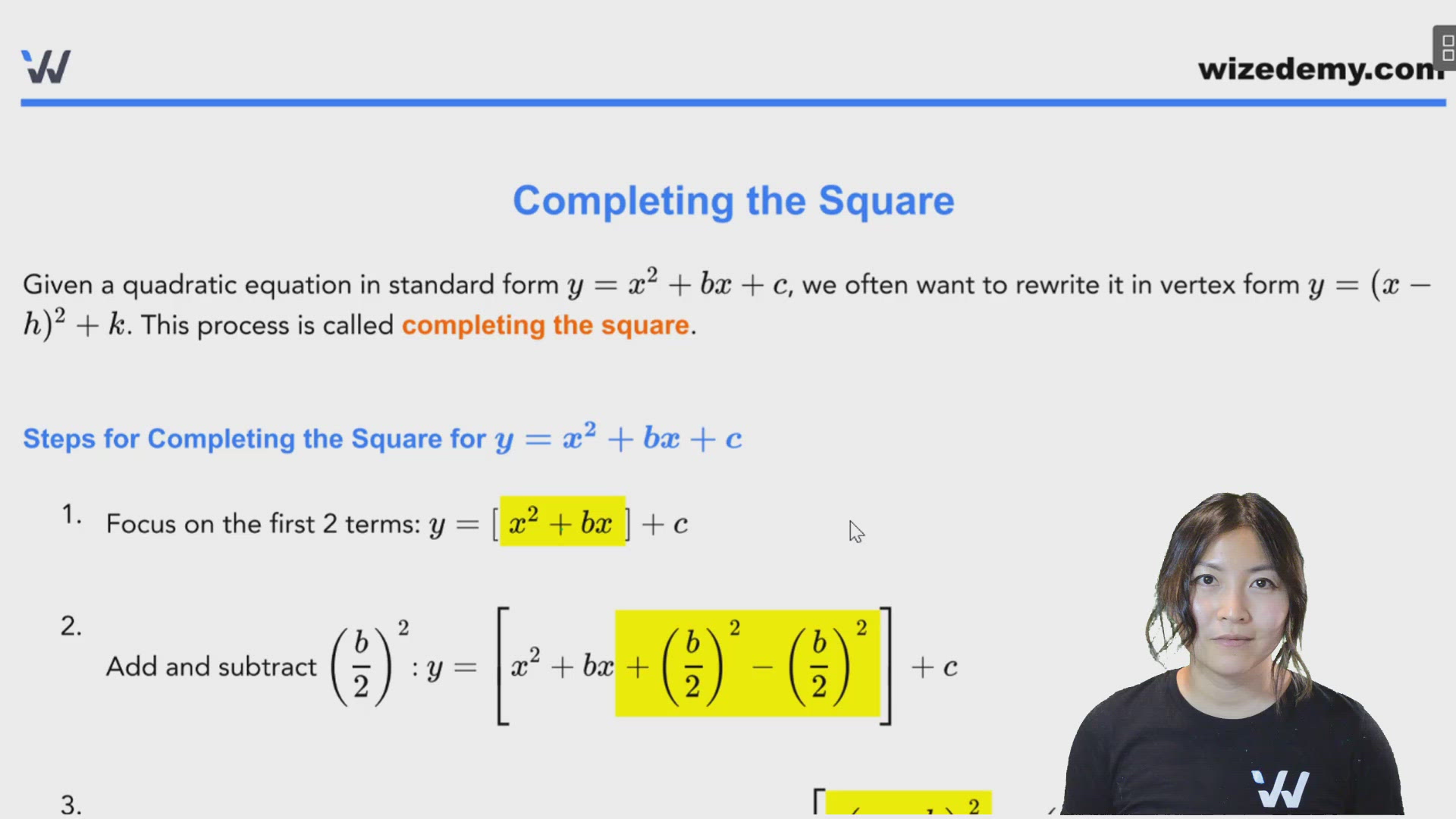
Given a quadratic equation in standard form y=x2+bx+c, we often want to rewrite it in vertex form y=(x−h)2+k. This process is called completing the square.
Steps for Completing the Square for y=x2+bx+c
- Focus on the first 2 terms: y=[x2+bx​]+c
- Add and subtract (2b​)2: y=​x2+bx+(2b​)2−(2b​)2​​+c
- Rewrite (factor) the first 3 terms as a perfect square: y=​(x+2b​)2​−(2b​)2​+c
- Simplify the constant terms: y=(x+2b​)2−(2b​)2+c​

Example: Completing the Square
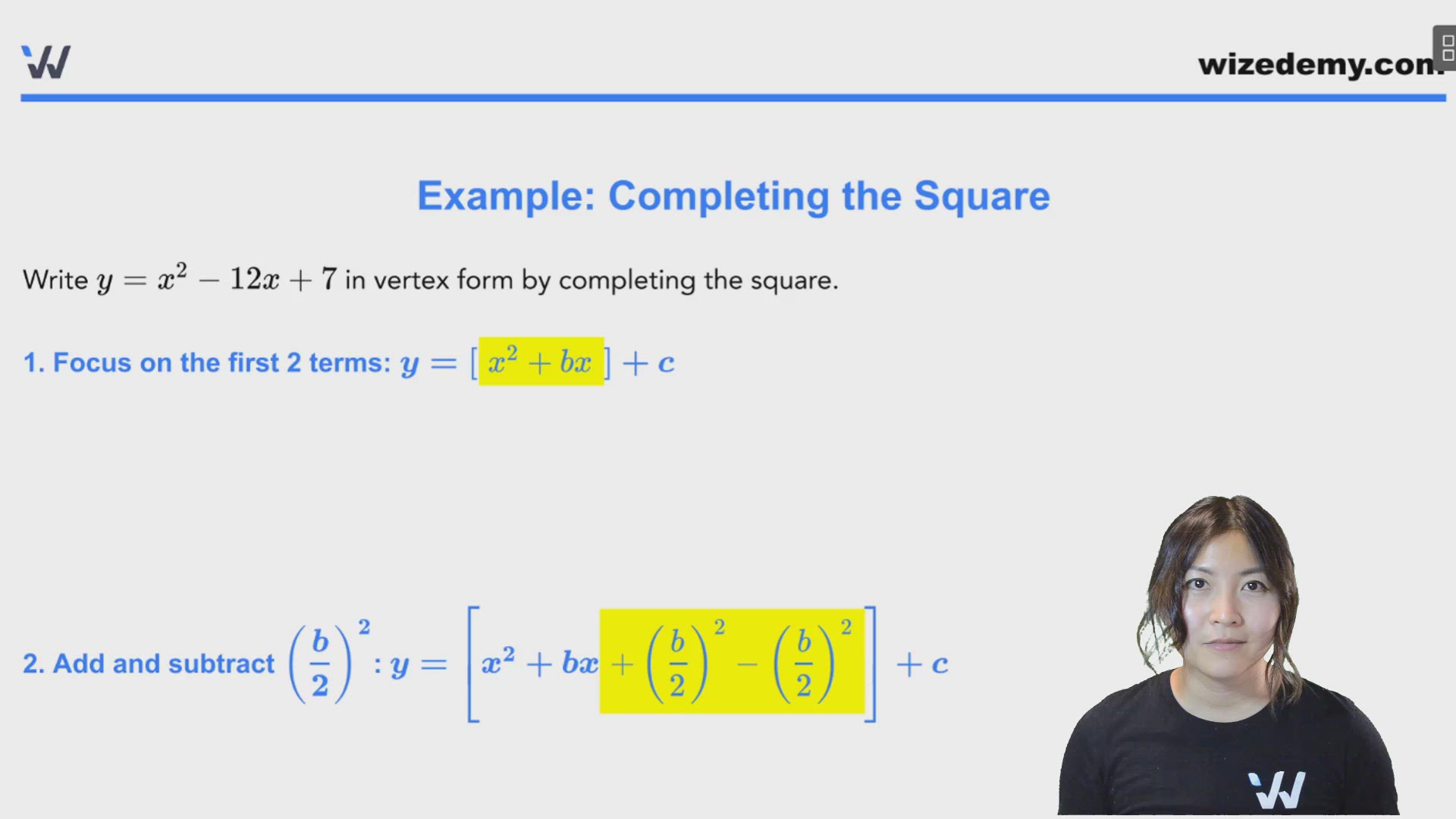
Write y=x2−12x+7 in vertex form by completing the square.
1. Focus on the first 2 terms: y=[x2+bx​]+c
y=[x2−12x]+7
2. Add and subtract (2b​)2: y=​x2+bx+(2b​)2−(2b​)2​​+c
- In our equation b=−12
- 2b​=2−12​=−6
- (2b​)2=(−6)2=36
y=[x2−12x+36−36]+7
3. Rewrite (factor) the first 3 terms as a perfect square: y=​(x+2b​)2​−(2b​)2​+c
y=[(x−6)2−36]+7
4. Simplify the constant terms: y=(x+2b​)2−(2b​)2+c​
yy​=(x−6)2−36+7=(x−6)2−29​
So, by completing the square, we get the vertex form equation y=(x−6)2−29
Practice: Completing the Square
Write y=x2−18x−11 in vertex form by completing the square. Then, graph this quadratic relation.
Practice: Completing the Square
Write y=x2−11x−6 in vertex form by completing the square. Then, determine the vertex and y-intercept of this quadratic relation.
Practice: Completing the Square
Write the following in vertex form by completing the square.
a) x2+8x
b) x2+16x−1
c) x2−6x+17
d) x2+9x+7
e) x2−21x−3