Quadratic Formula
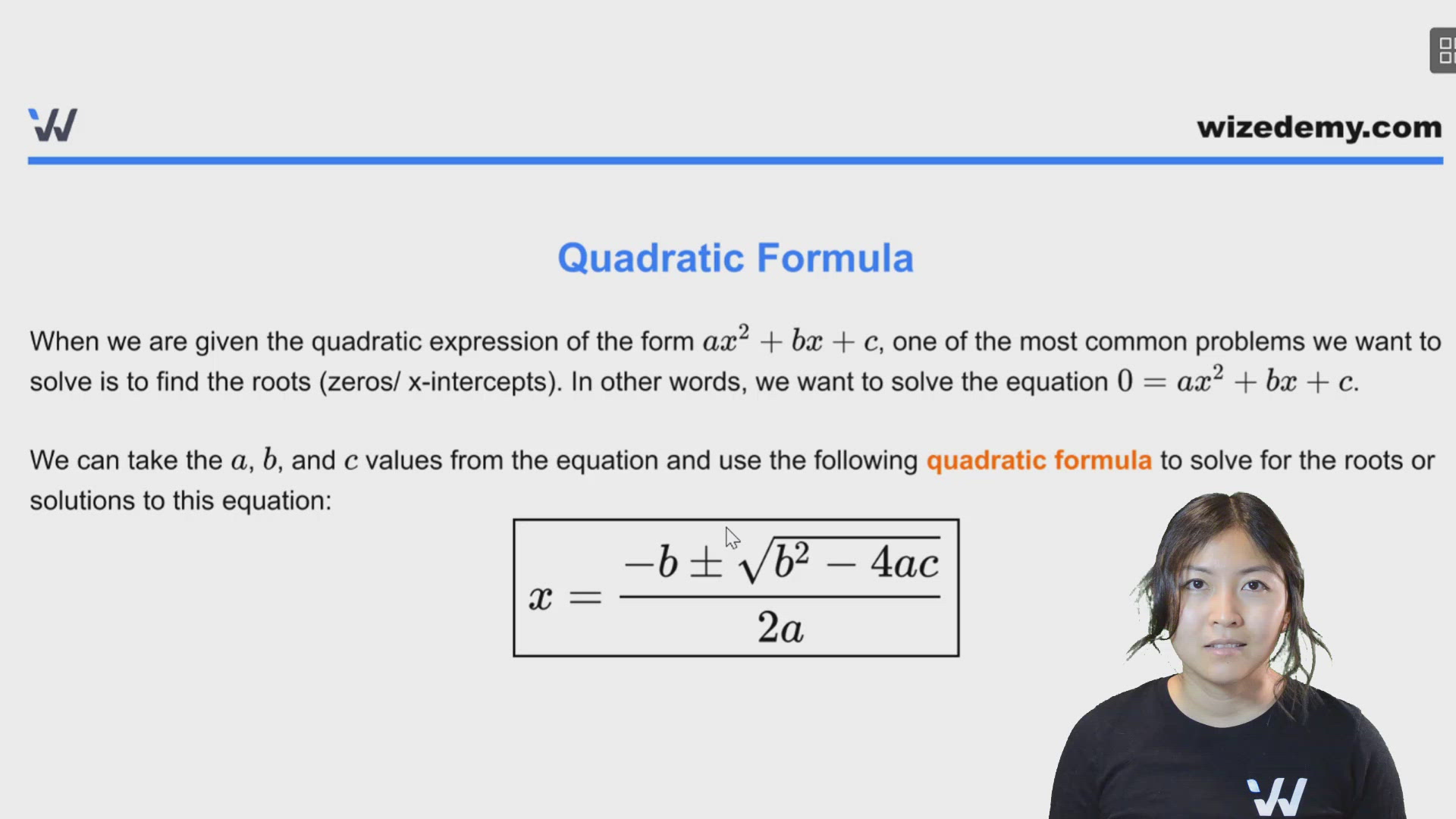
When we are given the quadratic expression of the form , one of the most common problems we want to solve is to find the roots (zeros/ x-intercepts). In other words, we want to solve the equation .
We can take the , , and values from the equation and use the following quadratic formula to solve for the roots or solutions to this equation:
How Did We Come Up With This Formula?
Recall the process for completing the square for :
- Factor out of the first 2 terms:
- Add and subtract :
- Rewrite (factor) the first 3 terms as a perfect square:
- Multiply into the brackets:
- Simplify the constant terms:
Now we can solve this equation !
Move the constant terms to the left side of the equation:
Divie both sides of the equation by :
Expand and simplify the left side of the equation until we have one fraction on the left:
Take the square root of both sides of the equation:
*We end up with both a + and - answer for the square root:
Move the constant to the left side:
So, we get the formula
Song credit: Pop Goes the Weasel. Licensed under Creative Commons: By Attribution 3.0 License: http://creativecommons.org/licenses/by/3.0/
Example: Solving Quadratic Equations Using the Quadratic Formula
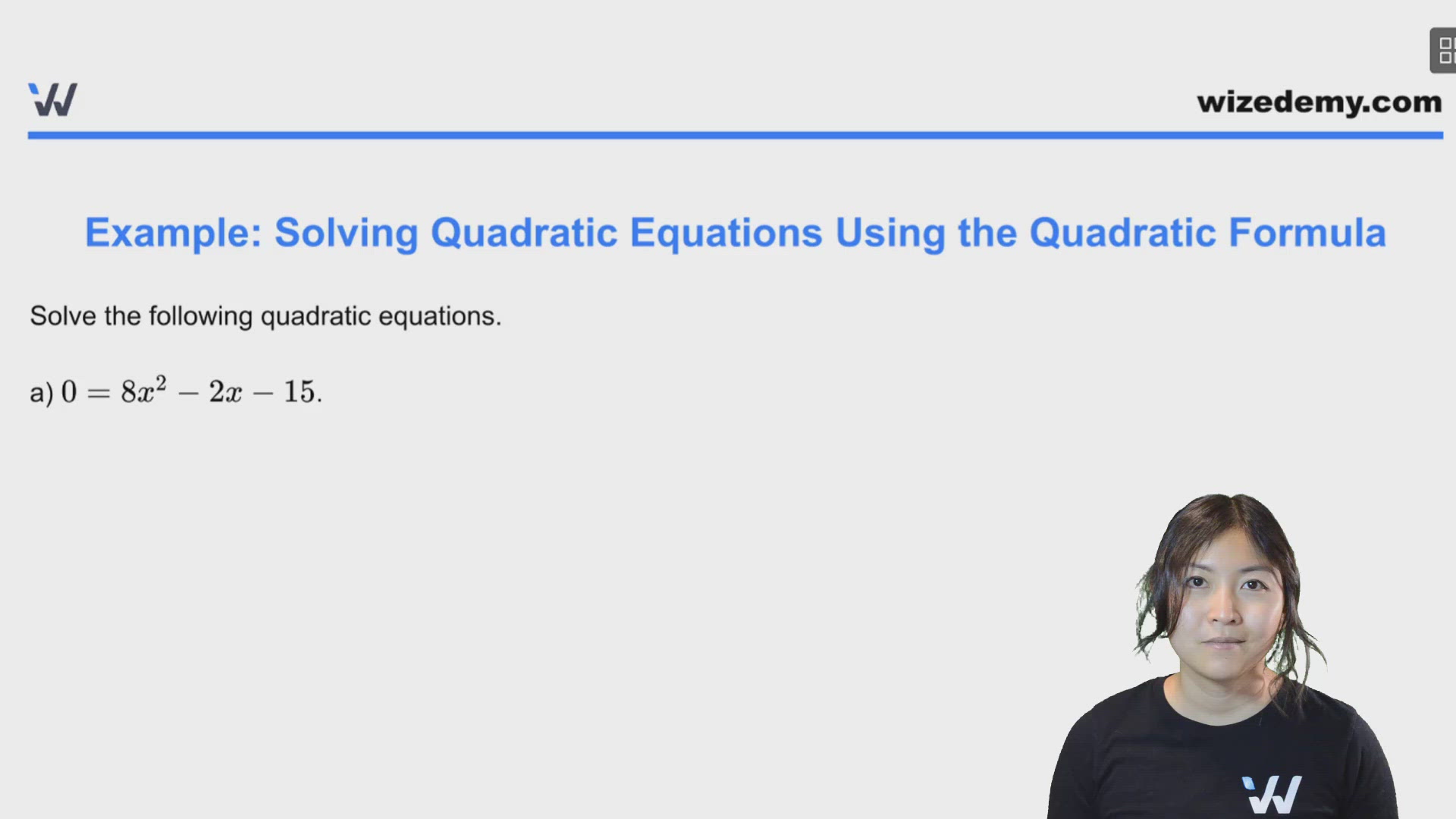
Solve the following quadratic equations.
a) .
Using the quadratic formula:
Therefore, there are two solutions to this equation and .
b) .
First rearrange so we get 0 on one side: .
Using the quadratic formula:
When we try to find the square root of a negative number with our calculator, we get undefined -- we cannot take the square root of a negative number!
Therefore, there are no solutions to this equation.