0:00 / 0:00

Binomial x Binomial

There are a few methods for multiplying two binomials together.

FOIL Method

Some teachers will teach the FOIL method.
  • F: First
  • O: Outside
  • I: Inside
  • L: Last
PAGE BREAK
Example (Foil)
Multiply the binomials (3x+1)(−2x−6)(3x+1)(-2x-6).

F:(3x⏟First+1)(−2x⏟First−6))=(3x)(−2x)   ...O:(3x⏟Outside+1)(−2x−6⏟Outside)=(3x)(−2x)+(3x)(−6)+   ...I:(3x+1⏟Inside)(−2x⏟Inside−6)=(3x)(−2x)+(3x)(−6)+(+1)(−2x)   ...L:(3x+1⏟Last)(−2x−6⏟Last)(3x)(−2x)+(3x)(−6)+(+1)(−2x)+(+1)(−6)\begin{array}{rl} F:&(\underbrace{\bct{3x}}_{\text{First}}+1)(\underbrace{\bct{-2x}}_{\text{First}}-6))\\\\ =&\bct{(3x)(-2x)}~~~...\\\\\\\\ O:&(\underbrace{\bcth{3x}}_\text{Outside}+1)(-2x\underbrace{\bcth{-6}}_\text{Outside})\\\\ =&\bct{(3x)(-2x)}+\bcth{(3x)(-6)}+~~~...\\\\\\\\ I:&(3x\underbrace{\bcf{+1}}_\text{Inside})(\underbrace{\bcf{-2x}}_\text{Inside}-6)\\\\ =&\bct{(3x)(-2x)}+\bcth{(3x)(-6)}+\bcf{(+1)(-2x)}~~~...\\\\\\\\ L:&(3x\underbrace{\bcfi{+1}}_\text{Last})(-2x\underbrace{\bcfi{-6}}_\text{Last})\\\\ &\bct{(3x)(-2x)}+\bcth{(3x)(-6)}+\bcf{(+1)(-2x)}+\bcfi{(+1)(-6)}\\\\\\ \end{array}

Finally, we simplify the answer:
(3x)(−2x)+(3x)(−6)+(+1)(−2x)+(+1)(−6)=−6x2+−18x+−2x+−6=−6x2+−20x−6\begin{array}{rccccccc} &\bct{(3x)(-2x)}&+&\bcth{(3x)(-6)}&+&\bcf{(+1)(-2x)}&+&\bcfi{(+1)(-6)}\\\\ =&\bct{-6x^2}&+&\bcth{-18x}&+&\bcf{-2x}&+&\bcfi{-6}\\\\ =&-6x^2&+&&-20x&&-6 \end{array}

So, the answer is −6x2−20x−6-6x^2-20x-6, which is a trinomial.
PAGE BREAK

Distributive Method

Instead of remembering FOIL, we can use the distributive method ("hand-shake" rule) that helps us multiply any polynomials together, not just binomials!



Distributive Method: Every term in the first bracket needs to be multiplied by every term in the second bracket.

PAGE BREAK
Example (Distributive Method)
Multiply the binomials (3x+1)(−2x−6)(3x+1)(-2x-6).

(3x  +1)(−2x −6)=(3x)(−2x)  +  (3x)(−6)  +  (+1)(−2x)+(+1)(−6)=−6x2  −18x+−2x  −6Grouping the like terms:=−6x2−20x−6\begin{array}{rccc} &(\bct{3x}~~\bcth{+1})(-2x~-6)\\\\ =&\bct{(3x)}(-2x)~~+~~\bct{(3x)}(-6)&~~+~~&\bcth{(+1)}(-2x)+\bcth{(+1)}(-6)\\\\ =&\bct{-6x^2~~-18x}&+&\bcth{-2x~~-6}\\\\ &\text{Grouping the like terms:}\\ =&-6x^2-20x-6 \end{array}
0:00 / 0:00

Multiplying Binomials Using Algebra Tiles

We can visualize how to multiply binomials by using an area model (using algebra tiles)

Example
(3x+1)(−2x−6)(3x+1)(-2x-6)


So, the answer is −6x2−2x−18x−6-6x^2-2x-18x-6, which simplifies to −6x2−20x−6-6x^2-20x-6.

0:00 / 0:00

Example: Multiplying Binomials

Expand and simplify the following

a) (−3h−2)(4h+5)\left(-3h-2\right)\left(4h+5\right)

FOIL Method

First: (−3h)(4h)=−12h2(-3h)\left(4h\right)=-12h^2
Outside: (−3h)(5)=−15h(-3h)\left(5\right)=-15h
Inside: (−2)(4h)=−8h(-2)\left(4h\right)=-8h
Last: (−2)(5)=−10(-2)\left(5\right)=-10

Write these terms in a line:
=−12h2−15h−8h−10=-12h^2-15h-8h-10

Combine like terms (simplify):
=−12h2−23h−10=-12h^2-23h-10

Distributive Method

Multiply −3h-3h from the first bracket with all temrs in the second bracket, then multiply −2-2 from the first bracket with all terms in the second bracket.

=(−3h)(4h)+(−3h)(+5)+(−2)(4h)+(−2)(+5)=−12h2−15h−8h−10=−12h2−23h−10\begin{array}{rccccccc} =&(\bct{-3h})(4h)&+&(\bct{-3h})(+5)&+&(\bcth{-2})(4h)&+&(\bcth{-2})(+5)\\\\ =&-12h^2&&-15h&&-8h&&-10\\\\ =&-12h^2&&&-23h&&&-10 \end{array}

Using either method, we see that this simplifies to −12h2−23h−10\boxed{-12h^2-23h-10}.

PAGE BREAK
b) y=3(x−1)2+4y=3\left(x-1\right)^2+4

First rewrite this:
y=3(x−1)(x−1)+4y=3\left(x-1\right)\left(x-1\right)+4

Use either the FOIL or distributive method to expand the brackets:
y=3(x2−x−x+1)+4y=3\left(x^2-x-x+1\right)+4
y=3(x2−2x+1)+4y=3\left(x^2-2x+1\right)+4

Then multiply the 33 in and simplify.
y=3x2−6x+3+4y=3x^2-6x+3+4
y=3x2−6x+7\boxed{y=3x^2-6x+7}

Practice: Multiplying Binomials

Expand and simplify the following:

a) (3x+5)(7x−3)\left(3x+5\right)\left(7x-3\right).

b) (3x−1)2(3x-1)^2

Practice: Multiplying Binomials

Here's a blueprint of a patio that Mariel wants to build.
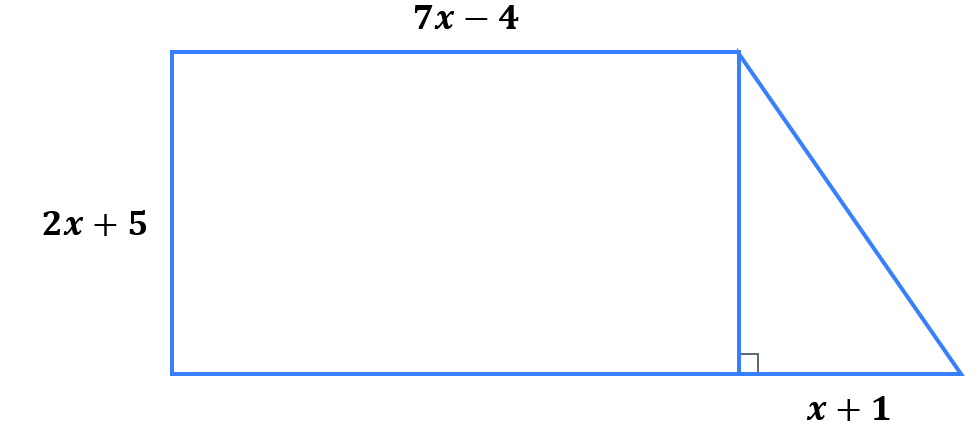

a) Writen an expression represending the area of the patio.

b) If x=2 ftx=2~\text{ft}, determine the total area of the patio.

Practice: Multiplying Binomials

Fill in the blanks.

a) (3x+1)(2x+(3x+1)(2x+
)) =6x2+15x+2x+5=6x^2+15x+2x+5


b) (−2x+3)(3x+(-2x+3)(3x+
)) =−6x2+2x+9x−3=-6x^2+2x+9x-3


c) ((
+3)(−3x−5)+3)(-3x-5)=12x2+11x−15=12x^2+11x-15


d) (−x+(-x+
))(2x−5)(2x-5)=−2x2+11x+=-2x^2+11x+