Wize High School Grade 10 Math Textbook > Expanding Polynomials
Binomial Binomial
Popular Courses
Grade 10 Math
Canada High School
Algebra I
US High School
DAT
General Course
Grade 10 Principles of Mathematics
Ontario High School
Math 10C
Alberta High School
Foundations of Math and Pre-Calculus 10
British Columbia High School
QMS 110
Toronto Metropolitan University
Grade 10 Foundations of Mathematics
Ontario High School
MA129
Wilfrid Laurier University
MATH 0098
Baton Rouge Community College
0:00 / 0:00
Binomial x Binomial
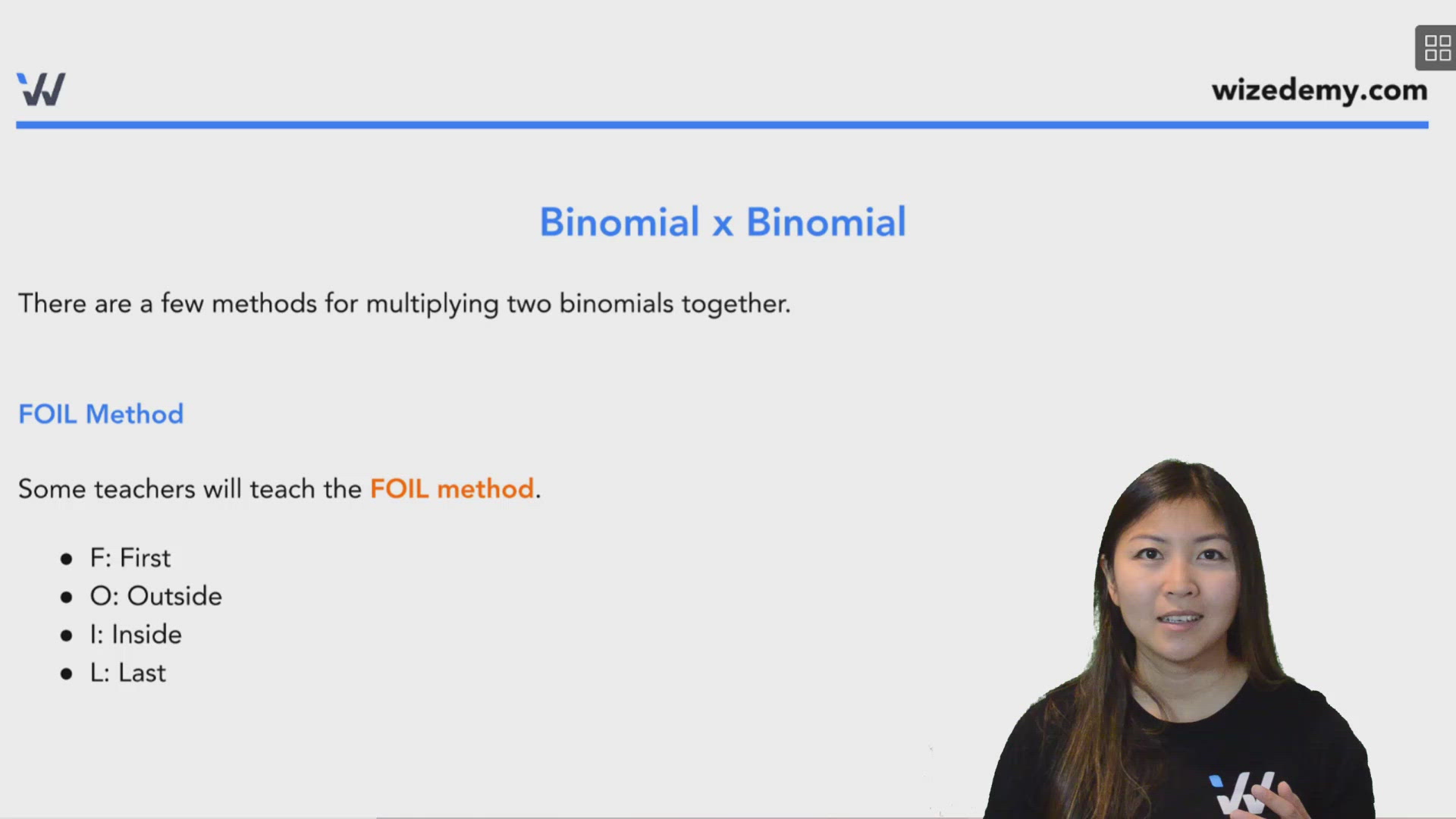
There are a few methods for multiplying two binomials together.
FOIL Method
Some teachers will teach the FOIL method.
- F: First
- O: Outside
- I: Inside
- L: Last
Example (Foil)
Multiply the binomials .
Finally, we simplify the answer:
So, the answer is , which is a trinomial.
Distributive Method
Instead of remembering FOIL, we can use the distributive method ("hand-shake" rule) that helps us multiply any polynomials together, not just binomials!

Distributive Method: Every term in the first bracket needs to be multiplied by every term in the second bracket.
Example (Distributive Method)
Multiply the binomials .

0:00 / 0:00
Multiplying Binomials Using Algebra Tiles
We can visualize how to multiply binomials by using an area model (using algebra tiles)
Example

So, the answer is , which simplifies to .

0:00 / 0:00
Example: Multiplying Binomials
Expand and simplify the following
a)
FOIL Method
First:
Outside:
Inside:
Last:
Write these terms in a line:
Combine like terms (simplify):
Distributive Method
Multiply from the first bracket with all temrs in the second bracket, then multiply from the first bracket with all terms in the second bracket.
Using either method, we see that this simplifies to .
b)
First rewrite this:
Use either the FOIL or distributive method to expand the brackets:
Then multiply the in and simplify.
Practice: Multiplying Binomials
Expand and simplify the following:
a) .
b)
Practice: Multiplying Binomials
Here's a blueprint of a patio that Mariel wants to build.
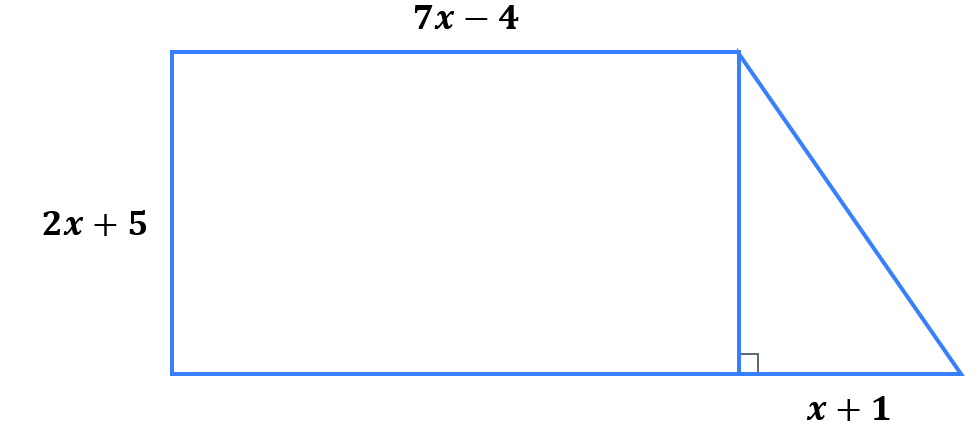
a) Writen an expression represending the area of the patio.
b) If , determine the total area of the patio.
Practice: Multiplying Binomials
Fill in the blanks.
a)
b)
c)
d)