Perfect Squares

So far, we've practiced multiplying two binomials together to get a trinomial.


What happens when we are multiplying two identical binomials together?

We get a special product of binomials, called a perfect square.
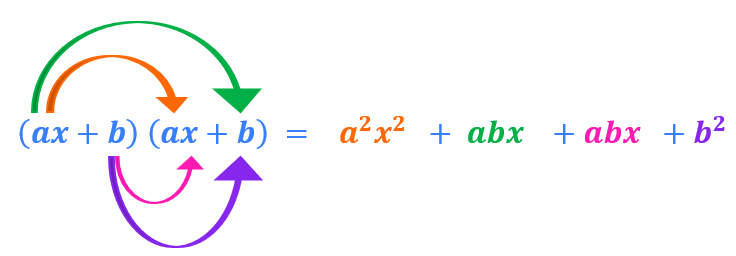
Notice that the first term axax gets squared, the second term bb also gets squared, and we end up with 2 copies of ax×bax\times b.

Try simplifying this expression:
(ax+b)(ax+b)=(ax)2+2(abx)+(b)2\large{\bm{(\colorFour{ax}+\colorFive{b})(\colorFour{ax}+\colorFive{b})=\colorFour{(ax)^2} +2\colorOne{(abx)}+\colorFive{(b)^2}}}


Write it Down
In general, when we multiply two identical binomials, we get the following perfect squares:
(a+b)2  =    a2 + 2ab + b2\large\bm{(\colorFour{a}\colorbox{yellow}{$+$}\colorFive{b})^2~~=~~~~\colorFour{a^2}~\colorbox{yellow}{$+$}~2\colorFour{a}\colorFive{b}~\colorbox{aqua}{$+$}~\colorFive{b^2}}

(ab)2  =    a2  2ab + b2\large\bm{(\colorFour{a}\colorbox{yellow}{$-$}\colorFive{b})^2~~=~~~~\colorFour{a^2}~\colorbox{yellow}{$-$}~2\colorFour{a}\colorFive{b}~\colorbox{aqua}{$+$}~\colorFive{b^2}}

Now we can use these formulas as a short-cut to expanding perfect squares!

Examples
a) Expand and simplify (x+5)2(x+5)^2

(x+5)2=(x)2 + 2(x)(5) + (5)2=x2   +    10x    + 25\begin{array}{rcl} (x+5)^2&=&(x)^2~+~2(x)(5)~+~(5)^2\\[1em] &=&\boxed{x^2~~~+~~~~10x~~~~+~25} \end{array}

b) Expand and simplify (3x2)2(3x-2)^2

(3x2)2=(3x)2  2(3x)(2) + (2)2=9x2       12x      + 4\begin{array}{rcl} (3x-2)^2&=&(3x)^2~-~2(3x)(2)~+~(2)^2\\[1em] &=&\boxed{9x^2~~~-~~~~12x~~~~~~+~4} \end{array}

c) Expand and simplify (2x7y)2(-2x-7y)^2

(2x7y)2=(2x)2  2(2x)(7y) + (7y)2=4x2      +      28xy       + 49y2\begin{array}{rcl} (-2x-7y)^2&=&(-2x)^2~-~2(-2x)(7y)~+~(7y)^2\\[1em] &=&\boxed{4x^2~~~~~~+~~~~~~28xy~~~~~~~+~49y^2} \end{array}

Practice: Perfect Squares

Expand and simplify the following:

a) (2x+9)2(2x+9)^2

b) (5x4)2(5x-4)^2

c) (4x7y)2(-4x-7y)^2

Sum & Difference Pattern (Difference of Squares)

There is another kind of special product of binomials:
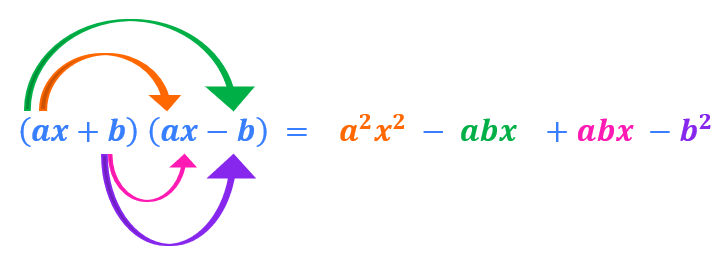

Notice that the first term axax gets squared, then we have two copies of abxabx that will cancel each other out, and finally we have a copy of b2-b^2.

Try simplifying this expression:
(ax+b)(axb)=(ax)2(b)2\large{\bm{(\colorFour{ax}+\colorFive{b})(\colorFour{ax}-\colorFive{b})=\colorFour{(ax)^2} -\colorFive{(b)^2}}}
This special expression is called a difference of squares.


Write it Down
In general, when we multiply a sum and a difference of two terms, we get the following perfect square:

(a+b)(ab)=a2b2\large\bm{(\colorFour{a}+\colorFive{b})(\colorFour{a}-\colorFive{b})=\colorFour{a^2}\colorbox{yellow}{$-$}\colorFive{b^2}}
Now we can use this formulas as a short-cut to expanding a sum and difference of two terms!

Examples
a) Expand and simplify (x+2)(x2)(x+2)(x-2)

(x+2)(x2)=(x)2  (2)2=x2     4\begin{array}{rcl} (x+2)(x-2)&=&(x)^2~-~(2)^2\\[1em] &=&\boxed{x^2~~~-~~4} \end{array}

b) Expand and simplify (3x7)(3x+7)(3x-7)(3x+7)

(3x7)(3x+7)=(3x)2  (7)2=9x2     49\begin{array}{rcl} (3x-7)(3x+7)&=&(3x)^2~-~(7)^2\\[1em] &=&\boxed{9x^2~~~-~~49} \end{array}

a) Expand and simplify (3x+4y)(3x4y)(-3x+4y)(-3x-4y)

(3x+4y)(3x4y)=(3x)2  (4y)2=9x2        16y2\begin{array}{rcl} (-3x+4y)(-3x-4y)&=&(-3x)^2~-~(4y)^2\\[1em] &=&\boxed{9x^2~~~~~~-~~16y^2} \end{array}

Practice: Sum & Difference Pattern (Difference of Squares)

Expand and simplify the following:

a) (4x1)(4x+1)(4x-1)(4x+1)

b) (3x7)(3x+7)(-3x-7)(-3x+7)

c) (10x3y)(10x+3y)(10x-3y)(10x+3y)