0:00 / 0:00

Investigating Rational Exponents

So far, we've worked with integer exponents. What happens when our exponent is a rational number (fraction or decimal)?

Investigate Exponents of the form 1m\bco {\frac{1}{m}}

1a. How can we use our exponent rules to evaluate 41/2×41/24^{1/2}\times4^{1/2}?

412×412Multiplying powers of the same base=412+12=41\begin{array}{cl} &\large 4^{\colorTwo{\frac{1}{2}}}\times4^{\colorTwo{\frac{1}{2}}}&\text{Multiplying powers of the same base}\\[1em] =&\large 4^{\colorTwo{\frac{1}{2}+\frac{1}{2}}}\\[1em] =&\large4^{\colorTwo{1}} \end{array}

1b. What does this tell us about the value of 41/24^{1/2}?

We know that 41/2×41/2=44^{1/2}\times4^{1/2}=4.

That means 41/24^{1/2} is a number such that when it is multiplied by itself, it gives us 44 ➡ this is the same meaning as square roots!

Therefore, 41/2=44^{1/2}=\sqrt{4}.


2. Using the following equations, find the meaning of b1/2b^{1/2}, b1/3b^{1/3}, and b1/4b^{1/4}.

b1/2×b1/2=b1b^{1/2}\times b^{1/2}=b^1
This means that b1/2b^{1/2} is the square root of bb.
b1/2=b\large\boxed{b^{1/2}=\sqrt{b}}


b1/3×b1/3×b1/3=b1b^{1/3}\times b^{1/3}\times b^{1/3}=b^1
This means that b1/3b^{1/3} is the cube root of bb.
b1/3=bb\large\boxed{b^{1/3}=\sqrt[b]{b}}


b1/4×b1/4×b1/4×b1/4=b1b^{1/4}\times b^{1/4}\times b^{1/4}\times b^{1/4}=b^1
This means that b1/4b^{1/4} is the fourth root of bb.
b1/4=b4\large\boxed{b^{1/4}=\sqrt[4]{b}}

PAGE BREAK

Investigating Exponents of the form nm\bco{\frac{n}{m}}

Using the power of a power exponent rule, we see that bn/m=(b1/m)n\large\bm{ \colorTwo b^{\colorFive n/\colorThree m}=\left(\colorTwo b^{1/\colorThree m}\right)^{\colorFive{n}}}.

Can you rewrite this as a radical (root)?

bn/m=bnm  or  (bm)n\large\bm{ \colorTwo b^{\colorFive n/\colorThree m}=\sqrt[\colorThree m]{\colorTwo b^{\colorFive n}}~~\text{or}~~\left(\sqrt[\colorThree m]{\colorTwo b}\right)^{\colorFive n}}
Note: We can evaluate the exponent of n first, then evaluate the mth root OR we can evaluate the mth root first, then the exponent of n.
0:00 / 0:00

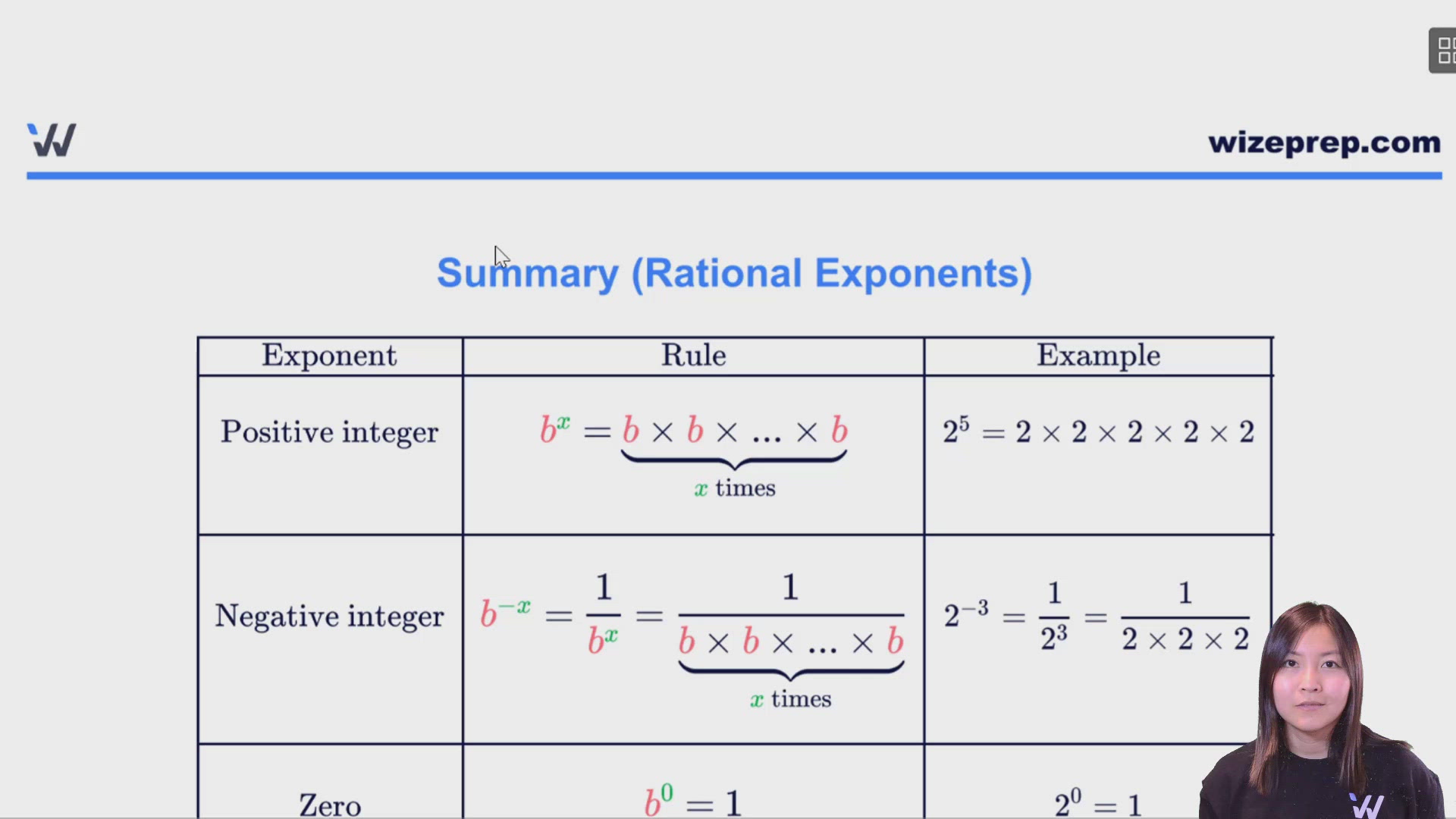
Summary (Rational Exponents)

ExponentRuleExamplePositive integerbx=b×b×...×bx times25=2×2×2×2×2Negative integerbx=1bx=1b×b×...×bx times23=123=12×2×2Zerob0=120=11mb1/m=bm21/3=23nmbn/m=bnm  or  bmn23/5=235  or  253\begin{array}{|c|c|c|} \hline \text{Exponent}&\text{Rule}&\text{Example}\\ \hline\\ \text{Positive integer}& \large{\colorTwo b^{\colorThree x}}=\underbrace{\colorTwo b\times \colorTwo b\times...\times \colorTwo b}_{\colorThree x~\text{times}}& 2^5=2\times2\times2\times2\times2\\\\ \hline\\ \text{Negative integer}& \large{\colorTwo b^{\colorThree {-x}}}=\dfrac{1}{\colorTwo b^{\colorThree x}}=\dfrac{1}{\underbrace{\colorTwo b\times \colorTwo b\times...\times \colorTwo b}_{\colorThree x~\text{times}}}& 2^{-3}=\dfrac{1}{2^3}=\dfrac{1}{2\times2\times2}\\\\ \hline\\ \text{Zero}& \large{\colorTwo b^{\colorThree 0}}=1& 2^0=1\\\\ \hline\\ \dfrac{1}{m}& \large{\colorTwo b^{\colorThree {1/m}}}=\sqrt[\colorThree m]{\colorTwo b}& 2^{1/3}=\sqrt[3]{2}\\\\ \hline\\ \dfrac{n}{m}& \large{\colorTwo b^{\colorFive{n}/\colorThree{m}}}=\sqrt[{\colorThree m}]{\colorTwo {b}^{\colorFive{n}}}~~\text{or}~~\sqrt[{\colorThree m}]{\colorTwo {b}}^{\colorFive{n}}& 2^{3/5}=\sqrt[5]{2^3}~~\text{or}~~\sqrt[5]{2}^3\\\\ \hline \end{array}

Practice: Rational Exponents

Write the following in radical form, then simplify without a calculator.


a) 641/364^{1/3}

b) (25)1/2-(25)^{1/2}

c) (32)0.2(-32)^{0.2}

Practice: Rational Exponents

Simplify the following expressions.

a) 810.751281/781^{0.75}-128^{1/7}

b) 98×99.5(96)0.75\dfrac{9^{-8}\times9^{9.5}}{(9^6)^{-0.75}}

Practice: Rational Exponents

Simplify the expression 184(94)26\dfrac{\sqrt[4]{18}\left(\sqrt[4]{9}\right)^2}{\sqrt{6}}.