Wize High School Algebra I Textbook (Common Core) > Foundations of Algebra
📝Review: Ratios, Rates, and Proportions

0:00 / 0:00
The Vitruvian Man Activity
In this activity, you will measure various body parts and try to find commonality between you and 2 other friends/family members.
If you want to go straight into learning about ratios, rates, and proportions, feel free to skip over this section and check out the lesson after this activity.
Activity Instructions
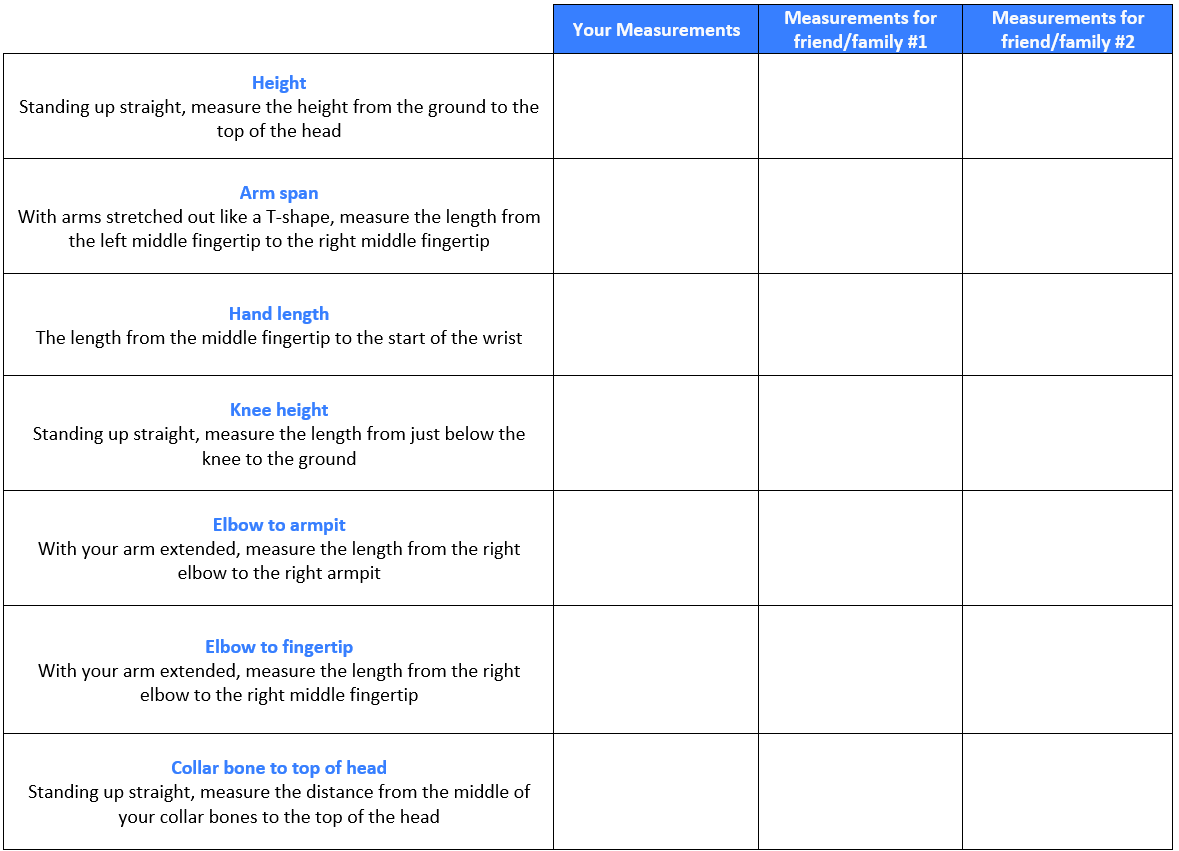
For this activity, you will need a measuring tape (yarn or rope and a ruler will work as well), and two other friends or family members. Perform the following measurements and record them in a table like this:
Reflection
- List anything you noticed from this activity.
Your answer can really be anything! It can be something related to a math concept you learned, or it can even be something like "using a measuring tape is hard!" or "I prefer to measure in centimeters (cm) than inches (")"
- Using only the measurements for your body, try to come up with a few different ratios that you are interested in exploring.
You can come up with many different ratios. Here are just a few suggestions:
- height : arm span
- height : hand length
- arm span : knee height
- elbow to armpit : height
- elbow to fingertip : hand length
- collar bone to top of head : arm span
- ... there are many more possible ratios!
- Using the other two sets of measurements (for your other two friends or family members), come up with the same ratios you created in question 2 above.
- Did you notice any patterns in these ratios?
The Vitruvian Man
The Vitruvian Man is a drawing created by Leonardo Da Vinci. Using geometry (circles, lines, length, etc.), Leonardo discovered that most human bodies exhibit the same ratios when the length of different body parts are measured.
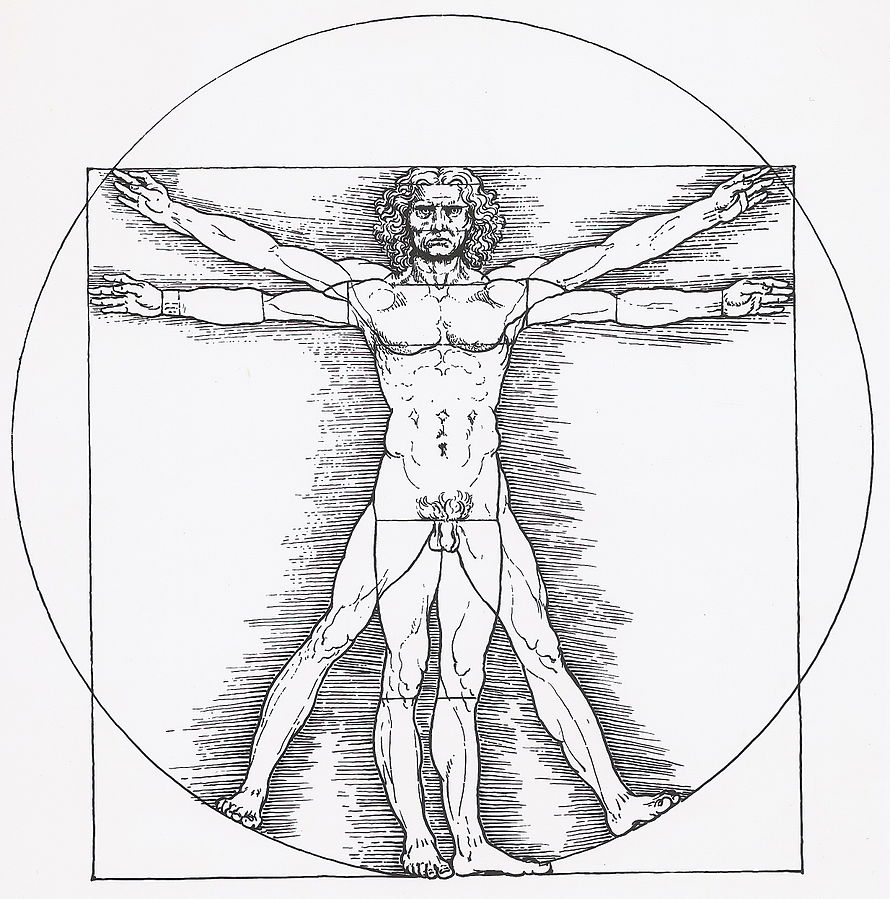
Although not all bodies are the same, if you measure the body parts of several different people, here are some common ratios you will get on average:
Using these ratios, you can come up with other common ratios as well!
0:00 / 0:00
Intro to Ratios, Rates, & Proportions
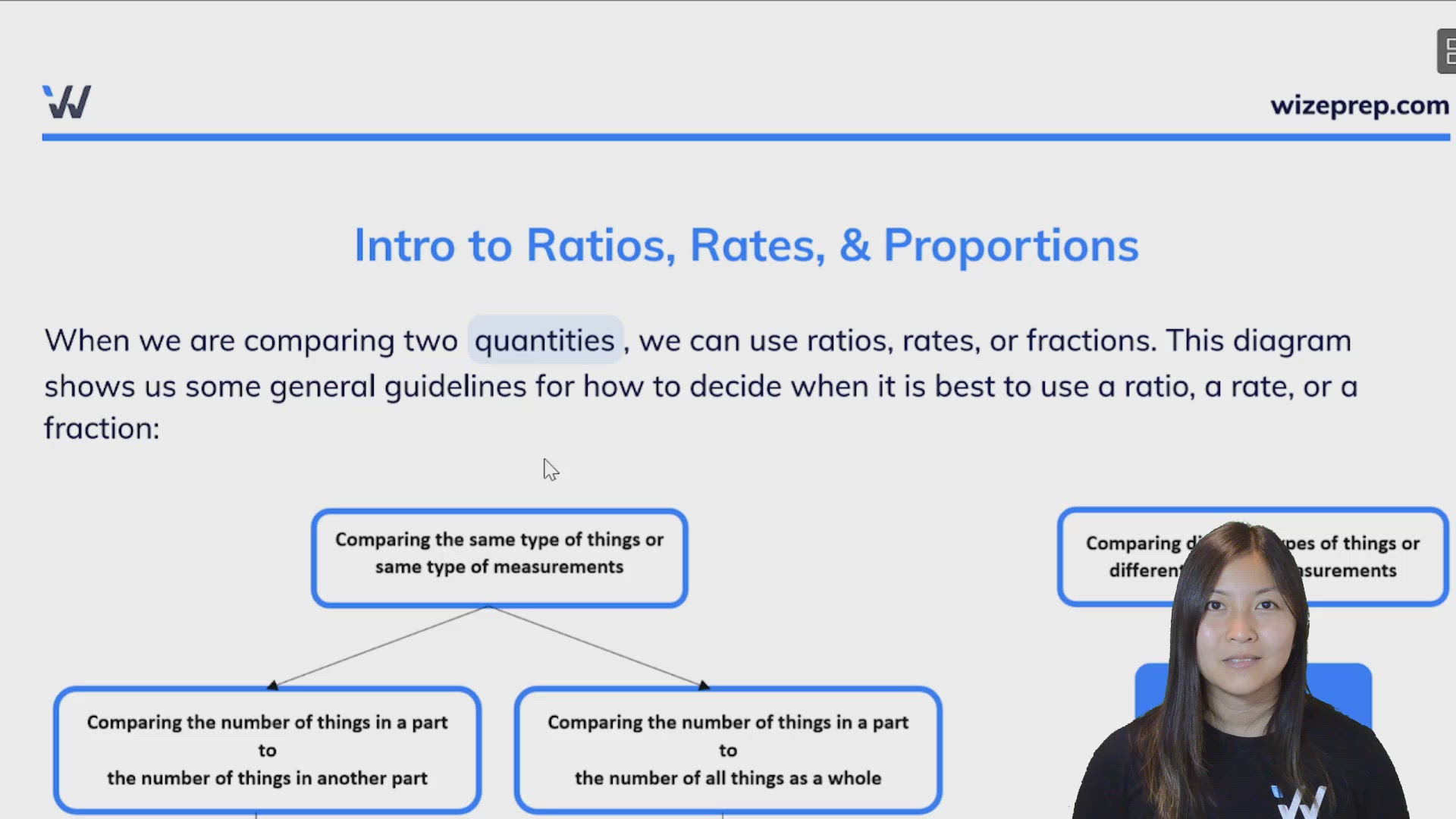
When we are comparing two quantities, we can use ratios, rates, or fractions. This diagram shows us some general guidelines for how to decide when it is best to use a ratio, a rate, or a fraction:

Note: You can use a ratio, a fraction, and a rate interchangeably.
Proportions are used to show that two ratios, fractions, or rates are the same.

0:00 / 0:00
Ratios & Fractions
Ratios and Fractions are usually used to compare the same type of things or same type of measurements.
Ratios
A ratio tells us how much of one thing there is compared to another thing.
For example, in the picture below, there are 5 apples 🍎 to 3 bananas 🍌

We read the ratio of apples to bananas as and we can write it as .
Watch Out!
The order of the numbers in a ratio matters! If we are talking about an apples to bananas ratio, then the first number must represent apples, the second number must represent bananas.
Working with Ratios
Similar to fractions, we can scale a ratio by multiplying or dividing both numbers in the ratio by the same amount. If two ratios are just multiples of one another, we say that they are the same or "in proportion"
For example
We can scale down the ratio 2 : 4 by halving it, which becomes 1 :
2
(this is reduced to simplest form)We can scale up the ratio 2 : 4 by tripling it, which becomes
6
: 12 (not reduced to simplest form)We say that , these ratios are in proportion.

Example
When cooking rice, the rice to water ratio is 1 : 2 (in simplest form). This means that
But you can also cook 10 times that amount for a big family (you will need a really big pot!)
Or, you can cook a tiny bit of rice for your pet mouse:
Fractions
A fraction is also a ratio, but it is most commonly used to tell us how much of one thing there is compared to how much of everything there is. It allows us to "compare the part to the whole".
For example, in the picture below there are 5 apples 🍎 out of 8 total fruits 🍎🍌.

We read the fraction as and we can write it as .
Wize Tip
You can also use ratios to compare the part to the whole!
For example, if there are 7 dogs and 10 cats in a park, then
- the ratio of dogs to cats is 7 : 10 , which we can also write as 7/10
- the ratio of dogs to pets is 7 : 17 , which we can also write as 7/17
Negative Ratios and Fractions
Since ratios can also be written as fractions, when do you think a ratio will be negative?
A fraction is negative when either of the following happens:
- the numerator is negative and denominator is positive OR
- the numerator is positive and denominator is negative
Since we can also write a ratio as a fraction, where the first number becomes the numerator and the second number becomes the denominator, we know that a ratio will be negative when one of the numbers in the ratio is negative while the other one is positive.
Example of negative ratios
Kathy is cleaning out her closet and decides that for every 2 t-shirts she donates, she will buy 1 pair of new shoes. Then the ratio of t-shirts to shoes is
-2 : 1
.Notice that the number in the t-shirt spot is negative, because she needs to get rid of 2 t-shirts to gain 1 pair of shoes.
0:00 / 0:00
Rates
A rate is also a ratio, but it is most commonly used to compare different types of things or different types of measurements.
Examples
- Comparing the distance traveled and the time it took to travel
- Comparing the amount of money made and the time it took to make that money
- Comparing the volume of water needed and the number of people there are
To write out a rate, we simply divide one quantity by another.
For example

If you can run 2 km every 10 minutes, then your running rate (or speed) is and we read this as .
We can also change the units and get the following rates that all mean the same thing:
- 12km / hour
- 6000m / 30 minutes
- 0.2km / minute
- ...
Unit Rates
It's usually easiest to work with unit rates, which shows how much of something there is per 1 unit of something else.
For example
If you know that a bag of 20 apples costs $30, how much will 7 apples cost?
Let's first find the rate of money per apples:
$30 / 20 apples
Let's divide these numbers out like a fraction:
Now we have the unit rate:
$1.5 / apple
Therefore, 7 apples will cost
Tips for Converting Units Within a Rate
If you want to change the units in a rate, treat the rate as a fraction, then use a fraction multiplication trick to convert the units:
- If the rate has units and you want to convert it to , multiply by .
- If the rate has units and you want to convert it to , multiply by .
For example
Convert 365 days/year into hours/month.
Let's first convert the year to month:
Then, convert the days to hours:
Negative Rates
Can a rate be negative?
Yes! When one of the quantities we are comparing is negative, we will have a negative rate.
For example
You decide to sell cookies at a school bake-sale. Your cookies are priced at 2 for $1, but it actually cost you $2 to make 2 cookies because you accidentally used super special flour that costs a lot of money. What is your profit rate per cookie sold?
Remember, . So, your profit for every 2 cookies is .
Therefore, you profit rate per 2 cookies sold is -$1 / 2 cookies.
Rewriting this as a unit rate, we get -$0.5 / cookie.
0:00 / 0:00
Example: Ratios & Rates
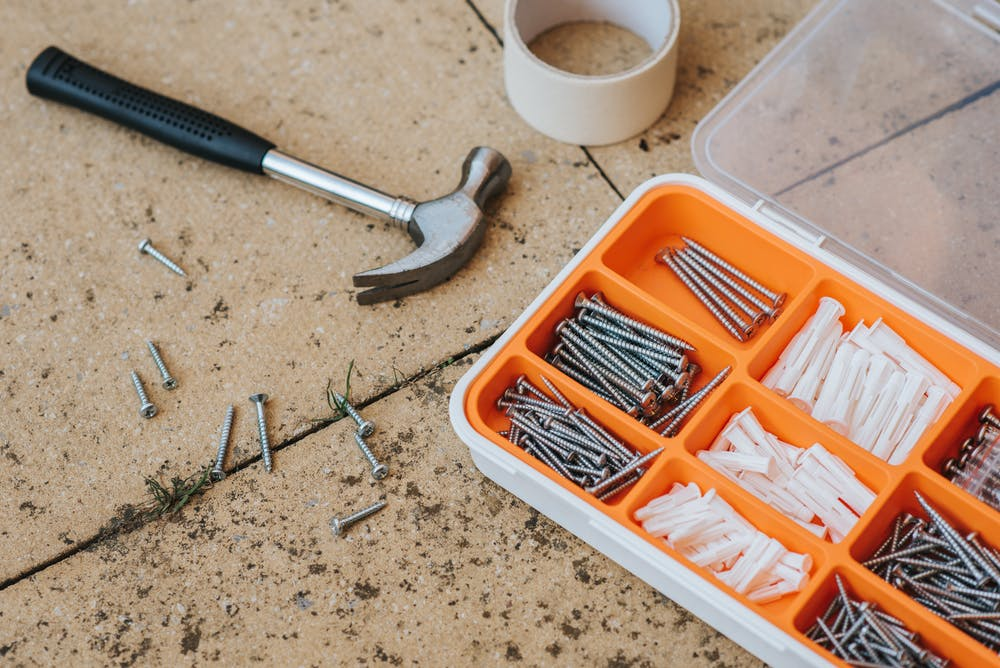
Angie is putting up 8 feet tall drywall panels for her home, she noticed that for every 4 feet length of drywall, she needed 10 nails and 8 feet of drywall tape.
a) Write the ratio of the length of drywall (in feet) to the length of drywall tape (in feet) to the number of nails. Reduce this ratio into simplest form.
The ratio is
Reducing to lowest terms by dividing all numbers by 2
b) If Angie only has 314 nails, how many feet of drywall can she hang?
The ratio 2 : 4 : 5 is already in simplest form, so we must use nails in multiples of 5.
Since , we know that out of the 314 nails, we can only use 310 of them (a multiple of 5), specifically, we will group them into 62 groups:
So, using 310 of the 314 nails, Angie will be able to hand 124 feet of drywall.
c) The cost of the material is listed below:
- 4 feet of drywall costs $15
- The drywall tape costs $10 per 200 feet
- A box of nails costs $52.50 and contains 3500 nails
Convert each cost into a rate.
Since we can also scale each rate, there are many possible answers:
Drywall
- Often, stores will sell drywall as premade sheets that are 4 feet in length, so the per-sheet rate is $15/sheet
- We can also divide $15 by 4 to get the per-foot unit rate of $3.75/ft
- Since our ratio in simplest form uses 2 feet of drywall, we can also divide $15 by 4 to get the per-2-feet rate of $7.50/2 feet
Drywall tape
- If 200 feet of drywall tape is sold as a roll, then the cost per roll is $10/roll
- We can also divide $10 by 200 to get the per-foot unit rate of $0.05/ft
Nails
- If the 3500 nails is sold as a box, then the cost per box is $52.50/box
- We can also divide $52.50 by 3500 to get a per-nail unit rate of $0.015/nail
d) Based on the rates calculated, how much will it cost Angie to hang 124 feet of drywall (length from part b)? Assume that she can purchase materials per unit and doesn't have to buy them in boxes or bundles.
From part b), we found this ratio:
Now, we can calculate the cost for each material:
- Drywall:
- Drywall tape:
- Nail:
Therefore, it will cost Angie a total of .
Practice: Ratios & Rates
Match the following ratios and rates to the appropriate scenario.
A.
$25/hour
B.
1 : 4
C.
4 : 2
For every table in the cafeteria, there are 4 chairs.
You get paid $50 for 2 hours of work
To bake a cake, you need 4 cups of flour for every 2 cups of sugar
Practice: Currency Exchange
Josh wants to convert some money in CAD (Canadian dollars) to USD (US dollars). He searches for the most up-to-date currency exchange rate on Google and sees the following:
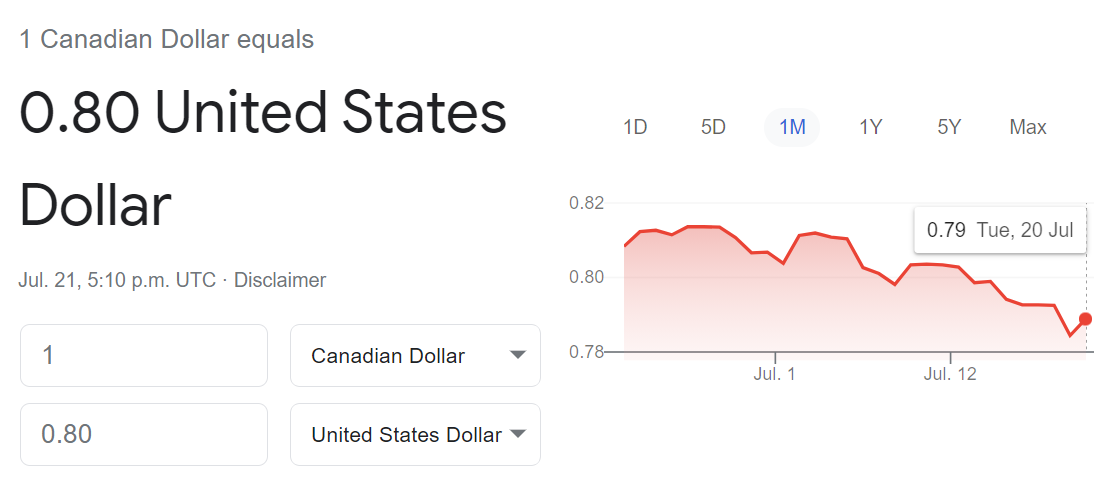
Select all answer options that represent the ratio of CAD to USD
Practice: Recipe Ratios
Here's a basic playdough recipe:
- 1 cup flour
- 1 cup water
- 1/3 cup salt
- 1 tablespoon vegetable oil

Select all answers that represent the ratio of cups of water to cups of salt.
Practice: Rates & Wages
Chris worked 35 hours last week and made $840. Nate worked 40 hours last week and made $900.
If Chris and Nate both work 30 hours this week, what is their combined pay (in dollars)?
Practice: Rates and Waste
It was found that the rate at which Canadians create garbage is 31 million tonnes/year.
Use the internet to find the population of Canada (round to the nearest million), then calculate the following rates.
a) the rate at which each person in Canada creates garbage (in kg) per day.
b) the rate at which an average family of four members in Canada creates garbage (in g) per minute.