Wize High School Grade 12 Pre-Calculus Textbook > Radical Functions
Solving Radical Equations
Popular Courses
Grade 12 Pre-Calculus/Functions
Canada High School
Math 30-1
Alberta High School
Pre-Calculus 12
British Columbia High School
MATH 206
Concordia University
MATH 22
Pennsylvania State University
MAC 1140
University of Florida
MAC 1105
Florida State University
MAT 012
University of California - Davis
MTH 103A
Michigan State University
MAC 1147
University of Florida
MATH 140
San Diego State University
MAC 1140C
University of Central Florida
MA 15800
Purdue University
MATH 102
California State University - Northridge
M 305G
The University of Texas at Austin
MATH 1019
University of Cincinnati
MATH 1022
Temple University
MA 107
North Carolina State University
MATH 1021
University of Cincinnati
MATH-141
San Diego State University

0:00 / 0:00
Solving Radical Equations
A radical equation is
where are continuous polynomial functions.
Solutions to Radical Equations
Solve . State the restrictions for 'x'.
Let and let .
Restrictions:
Graph and :
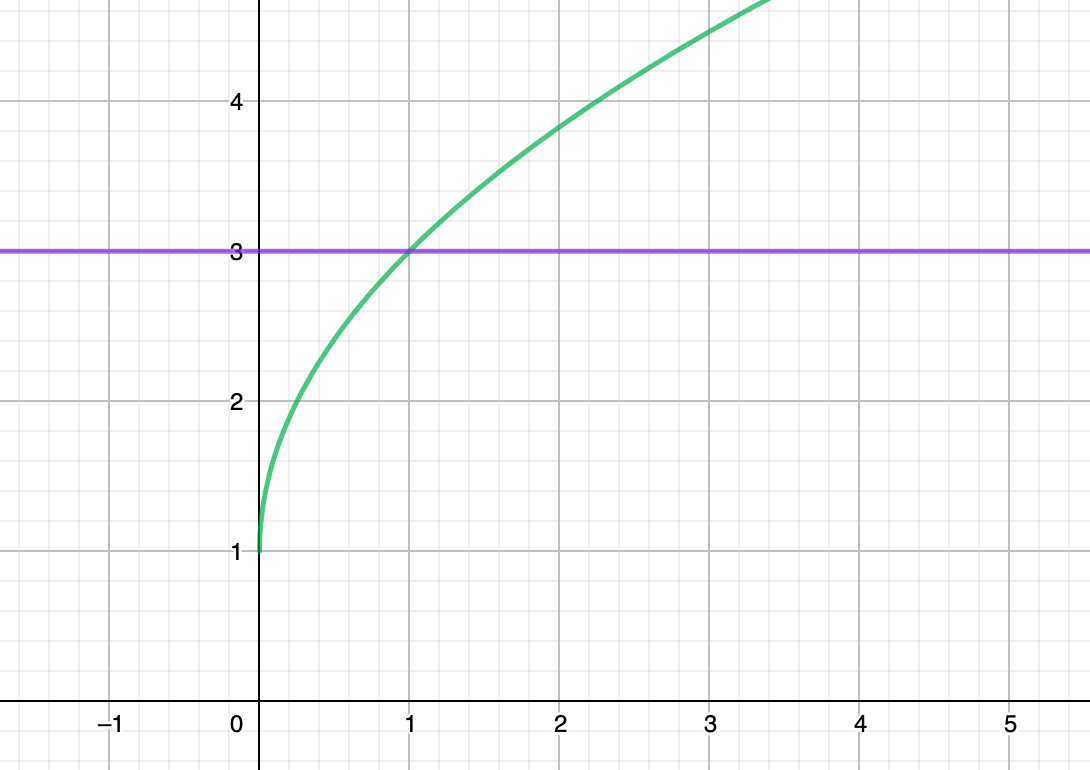
intersect at (1, 3).
Let's verify the answer:
Therefore, (1, 3) is the solution.
Algebraic Solutions to Radical Equations
Solve . State the domain and range
Isolate for 'x'
Restriction: Since the argument of a square root must be 0 or larger, which means that our domain can be given by , or in interval notation. The range can be found be recognizing that the square root has an output of 0 or higher, and so subtracting 2 from this will give us a possible range of .
Verify:
0:00 / 0:00
Example: Solving Radical Equations
Solve graphically & algebraically, stating the restrictions on :
Graphically:
Let and . Then,

The solution is (4, 4)
Restrictions on 'x':
Algebraically:
Verify:
Therefore, only x = 4 is a solution.
Practice: Transformations
Let .
Match the appropriate transformation with its transformed function.
A.
B.
C.
D.
Reflection about the x-axis, horizontal compression by , and translation 4 units up.
Reflection about the y-axis, vertical expansion by a factor of 3, and 4 units right
Horizontal expansion by a factor of 3, vertical compression by a factor of , and 4 units down
Horizontal compression by a factor of , vertical expansion by a factor of 3, and 4 units left
Practice: Solving Radical Equations
Solve algebraically, stating any restrictions on :
Practice: Solving Radical Equations
Solve algebraically, stating any restrictions: