Create a free account to get started

Unlock full course notes by signing up

  • Video lessons taught by top educators
  • Practice questions with guided solutions
  • Written review notes for reference
  • Expert answers anytime from course tutors

Sum & Difference

Functions can be combined through addition and subtraction.


Let f(x)f(x) and g(x)g(x) be two continuous functions defined on the interval (−∞,∞)(-\infin,\infin).

  • The sum of 2 functions, f(x)f(x) and g(x)g(x), can be expressed as f(x)+g(x)\boxed{f(x)+g(x)}.
  • The difference of 2 functions, f(x)f(x) and g(x)g(x), can be expressed as f(x)−g(x)\boxed{f(x)-g(x)}.


Example


Let f(x)=x−2f(x)=x-2 and g(x)=x+1g(x)=x+1. Find:

  1. f(x)+g(x)f(x)+g(x)
  2. f(x)−g(x)f(x)-g(x)

1.f(x)+g(x)=(x−2)+(x+1)=2x−12.f(x)−g(x)=(x−2)−(x+1)=−3\begin{array}{rrcl} 1.&f(x)+g(x)&=&(x-2)+(x+1)\\\\ &&=&2x-1\\\\\\ 2.&f(x)-g(x)&=&(x-2)-(x+1)\\\\ &&=&-3 \end{array}

Create a free account to get started

Unlock full course notes by signing up

  • Video lessons taught by top educators
  • Practice questions with guided solutions
  • Written review notes for reference
  • Expert answers anytime from course tutors

Example: Sum & Difference of Functions


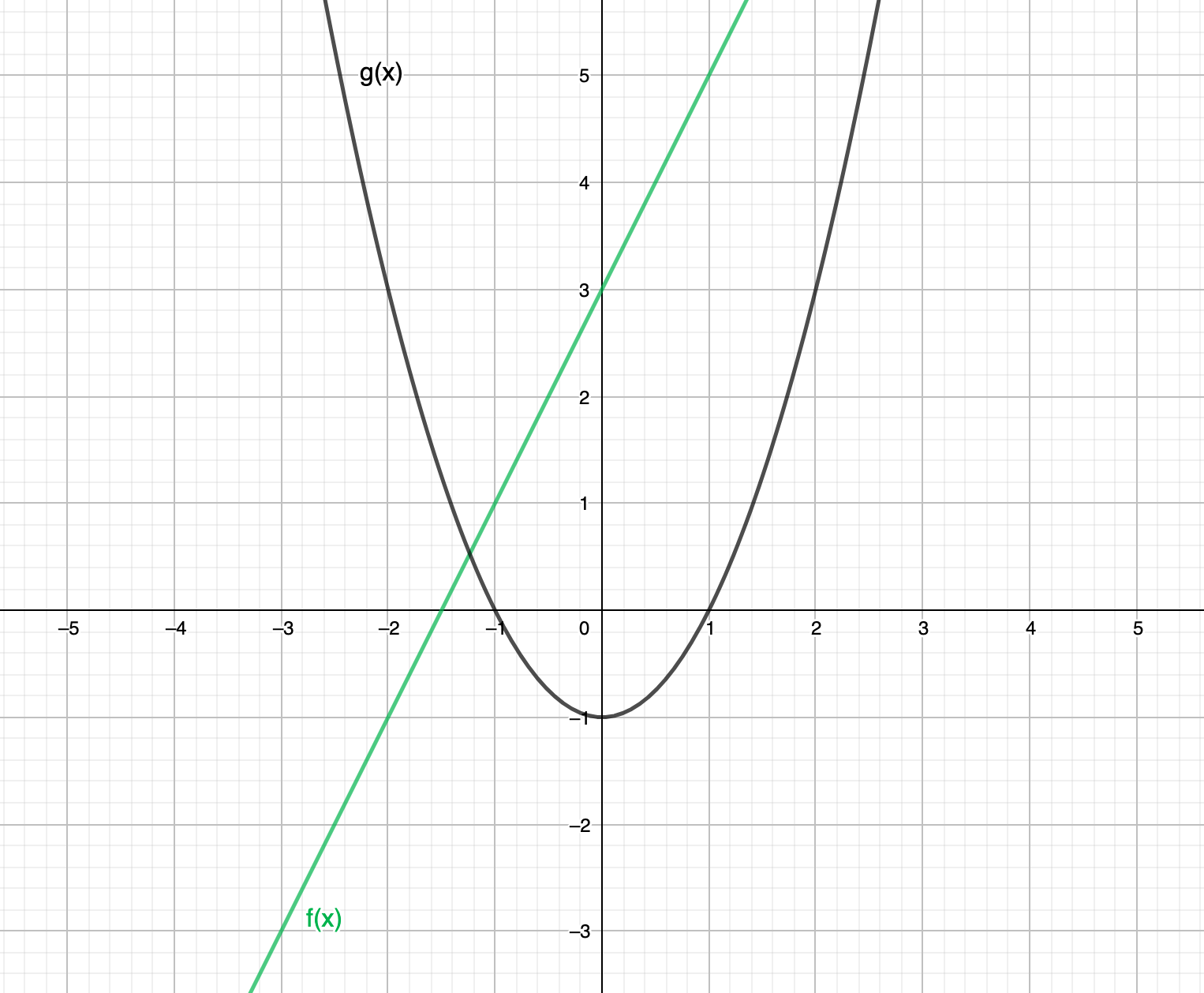
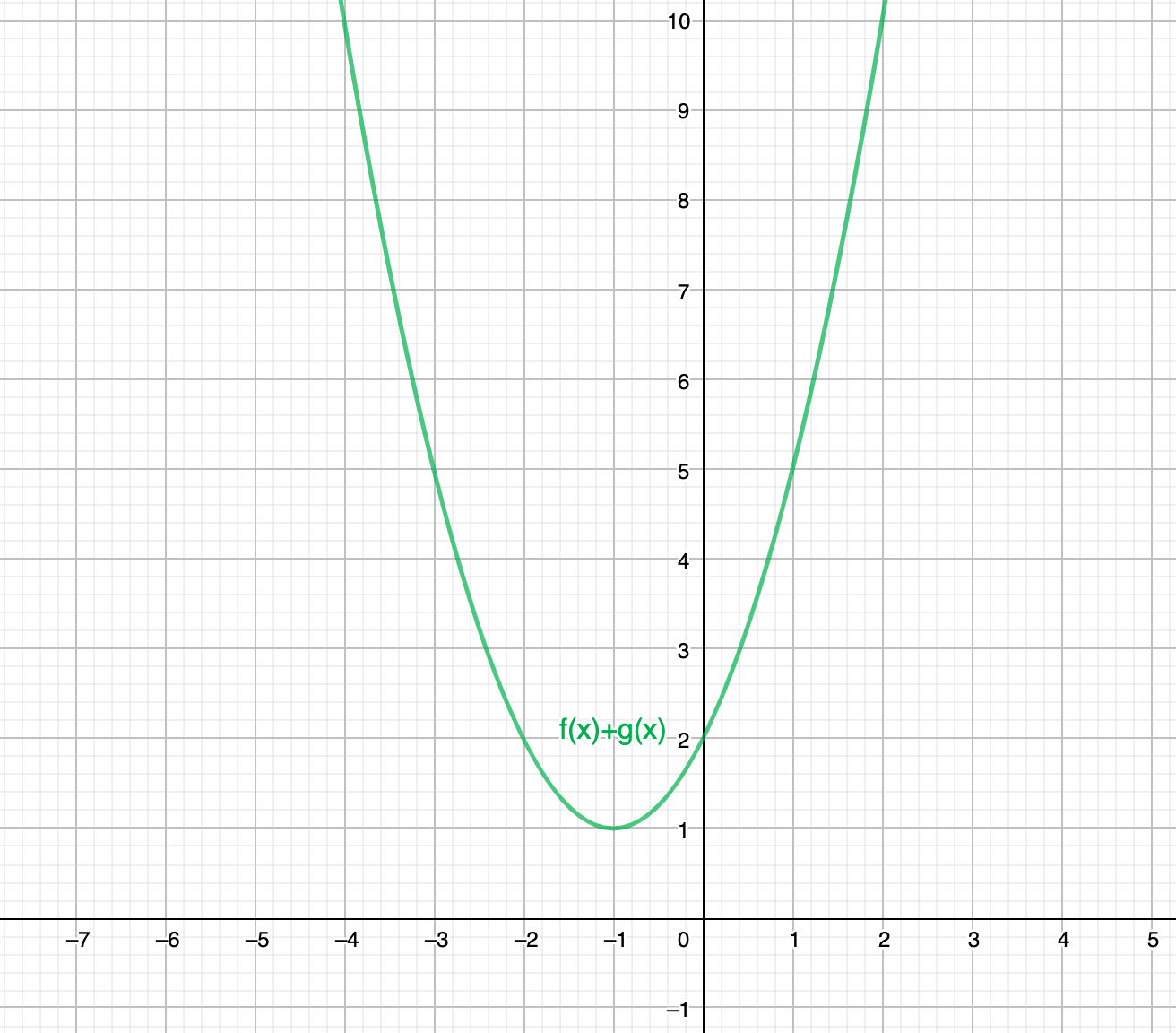
Given f(x)=2x+3f(x)=2x+3 and g(x)=x2−1g(x)=x^2-1, determine:

  1. f(x)+g(x)f(x)+g(x)
  2. Algebraically
  3. Graphically


1. f(x)+g(x):f(x)+g(x):

a. f(x)+g(x)=(2x+3)+(x2−1)=x2+2x+2=(x2+2x+1)+2−1=(x+1)2+1\begin{array}{rcl} f(x)+g(x)&=&(2x+3)+(x^2-1)\\\\ &=&x^2+2x+2\\\\ &=&(x^2+2x+1)+2-1\\\\ &=&(x+1)^2+1 \end{array}


b.

Image illustrating Example


xf(x)g(x)f(x)+g(x)−2−132−110103−12150527310\begin{array}{c|c|c|c} x&f(x)&g(x)&f(x)+g(x)\\\hline -2&-1&3&2\\\hline -1&1&0&1\\\hline 0&3&-1&2\\\hline 1&5&0&5\\\hline 2&7&3&10 \end{array}


Image illustrating Example

The solution is f(x)+g(x)=(x+1)2+1f(x)+g(x)=(x+1)^2+1

Practice: Sum & Difference of Functions

Let f(x)=x+8f(x)=x+8 and g(x)=9x2−1g(x)=9x^2-1. Determine the following:

Your answers

Create a free account to get started

Unlock full course notes by signing up

  • Video lessons taught by top educators
  • Practice questions with guided solutions
  • Written review notes for reference
  • Expert answers anytime from course tutors

Practice: Sum & Difference of Functions

If m(x)=13x−4m(x)=\dfrac{1}{3x-4} and n(x)=1x+1n(x)=\dfrac{1}{x+1}, determine:

Your answers

Create a free account to get started

Unlock full course notes by signing up

  • Video lessons taught by top educators
  • Practice questions with guided solutions
  • Written review notes for reference
  • Expert answers anytime from course tutors

Practice: Sum & Difference of Functions

Maisy went grocery shopping at Fresh-co and used her $5\$5 off coupon. She then went to London Drugs and used her 25% coupon.


Your answers

Create a free account to get started

Unlock full course notes by signing up

  • Video lessons taught by top educators
  • Practice questions with guided solutions
  • Written review notes for reference
  • Expert answers anytime from course tutors