0:00 / 0:00

Classifying Quadrilaterals


Every quadrilateral has four sides and four angles.

Notes about Side Lengths & Slopes

  • If it has 4 equal side lengths, it is a square or a rhombus
  • If two of the sides are perpendicular, it is a square
  • If there are no perpendicular sides, it is a rhombus
  • If it has 2 pairs of equal side lengths, it is a rectangle, parallelogram, or kite
  • If the adjacent sides have the same length, then it is a kite
  • If two of the sides are perpendicular, it is a rectangle
  • If there are no perpendicular sides, and the opposite sides are parallel (same slope), then it is a parallelogram
  • If it only has 1 pair of equal side lengths, it is an isosceles trapezoid
  • If is has 4 different side lengths, it is a trapezoid or irregular quadrilateral
  • If there is a pair of parallel sides, it is a trapezoid
  • If there are no parallel sides, it is an irregular quadrilateral

Practice: Classifying Quadrilaterals

The table provides information about some of the sides lengths and slopes of 7 different quadrilaterals. The sides are labelled in a clockwise direction.
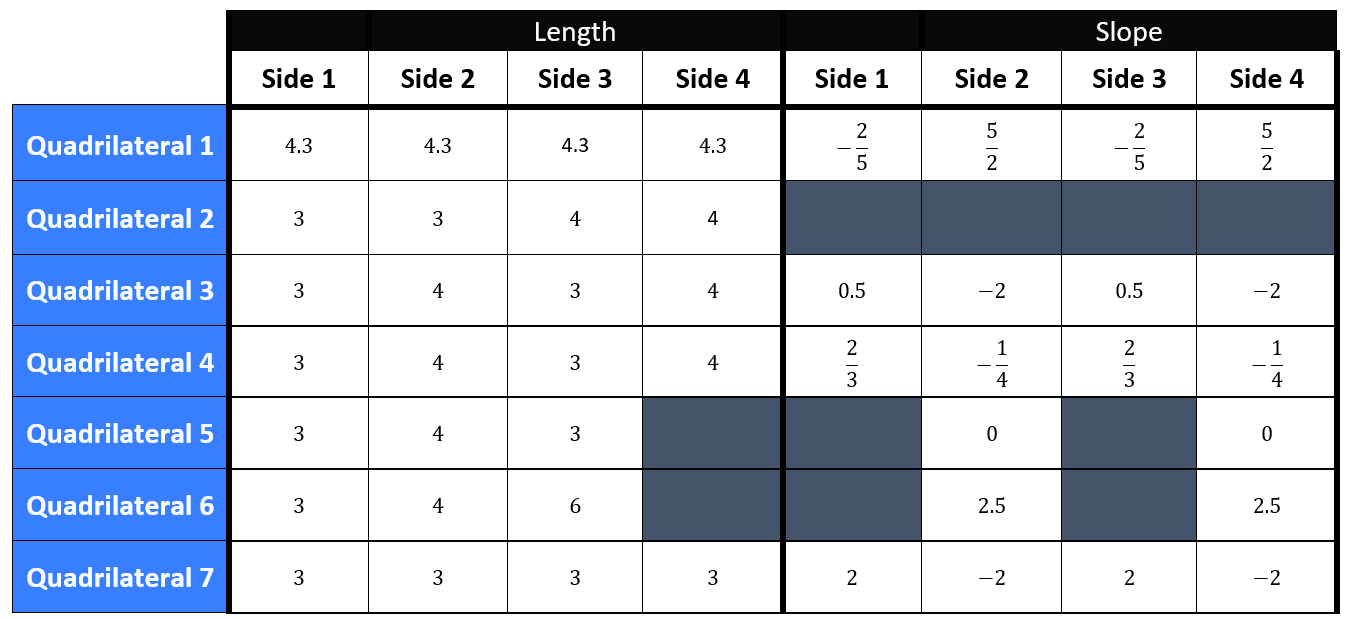
Match the quadrilateral with its type (square, rhombus, rectangle, parallelogram, trapezoid, isosceless trapezoid, and kite).

*You can only use one answer per quadrilateral.
A.
Isosceles Trapoezoid
B.
Trapezoid
C.
Parallelogram
D.
Rectangle
E.
Kite
F.
Square
G.
Rhombus
Quadrilateral 1
Quadrilateral 2
Quadrilateral 3
Quadrilateral 4
Quadrilateral 5
Quadrilateral 6
Quadrilateral 7
0:00 / 0:00

Example: Classifying Quadrilaterals

Classify the quadrilateral with vertices A(2,2)A(-2,2), B(1,4)B(1,4), C(4,1)C(4,1), and D(1,1)D(1,-1).

Side AB
x1y1A:(2,2)\begin{array}{ccccc} &x_1&&y_1\\ A:(&-2&,&2&) \end{array} and x2y2B:(1,4)\begin{array}{ccccc} &x_2&&y_2\\ B:(&1&,&4&) \end{array}

AB=(x2x1)2+(y2=y1)2=(1(2))2+(42)2=(3)2+(2)2=9+4=13mAB=y2y1x2x1=421(2)=23\begin{array}{c|c} \begin{array}{rcl} AB&=&\sqrt{(x_2-x_1)^2+(y_2=y_1)^2}\\[0.5em] &=&\sqrt{(1-(-2))^2+(4-2)^2}\\[0.5em] &=&\sqrt{(3)^2+(2)^2}\\[0.5em] &=&\sqrt{9+4}\\[0.5em] &=&\sqrt{13} \end{array} & \begin{array}{rcl} m_{_{AB}}&=&\dfrac{y_2-y_1}{x_2-x_1}\\[1em] &=&\dfrac{4-2}{1-(-2)}\\[1em] &=&\dfrac{2}{3}\\[1em] \end{array} \end{array}

Side BC
x1y1B:(1,4)\begin{array}{ccccc} &x_1&&y_1\\ B:(&1&,&4&) \end{array} and x2y2C:(4,1)\begin{array}{ccccc} &x_2&&y_2\\ C:(&4&,&1&) \end{array}

BC=(x2x1)2+(y2=y1)2=(41)2+(14)2=(3)2+(3)2=9+9=18mBC=y2y1x2x1=1441=33=1\begin{array}{c|c} \begin{array}{rcl} BC&=&\sqrt{(x_2-x_1)^2+(y_2=y_1)^2}\\[0.5em] &=&\sqrt{(4-1)^2+(1-4)^2}\\[0.5em] &=&\sqrt{(3)^2+(-3)^2}\\[0.5em] &=&\sqrt{9+9}\\[0.5em] &=&\sqrt{18} \end{array} & \begin{array}{rcl} m_{_{BC}}&=&\dfrac{y_2-y_1}{x_2-x_1}\\[1em] &=&\dfrac{1-4}{4-1}\\[1em] &=&\dfrac{-3}{3}\\[1em] &=&-1 \end{array} \end{array}

Side CD
x1y1C:(4,1)\begin{array}{ccccc} &x_1&&y_1\\ C:(&4&,&1&) \end{array} and x2y2D:(1,1)\begin{array}{ccccc} &x_2&&y_2\\ D:(&1&,&-1&) \end{array}

CD=(x2x1)2+(y2=y1)2=(14)2+(11)2=(3)2+(2)2=9+4=13mCD=y2y1x2x1=1114=23=23\begin{array}{c|c} \begin{array}{rcl} CD&=&\sqrt{(x_2-x_1)^2+(y_2=y_1)^2}\\[0.5em] &=&\sqrt{(1-4)^2+(-1-1)^2}\\[0.5em] &=&\sqrt{(-3)^2+(-2)^2}\\[0.5em] &=&\sqrt{9+4}\\[0.5em] &=&\sqrt{13} \end{array} & \begin{array}{rcl} m_{_{CD}}&=&\dfrac{y_2-y_1}{x_2-x_1}\\[1em] &=&\dfrac{-1-1}{1-4}\\[1em] &=&\dfrac{-2}{-3}\\[1em] &=&\dfrac{2}{3} \end{array} \end{array}

Side DA
x1y1D:(1,1)\begin{array}{ccccc} &x_1&&y_1\\ D:(&1&,&-1&) \end{array} and x2y2A:(2,2)\begin{array}{ccccc} &x_2&&y_2\\ A:(&-2&,&2&) \end{array}

DA=(x2x1)2+(y2=y1)2=(21)2+(2(1))2=(3)2+(3)2=9+9=18mDA=y2y1x2x1=2(1)21=33=1\begin{array}{c|c} \begin{array}{rcl} DA&=&\sqrt{(x_2-x_1)^2+(y_2=y_1)^2}\\[0.5em] &=&\sqrt{(-2-1)^2+(2-(-1))^2}\\[0.5em] &=&\sqrt{(-3)^2+(3)^2}\\[0.5em] &=&\sqrt{9+9}\\[0.5em] &=&\sqrt{18} \end{array} & \begin{array}{rcl} m_{_{DA}}&=&\dfrac{y_2-y_1}{x_2-x_1}\\[1em] &=&\dfrac{2-(-1)}{-2-1}\\[1em] &=&\dfrac{3}{-3}\\[1em] &=&-1 \end{array} \end{array}

Here's what we know:
  • 2 pairs of equal side lengths that are opposite from one another
  • The slopes of opposite sides are the same -- opposite sides are parallel
  • The slopes of adjacent sides are not negative reciprocals -- there are no right angles
So, the quadrilateral is a parallelogram.

Practice: Classifying Quadrilaterals

A quadrilateral has the vertices A(1,2)A(-1, 2), B(2,2)B(2,2), C(4,1)C(4, -1), and D(1,1)D(-1,-1).
Classify this quadrilateral.

Practice: Classifying Quadrilaterals

Three of the vertices of a quadrilateral are A(1,2)A(1,2), B(5,3)B(5,3), and C(4,1)C(4,1).
How many possible parallelograms contain these three vertices?