Properties of Quadrilaterals

Example: Properties of Quadrilaterals
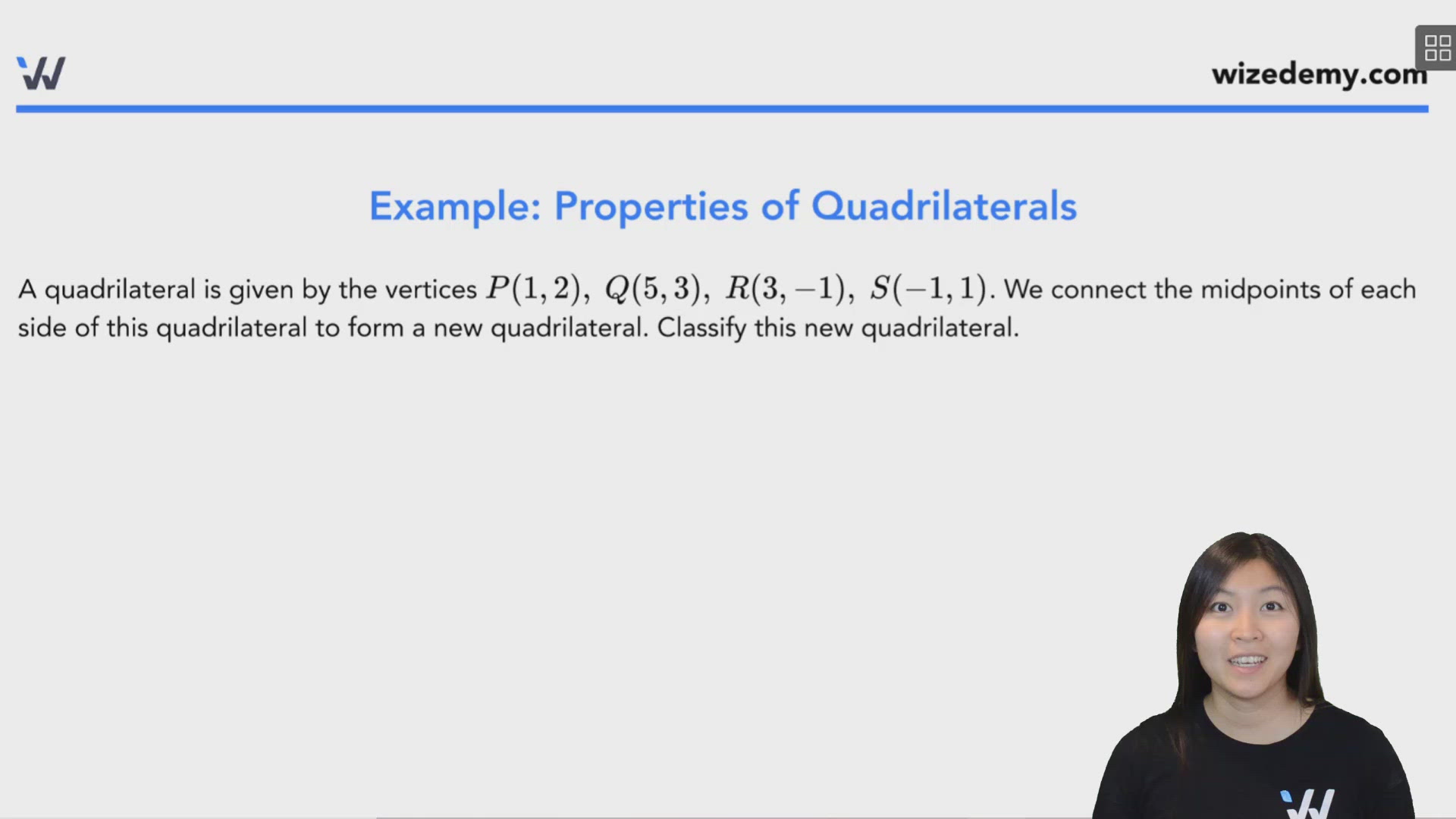
A quadrilateral is given by the vertices P(1,2), Q(5,3), R(3,−1), S(−1,1). We connect the midpoints of each side of this quadrilateral to form a new quadrilateral. Classify this new quadrilateral.
Midpoints:
MPQ===(2x1+x2,2y1+y2)(21+5,22+3)(3,25)MQR===(2x1+x2,2y1+y2)(25+3,23+(−1))(4,1)
MRS===(2x1+x2,2y1+y2)(23+(−1),2(−1)+1)(1,0)MSP===(2x1+x2,2y1+y2)(2(−1)+1,21+2)(0,23)
Side Lengths of new quadrilateral:
Side1 MPQMQR=====(x2−x1)2+(y2−y1)2(4−3)2+(1−25)2(1)2+(−23)21+(49)(413)Side2 MQRMRS=====(x2−x1)2+(y2−y1)2(1−4)2+(0−1)2(−3)2+(−1)29+110
Side3 MRSMSP=====(x2−x1)2+(y2−y1)2(0−1)2+(23−0)2(−1)2+(23)21+(49)(413)Side4 MSPMPQ=====(x2−x1)2+(y2−y1)2(3−0)2+(25−23)2(3)2+(1)29+110
There are 2 pairs of equal side lengths -- the opposite side lengths are the same
Slopes of the new quadrilateral
mside1====x2−x1y2−y14−31−251−23−23mside2====x2−x1y2−y11−40−1−3−131mside3====x2−x1y2−y10−123−0−123−23mside4===x2−x1y2−y13−025−2331
The opposite sides are parallel, and there are no right angles.
Therefore, this new quadrilateral is a parallelogram.
Mark Yourself Question
- Grab a piece of paper and try this problem yourself.
- When you're done, check the "I have answered this question" box below.
- View the solution and report whether you got it right or wrong.
Practice: Properties of Quadrilaterals
A quadrilateral has vertices A(−2,2), B(0,2), C(3,0), D(−3,0).
a) Show that this is trapezoid by finding the lengths and slopes of each side.
b) Show that the line segment joining the midpoints of the non-parallel sides of the trapezoid is parallel to the parallel sides of the trapezoid.
c) Show that the line segment joining the midpoints of the non-parallel sides of the trapezod has a length equal to the average of the lengths of the parallel sides.