0:00 / 0:00

Example: Properties of Quadrilaterals

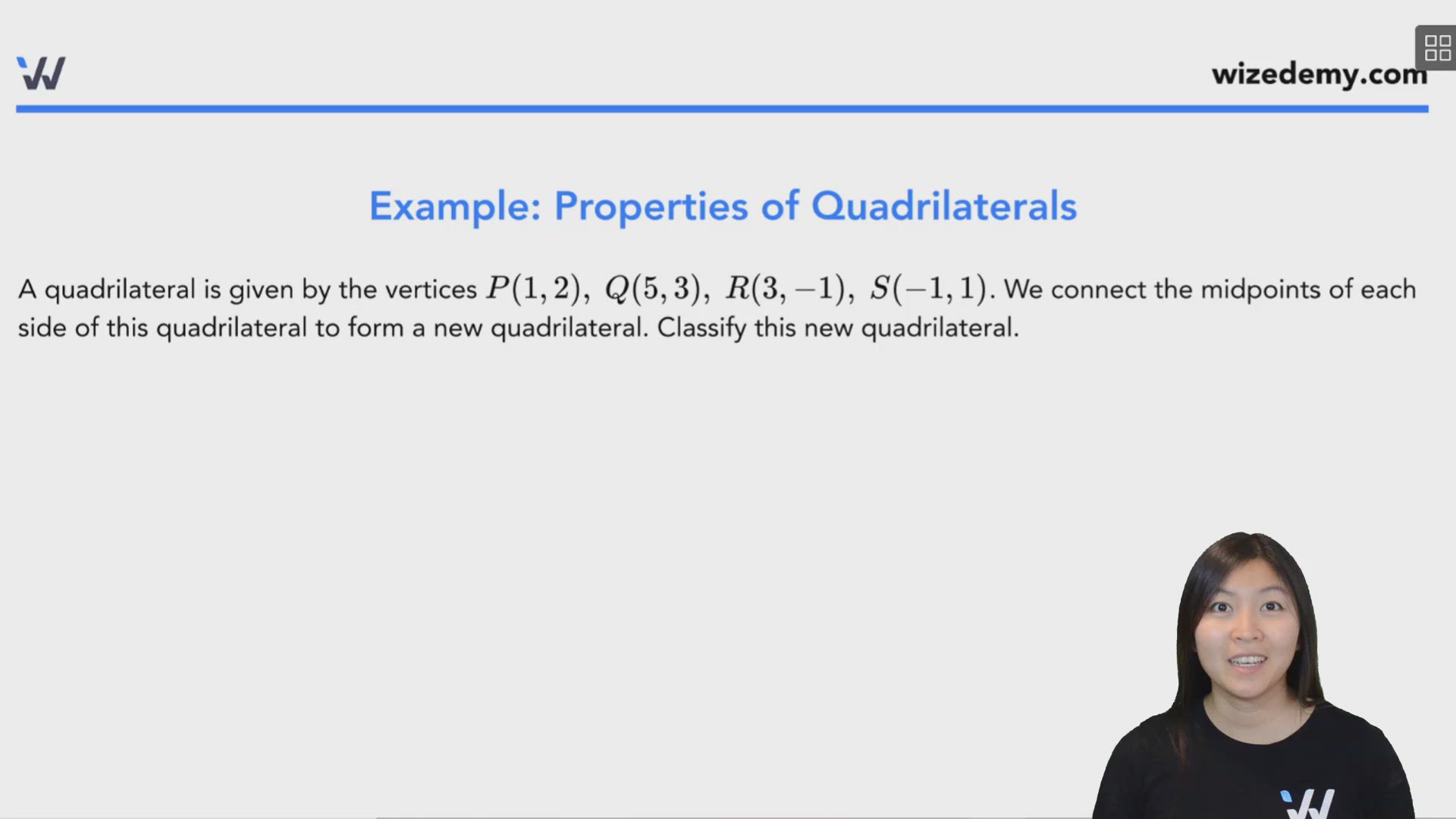
A quadrilateral is given by the vertices P(1,2), Q(5,3), R(3,1), S(1,1)P(1,2),~Q(5,3),~R(3,-1),~S(-1,1). We connect the midpoints of each side of this quadrilateral to form a new quadrilateral. Classify this new quadrilateral.

Midpoints:
MPQ=(x1+x22,y1+y22)=(1+52,2+32)=(3,52)MQR=(x1+x22,y1+y22)=(5+32,3+(1)2)=(4,1)\begin{array}{c|c|} \begin{array}{rl} M_{PQ}=&\left(\dfrac{x_1+x_2}{2},\dfrac{y_1+y_2}{2}\right)\\[1em] =&\left(\dfrac{1+5}{2},\dfrac{2+3}{2}\right)\\[1em] =&\left(3,\dfrac{5}{2}\right)\\[1em] \end{array} & \begin{array}{rl} M_{QR}=&\left(\dfrac{x_1+x_2}{2},\dfrac{y_1+y_2}{2}\right)\\[1em] =&\left(\dfrac{5+3}{2},\dfrac{3+(-1)}{2}\right)\\[1em] =&\left(4,1\right)\\[1em] \end{array} \end{array}

MRS=(x1+x22,y1+y22)=(3+(1)2,(1)+12)=(1,0)MSP=(x1+x22,y1+y22)=((1)+12,1+22)=(0,32)\begin{array}{c|c|} \begin{array}{rl} M_{RS}=&\left(\dfrac{x_1+x_2}{2},\dfrac{y_1+y_2}{2}\right)\\[1em] =&\left(\dfrac{3+(-1)}{2},\dfrac{(-1)+1}{2}\right)\\[1em] =&\left(1,0\right)\\[1em] \end{array} & \begin{array}{rl} M_{SP}=&\left(\dfrac{x_1+x_2}{2},\dfrac{y_1+y_2}{2}\right)\\[1em] =&\left(\dfrac{(-1)+1}{2},\dfrac{1+2}{2}\right)\\[1em] =&\left(0,\dfrac{3}{2}\right)\\[1em] \end{array} \end{array}

Side Lengths of new quadrilateral:
Side1 MPQMQR=(x2x1)2+(y2y1)2=(43)2+(152)2=(1)2+(32)2=1+(94)=(134)Side2 MQRMRS=(x2x1)2+(y2y1)2=(14)2+(01)2=(3)2+(1)2=9+1=10\begin{array}{c|c|} \begin{array}{rl} \text{Side1 }M_{PQ}M_{QR}=&\sqrt{(x_2-x_1)^2+(y_2-y_1)^2}\\[1em] =&\sqrt{\left(4-3\right)^2+\left(1-\dfrac{5}{2}\right)^2}\\[1em] =&\sqrt{\left(1\right)^2+\left(-\dfrac{3}{2}\right)^2}\\[1em] =&\sqrt{1+\left(\dfrac{9}{4}\right)}\\[1em] =&\colorThree{\sqrt{\left(\dfrac{13}{4}\right)}}\\[1em] \end{array} & \begin{array}{rl} \text{Side2 }M_{QR}M_{RS}=&\sqrt{(x_2-x_1)^2+(y_2-y_1)^2}\\[1em] =&\sqrt{\left(1-4\right)^2+\left(0-1\right)^2}\\[1em] =&\sqrt{\left(-3\right)^2+\left(-1\right)^2}\\[1em] =&\sqrt{9+1}\\[1em] =&\colorThree{\sqrt{10}}\\[1em] \\[1em] \\ \end{array} \end{array}

Side3 MRSMSP=(x2x1)2+(y2y1)2=(01)2+(320)2=(1)2+(32)2=1+(94)=(134)Side4 MSPMPQ=(x2x1)2+(y2y1)2=(30)2+(5232)2=(3)2+(1)2=9+1=10\begin{array}{c|c|} \begin{array}{rl} \text{Side3 }M_{RS}M_{SP}=&\sqrt{(x_2-x_1)^2+(y_2-y_1)^2}\\[1em] =&\sqrt{\left(0-1\right)^2+\left(\dfrac{3}{2}-0\right)^2}\\[1em] =&\sqrt{\left(-1\right)^2+\left(\dfrac{3}{2}\right)^2}\\[1em] =&\sqrt{1+\left(\dfrac{9}{4}\right)}\\[1em] =&\colorThree{\sqrt{\left(\dfrac{13}{4}\right)}}\\[1em] \end{array} & \begin{array}{rl} \text{Side4 }M_{SP}M_{PQ}=&\sqrt{(x_2-x_1)^2+(y_2-y_1)^2}\\[1em] =&\sqrt{\left(3-0\right)^2+\left(\dfrac{5}{2}-\dfrac{3}{2}\right)^2}\\[1em] =&\sqrt{\left(3\right)^2+\left(1\right)^2}\\[1em] =&\sqrt{9+1}\\[1em] =&\colorThree{\sqrt{10}}\\[1em] \\[1em] \\ \end{array} \end{array}

There are 2 pairs of equal side lengths -- the opposite side lengths are the same

Slopes of the new quadrilateral
mside1=y2y1x2x1=15243=321=32mside2=y2y1x2x1=0114=13=13mside3=y2y1x2x1=32001=321=32mside4=y2y1x2x1=523230=13\begin{array}{c|c|c|c} \begin{array}{rl} m_\text{side1}=&\dfrac{y_2-y_1}{x_2-x_1}\\[1em] =&\dfrac{1-\dfrac{5}{2}}{4-3}\\[1em] =&\dfrac{-\dfrac{3}{2}}{1}\\[1em] =&\colorThree{-\dfrac{3}{2}}\\[1em] \end{array} & \begin{array}{rl} m_\text{side2}=&\dfrac{y_2-y_1}{x_2-x_1}\\[1em] =&\dfrac{0-1}{1-4}\\[1em] =&\dfrac{-1}{-3}\\[1em] =&\colorThree{\dfrac{1}{3}}\\[1em] \\[1em] \end{array} & \begin{array}{rl} m_\text{side3}=&\dfrac{y_2-y_1}{x_2-x_1}\\[1em] =&\dfrac{\dfrac{3}{2}-0}{0-1}\\[1em] =&\dfrac{\dfrac{3}{2}}{-1}\\[1em] =&\colorThree{-\dfrac{3}{2}}\\[1em] \end{array} &\begin{array}{rl} m_\text{side4}=&\dfrac{y_2-y_1}{x_2-x_1}\\[1em] =&\dfrac{\dfrac{5}{2}-\dfrac{3}{2}}{3-0}\\[1em] =&\colorThree{\dfrac{1}{3}}\\[1em] \\[3em] \end{array} \end{array}

The opposite sides are parallel, and there are no right angles.

Therefore, this new quadrilateral is a parallelogram.

Practice: Properties of Quadrilaterals

A rectangle is given by the vertices A(1,3), B(5,1), C(3,3), D(1,1)A(1,3),~B(5,-1),~C(3,-3),~D(-1,1). What can you conclude about the diagonals of this rectangle?

Select all that apply.
checklist
Mark Yourself Question
  1. Grab a piece of paper and try this problem yourself.
  2. When you're done, check the "I have answered this question" box below.
  3. View the solution and report whether you got it right or wrong.

Practice: Properties of Quadrilaterals

A quadrilateral has vertices A(2,2), B(0,2), C(3,0), D(3,0)A(-2,2),~B(0,2),~C(3,0),~D(-3,0).

a) Show that this is trapezoid by finding the lengths and slopes of each side.

b) Show that the line segment joining the midpoints of the non-parallel sides of the trapezoid is parallel to the parallel sides of the trapezoid.

c) Show that the line segment joining the midpoints of the non-parallel sides of the trapezod has a length equal to the average of the lengths of the parallel sides.

Example: Properties of Quadrilaterals

Three conjectures about the diagonals of a quadrilateral are given:
  1. The diagonals are equal
  2. The diagonals bisect each other ("cuts each other in half")
  3. The diagonals meet at a 90°90\degree angle (they are perpendicular)
Come up with examples to support the conjecture or come up with a counterexample to disprove the conjecture. Then put a ✔ or ✖ in each of the following boxes to indicate whether the conjecture is likely true or not true for each quadrilateral.


PAGE BREAK

The diagonals are always equal
For each type of quadrilateral, create a few different sizes and draw in the diagonals. If you measure these diagonals, you'll see if their lengths are the same. If they are, the diagonals are likely equal. If you are able to come up with even one example where the lengths are not the same, then we know for sure that the lengths are not always equal.
  • Rectangles: ✔
  • Squares: ✔
  • Parallelograms: ✔
  • Isosceles Trapezoid: ✔
  • Rhombus: ✖ (they aren't always equal)
  • Kite: ✖ (they aren't always equal)

The diagonals always bisect each other
For each type of quadrilateral, create a few different sizes and draw in the diagonals. Measure the lengths of each side of each diagonal, if they are the same, then the diagonals likely bisect each others. If you are able to come up with even one example where the lengths are not the same, then we know for sure that the diagonals do not always bisect each other.
  • Rectangles: ✔
  • Squares: ✔
  • Parallelograms: ✔
  • Isosceles Trapezoid: ✖
  • Rhombus: ✖ (they don't always bisect each other)
  • Kite: ✖ (they don't always bisect each other)

The diagonals are always perpendicular (meet at 90°90\degree)
For each type of quadrilateral, create a few different sizes and draw in the diagonals. Measure the angle the diagonals make with one another, if they are90°90\degree, then the diagonals likely are always perpendicular. If you are able to come up with even one examlpe where they are not 90°90\degree, then we know for sure that the diagonals are not always perpendicular
  • Rectangles: ✖ (they aren't always perpendicular)
  • Squares: ✔
  • Parallelograms: ✖ (they aren't always perpendicular)
  • Isosceles Trapezoid: ✖ (they aren't always perpendicular)
  • Rhombus: ✔
  • Kite: ✖ (they aren't always perpendicular)

Practice: Properties of Quadrilaterals

Adjacent angles are the angles that are "next to each other".

Given the conjecture "the sum of the two adjacent angles is always 180°180\degree", come up with examples to either support this conjecture or come up with a counterexample to disprove the conjecture for each of the following quadrilaterals.

Put "yes" in the box if the conjecture for that quadrilateral is likely true, and put "no" in the box if the conjecture is not true for that quadrilateral.
RectangleSquareParallelogramIsosceles TrapezoidRhombusKite
The sum of the two adjacent angles is always 180 for this type of quadrilateral
checklist
Mark Yourself Question
  1. Grab a piece of paper and try this problem yourself.
  2. When you're done, check the "I have answered this question" box below.
  3. View the solution and report whether you got it right or wrong.

Practice: Properties of Quadrilaterlas.

The midsegment in a polygon is a line segment that joins the midpoints of two adjacent sides in that polygon.

The conjecture "the quadrilateral formed by connecting the four midsegments in any quadrilateral are parallelograms" is given. Either come up with multiple examples to support this conjecture or come up with one counterexample to disprove this conjecture.