Create a free account to get started

Unlock full course notes by signing up

  • Video lessons taught by top educators
  • Practice questions with guided solutions
  • Written review notes for reference
  • Expert answers anytime from course tutors

Prisms

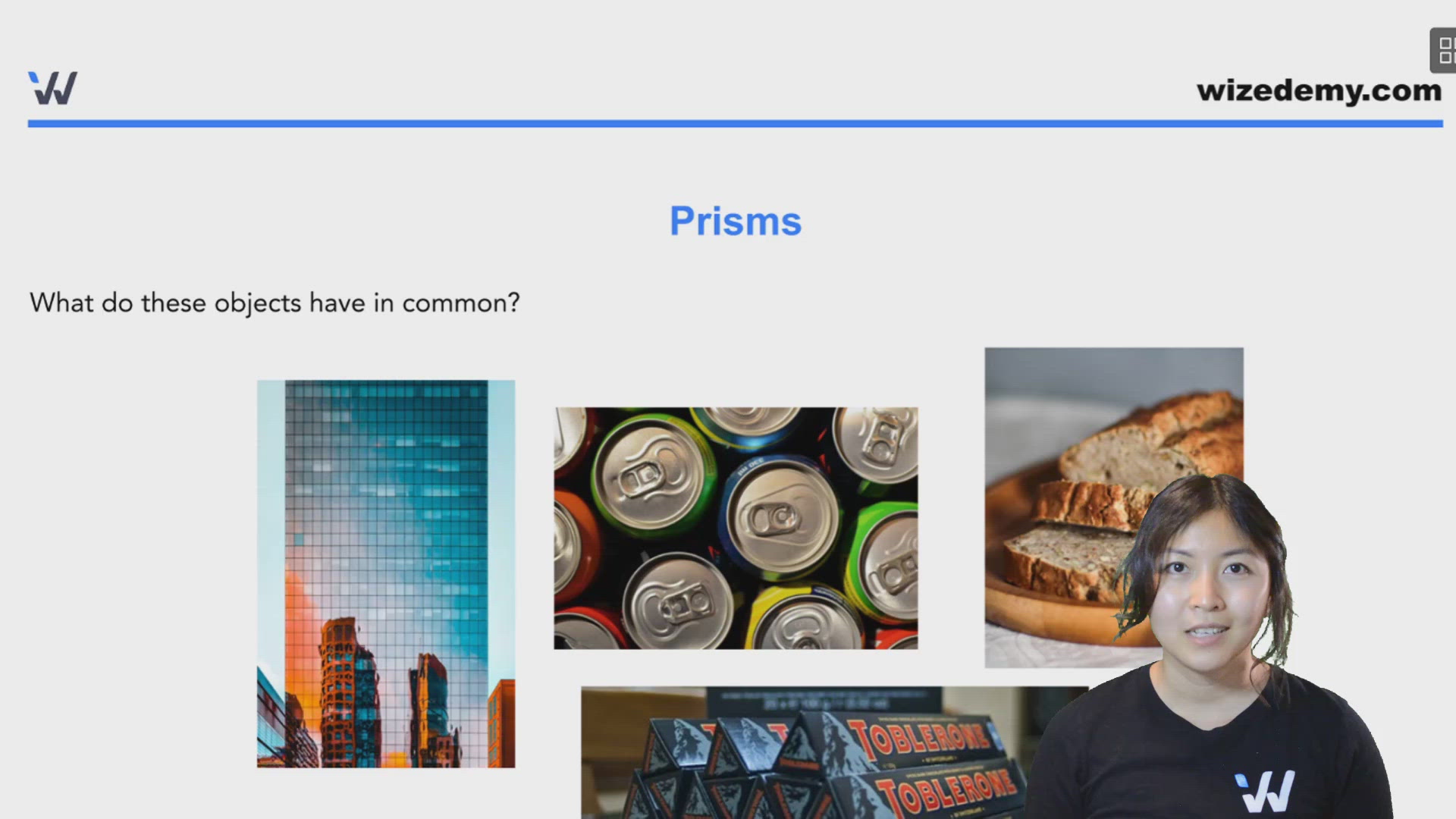
What do these objects have in common?

Image illustrating Prisms


A prism is a solid 3D object that has the same end faces, and the same cross-section along its length.
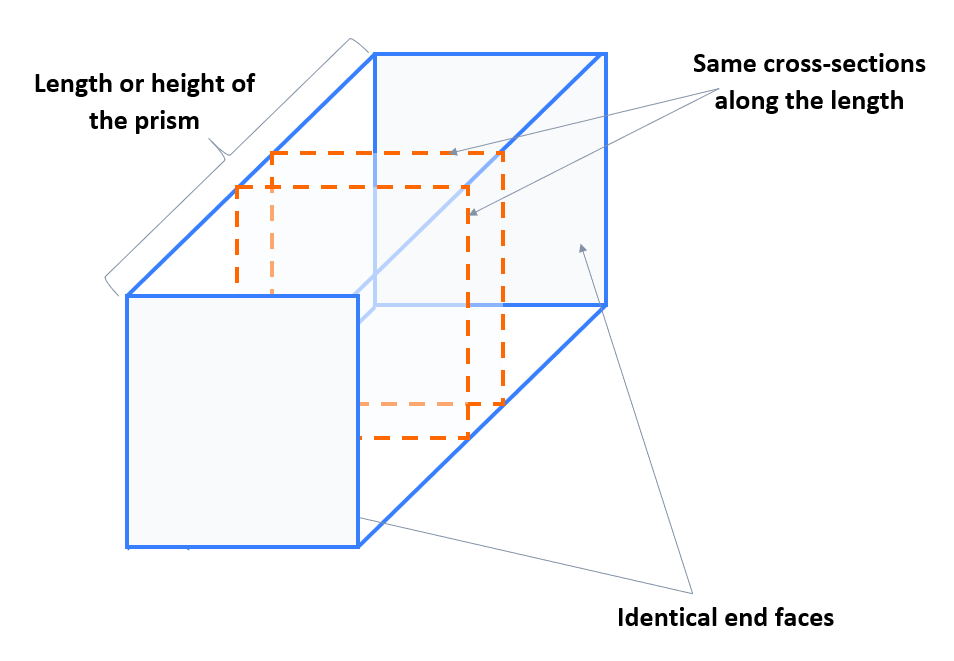

Image illustrating Prisms

Common Prisms


Image illustrating Prisms


Create a free account to get started

Unlock full course notes by signing up

  • Video lessons taught by top educators
  • Practice questions with guided solutions
  • Written review notes for reference
  • Expert answers anytime from course tutors

Surface Area of a Prism

The surface area of a prisms is the total area you get by adding up the area of each face of the prism.

  • Surface area is measured in unit2 (commonly cm2, m2, inch2, feet2, etc.)


Example
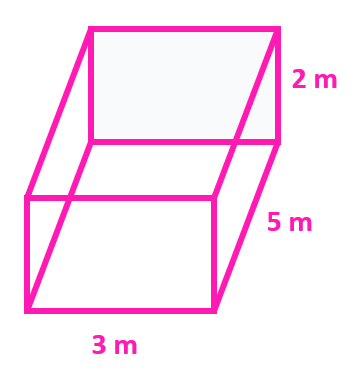
Image illustrating Surface Area of a Prism

The surface area of this prism is

  • Front face: 3×2=6m23\times2=6 m^2
  • Back face: 3×2=6m23\times 2=6 m^2
  • Top face: 3×5=15m23\times 5=15m^2
  • Bottom face: 3×5=15m23\times 5=15m^2
  • Left face: 2×5=10m22\times 5 =10m^2
  • Right face: 2×5=10m22\times 5 =10m^2

In total, the surface area of this prism is 6+6+15+15+10+10=62m26+6+15+15+10+10=62m^2
Practice: Surface Area of a Prism

What is the surface area of the following cube?

Illustration for practice question: Practice: Surface Area of a Prism


Your answers

Create a free account to get started

Unlock full course notes by signing up

  • Video lessons taught by top educators
  • Practice questions with guided solutions
  • Written review notes for reference
  • Expert answers anytime from course tutors

Practice: Surface Area of a Prism

What is the surface area of the following prism?


Illustration for practice question: Practice: Surface Area of a Prism


Your answers

Create a free account to get started

Unlock full course notes by signing up

  • Video lessons taught by top educators
  • Practice questions with guided solutions
  • Written review notes for reference
  • Expert answers anytime from course tutors

Create a free account to get started

Unlock full course notes by signing up

  • Video lessons taught by top educators
  • Practice questions with guided solutions
  • Written review notes for reference
  • Expert answers anytime from course tutors

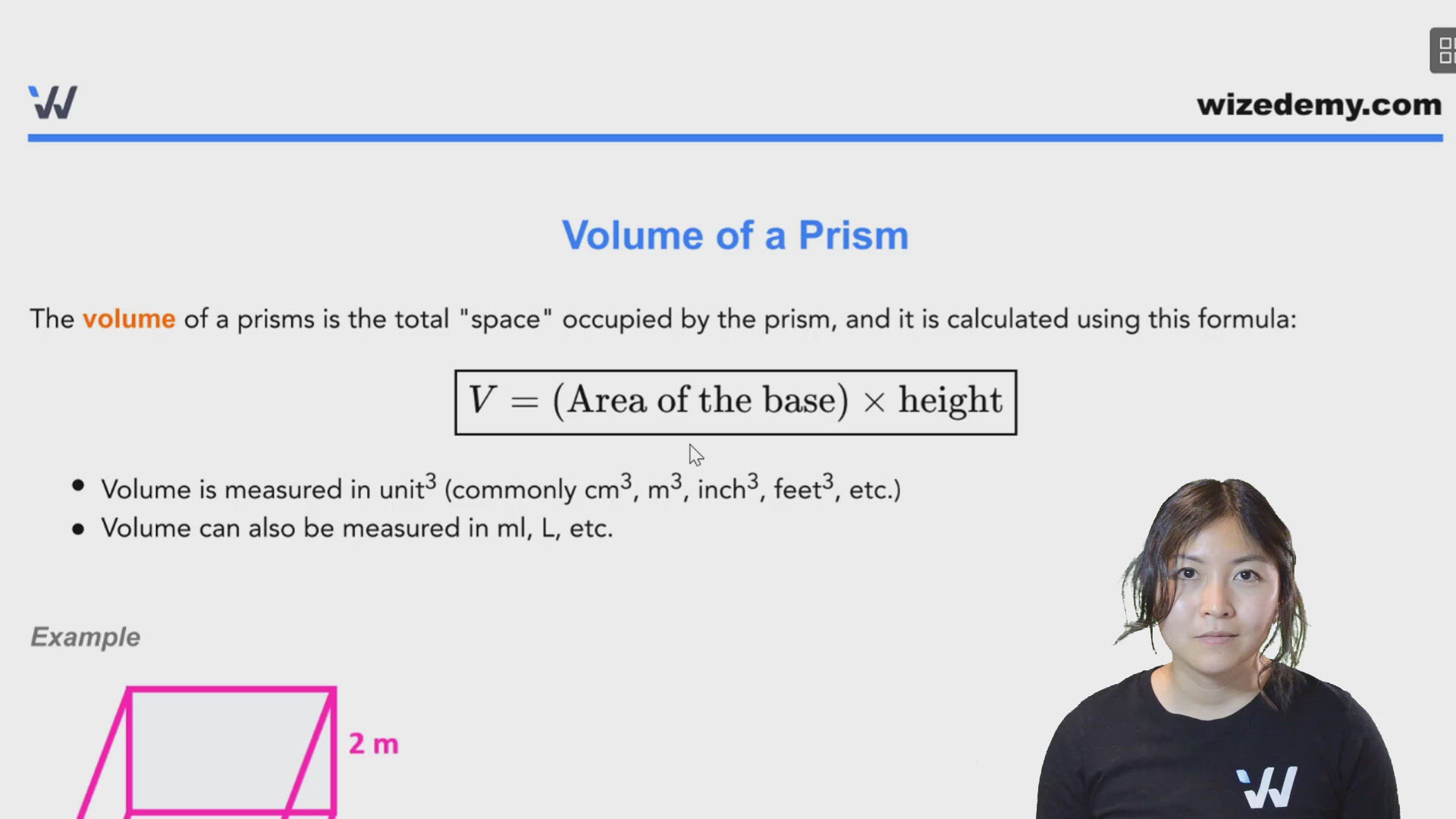
Volume of a Prism

The volume of a prisms is the total "space" occupied by the prism, and it is calculated using this formula:

Vprism=(Area of the base)×height\large\boxed{V_\text{prism}=(\text{Area of the base})\times \text{height}}

  • Volume is measured in unit3 (commonly cm3, m3, inch3, feet3, etc.)
  • Volume can also be measured in ml, L, etc.


Example

Image illustrating The Volume of a Prism

The volume of this prism is

V=(Area of the base)×heightV=(l×w)×hV=(3×2)×5V=30 m2\begin{array}{rcl} V&=&(\text{Area of the base})\times\text{height}\\ V&=&(l\times w)\times h\\ V&=&(3\times2)\times 5\\ V&=&30~m^2 \end{array}

So, the volume of this prism is 30 m2

Practice: Volume of a Prism

Find the volume of this cube.

Illustration for practice question: Practice: Volume of a Prism


Your answers

Create a free account to get started

Unlock full course notes by signing up

  • Video lessons taught by top educators
  • Practice questions with guided solutions
  • Written review notes for reference
  • Expert answers anytime from course tutors

Practice: Volume of a Prism

What is the volume of this triangular-based prism?


Illustration for practice question: Practice: Volume of a Prism


Your answers

Create a free account to get started

Unlock full course notes by signing up

  • Video lessons taught by top educators
  • Practice questions with guided solutions
  • Written review notes for reference
  • Expert answers anytime from course tutors

Practice: Prisms

Joe is designing a box for his chocolate company. He wants the box to be a prism with a regular pentagon base as shown in this diagram.


Illustration for practice question: Practice: Prisms

a) If the chocolate box must have a volume of 270 cm3, what should the length of this chocolate box be?


b) The chocolate box will be made out of cardboard material that cost $0.50/cm2. What is the cost required to produce the box from part a)?

Your answers

Create a free account to get started

Unlock full course notes by signing up

  • Video lessons taught by top educators
  • Practice questions with guided solutions
  • Written review notes for reference
  • Expert answers anytime from course tutors