Create a free account to get started

Unlock full course notes by signing up

  • Video lessons taught by top educators
  • Practice questions with guided solutions
  • Written review notes for reference
  • Expert answers anytime from course tutors

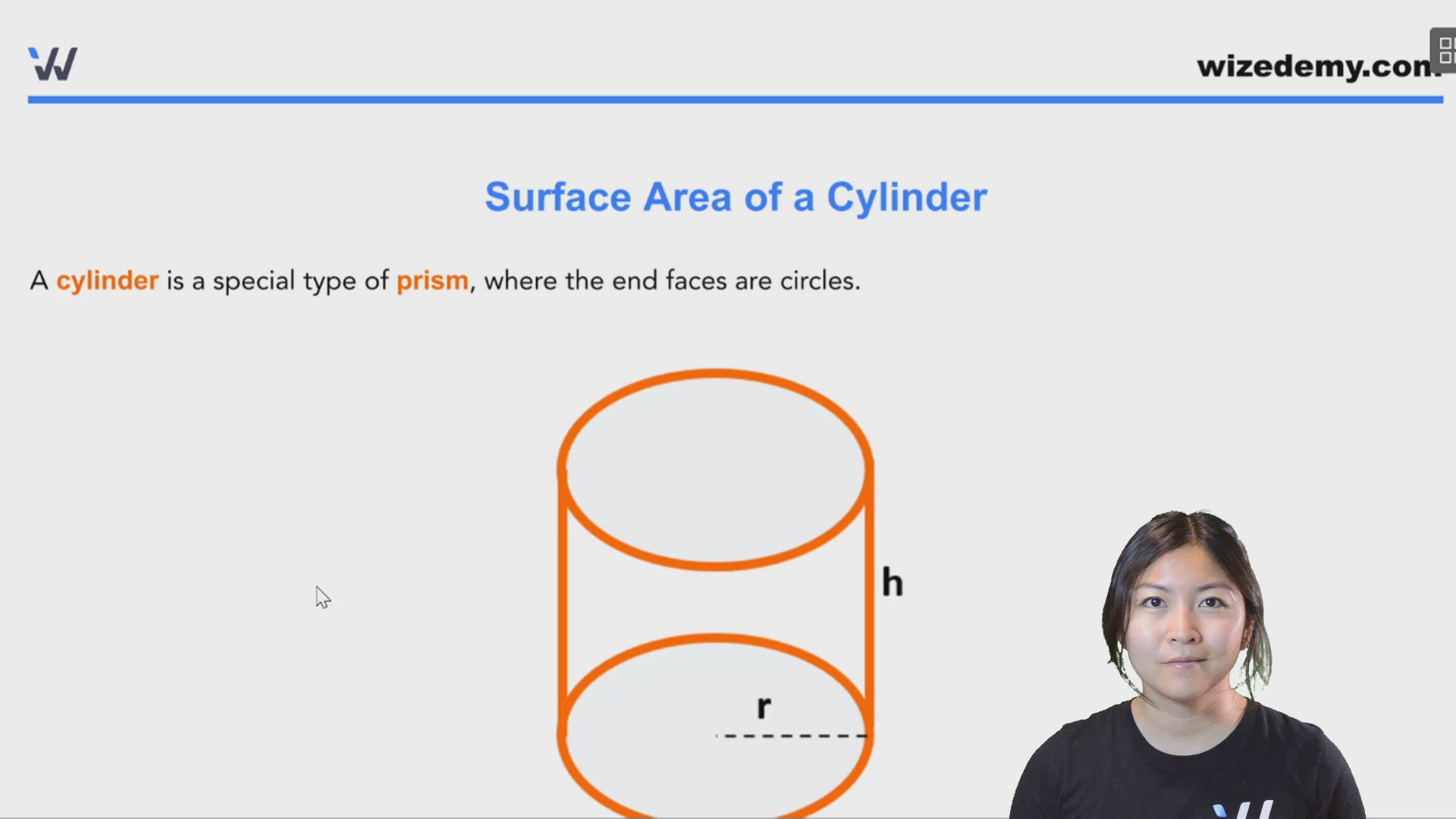
Surface Area of a Cylinder

A cylinder is a special type of prism, where the end faces are circles.
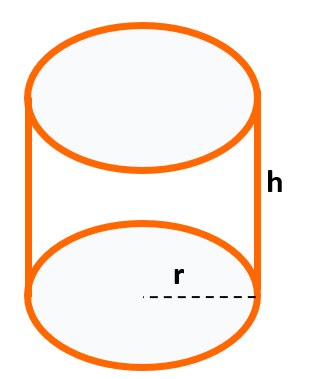

Image illustrating Surface Area of a Cylinder

The surface area of the cylinder is made up of the following:

  • Area of the top (circle): π×r2\pi\times r^2
  • Area of the bottom (circle): π×r2\pi\times r^2
  • Area of the side that wraps around the cylinder: ________
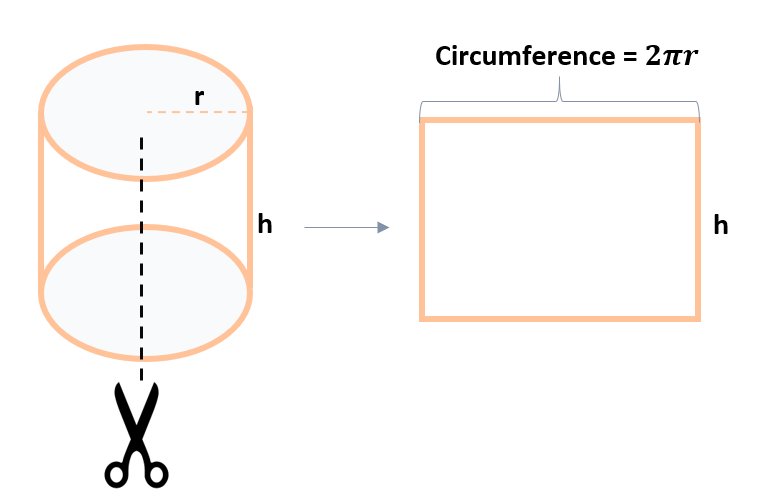
Image illustrating Surface Area of a Cylinder


So, the surface area of a cylinder is S.A.cylinder=2πr2+2πrh\large\boxed{\text{S.A.}_\text{cylinder}=2\pi r^2+2\pi r h}.


Practice: Surface Area of a Cylinder

Find the surface area of the cylinder with radius 3 m and height 10 m.

Your answers

Create a free account to get started

Unlock full course notes by signing up

  • Video lessons taught by top educators
  • Practice questions with guided solutions
  • Written review notes for reference
  • Expert answers anytime from course tutors

Create a free account to get started

Unlock full course notes by signing up

  • Video lessons taught by top educators
  • Practice questions with guided solutions
  • Written review notes for reference
  • Expert answers anytime from course tutors

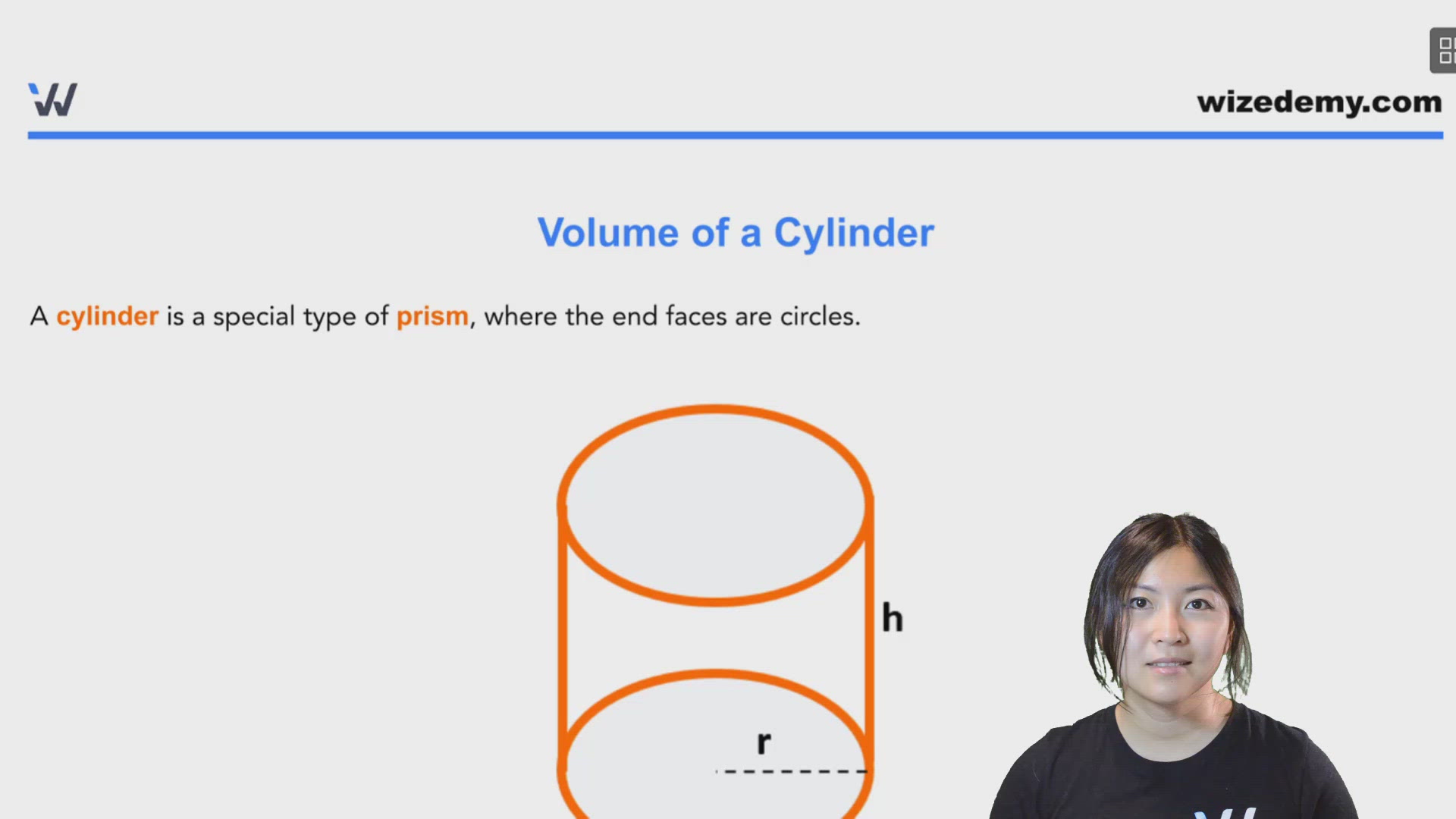
Volume of a Cylinder

A cylinder is a special type of prism, where the end faces are circles.


Image illustrating Volume of a Cylinder

Recall: The volume of a prism is V=(Area of the base)×heightV=(\text{Area of the base})\times\text{height}


So, the volume of a cylinder is Vcylinder=πr2h\large\boxed{V_\text{cylinder}=\pi r^2h}.

Practice: Volume of a Cylinder

Find the volume of a cylinder with radius 3 m and height 10 m.

Your answers

Create a free account to get started

Unlock full course notes by signing up

  • Video lessons taught by top educators
  • Practice questions with guided solutions
  • Written review notes for reference
  • Expert answers anytime from course tutors

Practice: Cylinders

Illustration for practice question: Practice: Cylinders


A cylindrical soda can has a volume of 0.35L. If the radius of the top of the can is 3.2 cm, determine the height of this soda can.


Useful conversions:

  • 1 L = 1000 ml
  • 1 ml = 1 cm3
Your answers

Create a free account to get started

Unlock full course notes by signing up

  • Video lessons taught by top educators
  • Practice questions with guided solutions
  • Written review notes for reference
  • Expert answers anytime from course tutors