Wize High School Grade 12 Pre-Calculus Textbook > Polynomial Functions
Factoring Polynomials (Degree 3+)
Popular Courses
Grade 12 Advanced Functions
Ontario High School
Grade 12 Pre-Calculus/Functions
Canada High School
Algebra II
US High School
Math 30-1
Alberta High School
Pre-Calculus 12
British Columbia High School
MATH 206
Concordia University
MATH 22
Pennsylvania State University
MAC 1140
University of Florida
MATH 150
Texas A&M University
MATH 41
Pennsylvania State University
MAT 170
Arizona State University - Tempe
MAC 1105
Florida State University
MAT 012
University of California - Davis
MATH 1148
Ohio State University
MTH 103A
Michigan State University
MTH 116
Michigan State University
MAC 1147
University of Florida
MATH 140
San Diego State University
MATH 2312
University of Houston
MA 15300
Purdue University

0:00 / 0:00
Remainder Theorem, Factor Theorem, & Rational Root Theorem
Factoring polynomials of degree 3 or higher requires the use of polynomial division along with 3 important theorems:
Remainder Theorem
Let be a polynomial function of degree . If , then the remainder, , is:
Example 1
Find the remainder of when it is divided by .
Using the remainder theorem, find
The remainder is -1
Factor Theorem
Let be a polynomial function of degree . If is a factor of Then:
Example 2
Determine if is a factor of .
Using the factor theorem:
Since the remainder is 0, then is a factor of
Rational Root Theorem
If is divided by , then the possible roots of are:
Example 3
Determine all the roots for .
Using the rational root theorem:
0:00 / 0:00
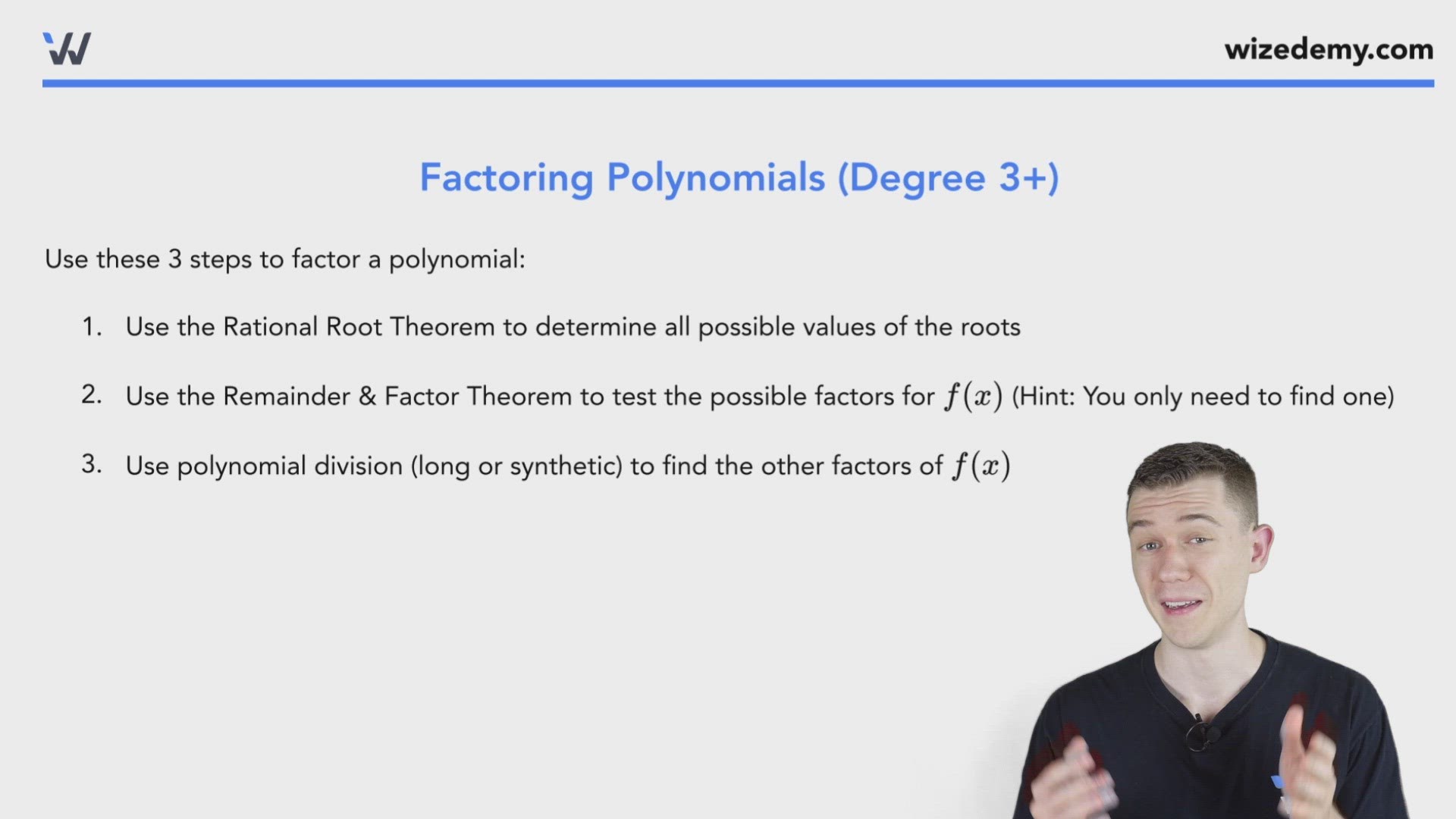
Factoring Polynomials (Degree 3+)
Use these 3 steps to factor a polynomial:
- Use the Rational Root Theorem to determine all possible values of the roots
- Use the Remainder & Factor Theorem to test the possible factors for (Hint: You only need to find one)
- Use polynomial division (long or synthetic) to find the other factors of
Example
Fully factor
Step 1.
Use the Rational Root Theorem to determine all possible values of the roots
Factors of 32: 1, 2, 4, 8, 16, 32
Factors of 2: 1, 2
All possible factors are:
Step 2.
Use the Remainder & Factor Theorem to test the possible factors for (Hint: You only need to find one)
:
Since does not give a remainder of 0, then is not a factor of f(x)
:
Since gives a remainder of 0, then is a factor
Step 3.
Use polynomial division (long or synthetic) to find the other factors of
The quotient becomes:
The division statement becomes:
0:00 / 0:00
Example: Factoring Polynomials (Degree 3+)
Factor fully and graph
Step 1.
Use the Rational Root Theorem to determine all possible values of the roots.
Factors of 6: 1, 2, 3, 6
Factors of 1: 1
All possible roots are:
Step 2.
Use the Remainder & Factor Theorem to test the possible factors for . (Hint: You only need to find one)
:
x = 1 is not a possible root
:
Therefore, is a root and is a factor
Step 3.
Use polynomial division (long or synthetic) to find the other factors of
The quotient becomes:
The division statement becomes:
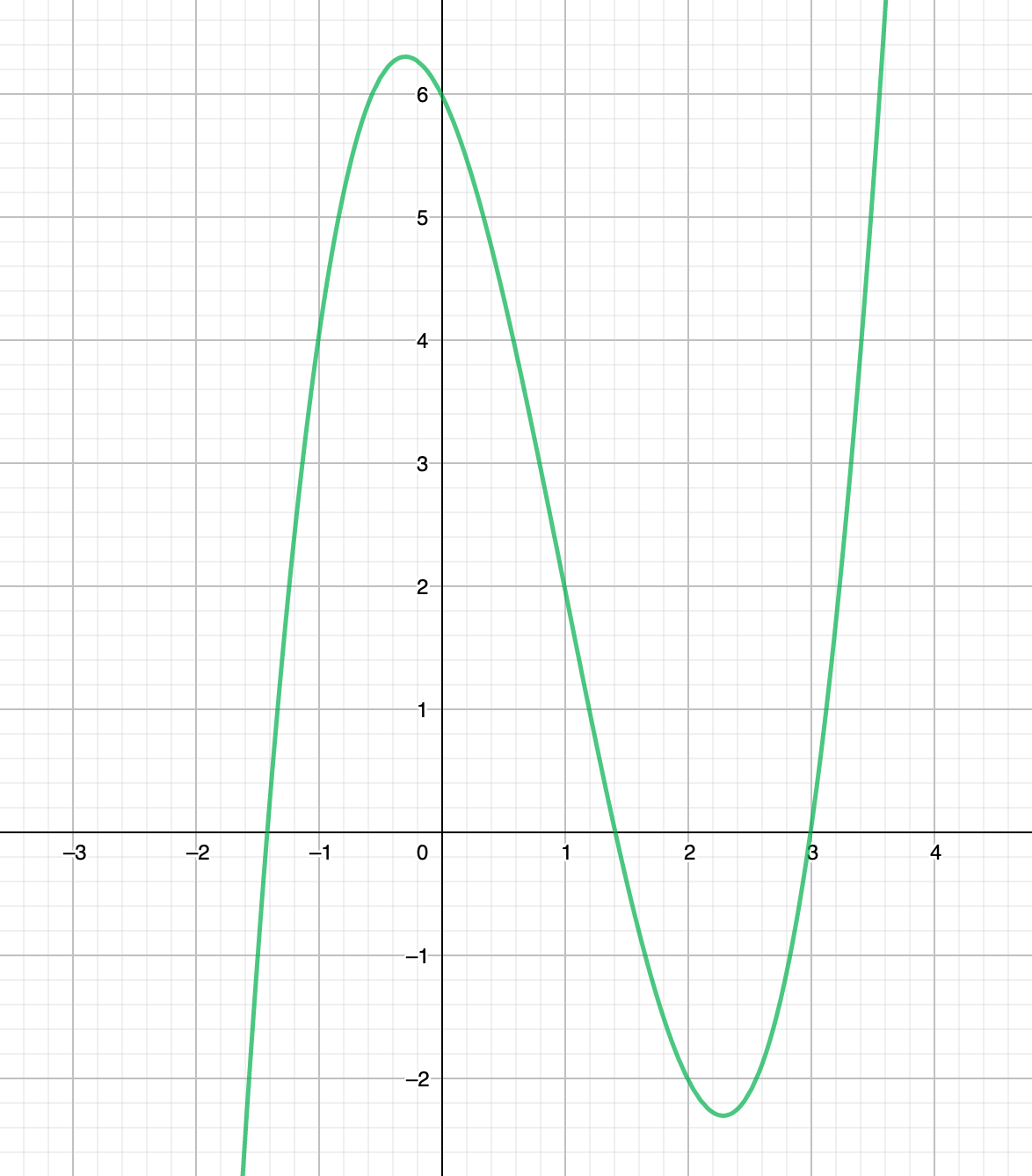
The graph:
Practice: Factoring Polynomials (Degree 3+)
True or False: A factor of is
Practice: Factoring Polynomials (Degree 3+)
Fully factor .
Practice: Factoring Polynomials (Degree 3+)
The remainder when is divided by (x - 5) is -14. When is divided by (x+1), the remainder is -2.
What are the values of a and b?