0:00 / 0:00

Transformations of Sinusoidal Functions (Pt 1)


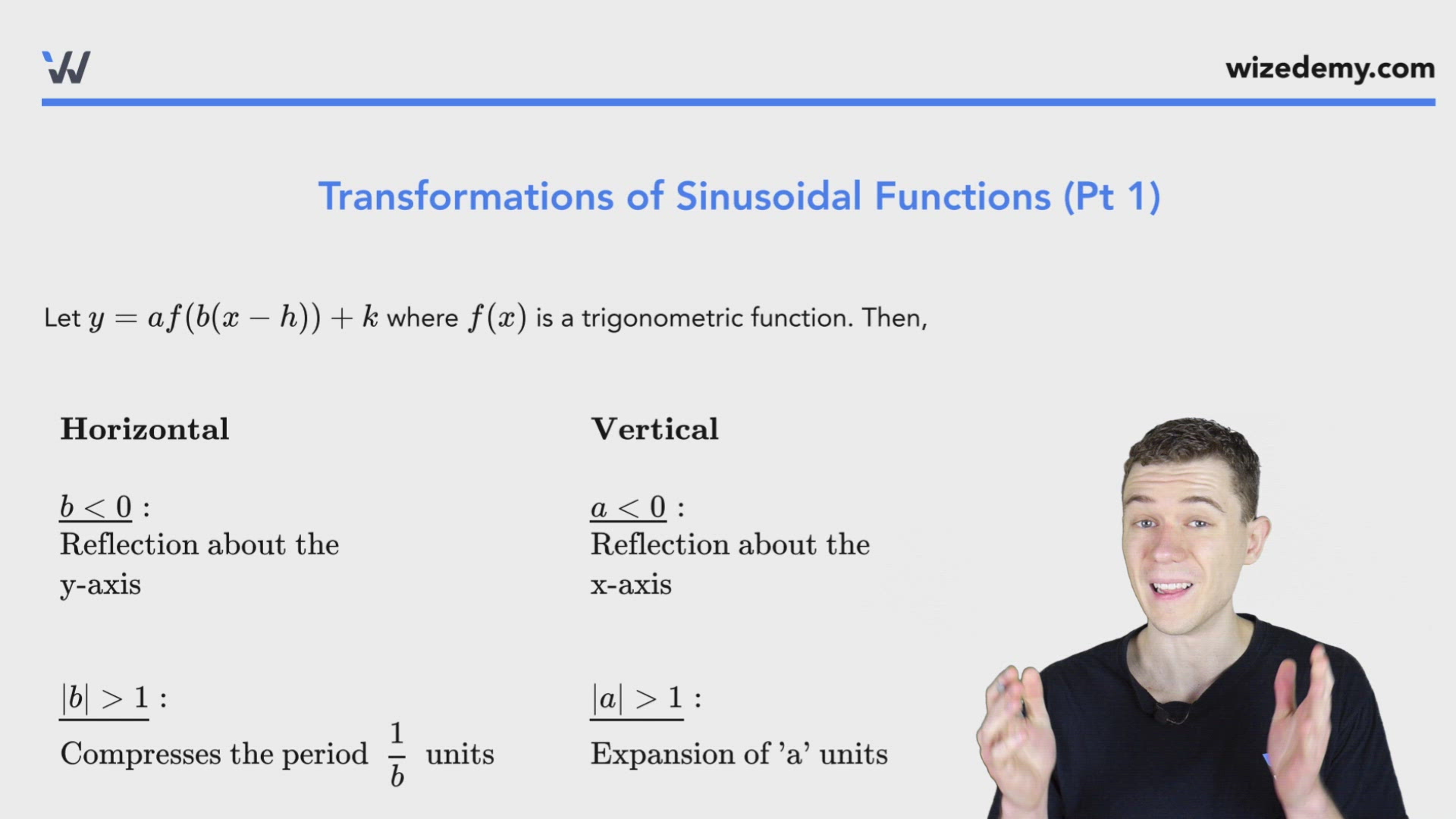
Let y=af(b(xh))+ky=af(b(x-h))+k where f(x)f(x) is a trigonometric function. Then,


HorizontalVerticalb<0:a<0:Reflection about theReflection about they-axisx-axisb>1:a>1:Compresses the period  1b  unitsExpansion of ’a’ unitsb<1:a<1:Expands the period  1b  unitsCompression of ’a’ unitsh>0:k>0:Phase shift ’h’ units rightDisplacement ’k units uph<0:k<0:Phase shift ’h’ units leftDisplacement ’k’ units down\begin{array}{l c c l} \textbf{Horizontal}&&&\textbf{Vertical}\\\\ \underline{b<0}:&&&\underline{a<0}:\\ \text{Reflection about the}&&&\text{Reflection about the}\\ \text{y-axis}&&&\text{x-axis}\\\\\\ \underline{|b|>1}:&&&\underline{|a|>1}:\\ \text{Compresses the period}~~\displaystyle\frac{1}{b}~~\text{units}&&&\text{Expansion of 'a' units}\\\\\\ \underline{|b|<1}:&&&\underline{|a|<1}:\\ \text{Expands the period}~~\displaystyle\frac{1}{b}~~\text{units}&&&\text{Compression of 'a' units}\\\\\\ \underline{h>0}:&&&\underline{k>0}:\\ \text{Phase shift 'h' units right}&&&\text{Displacement 'k units up}\\\\\\ \underline{h<0}:&&&\underline{k<0}:\\ \text{Phase shift 'h' units left}&&&\text{Displacement 'k' units down} \end{array}


Wize Tip
The value 2πb\colorThree{\displaystyle\frac{2\pi}{|b|}} is the period.

PAGE BREAK

How to Graph the Transformation of a Sine or Cosine Function

Step 1.
Find the period.

P=2πbP=\displaystyle\frac{2\pi}{b}

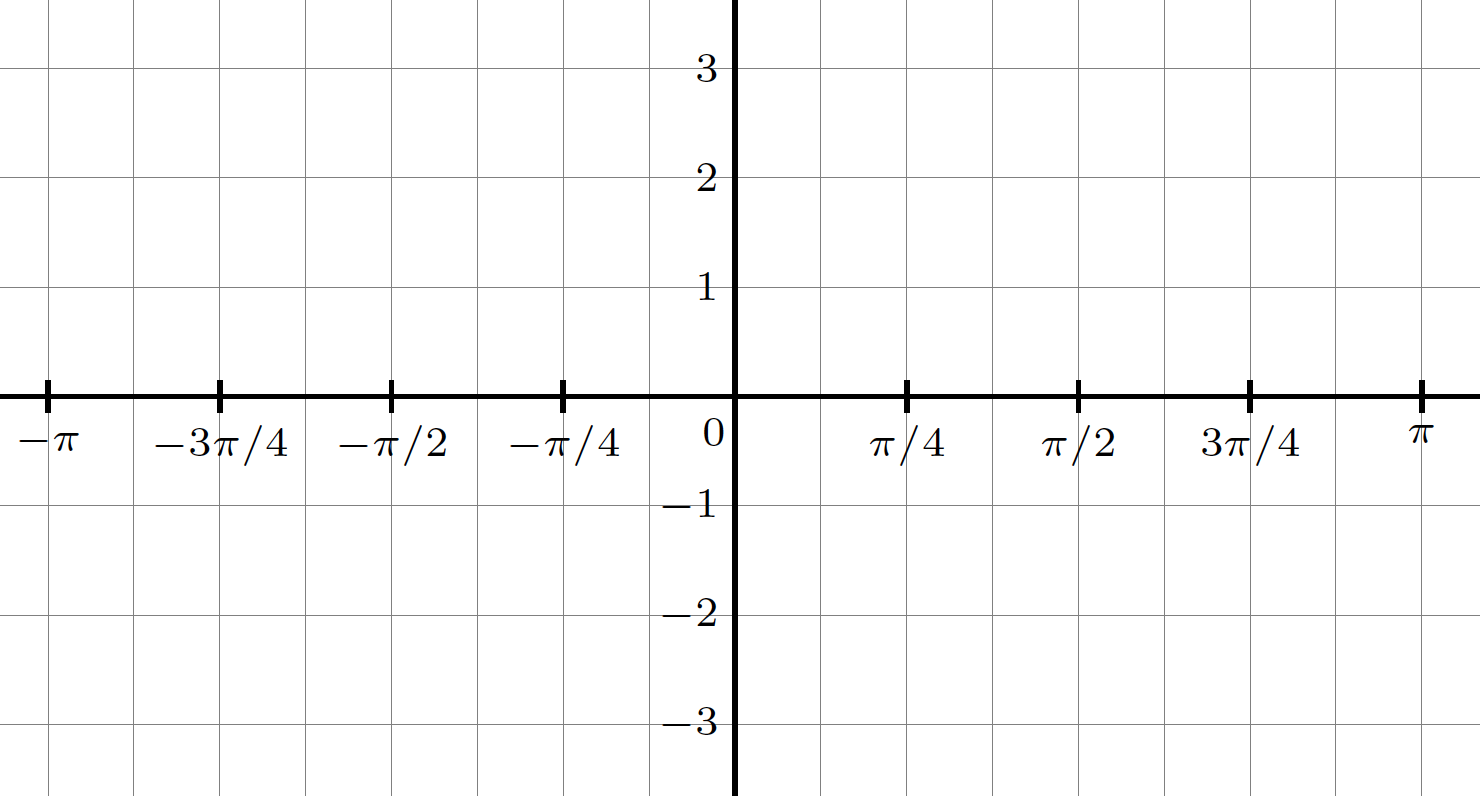
Count 8 spaces from the origin (left and/or right).
Label the period.
Label the rest of the graph.

Step 2.
Find the amplitude 'aa


Step 3.
Find the vertical displacement 'kk'.


PAGE BREAK

Step 4.
Identify:

YMaximum=a+kYAverage=kYMinimum=a+k\begin{array}{lcl} Y-\text{Maximum}&=&a+k\\\\ Y-\text{Average}&=&k\\\\ Y-\text{Minimum}&=&-a+k \end{array}


Step 5.

Identify the phase shift and determine how many units to the left or right the function must move.

n=Phase Shift(Period÷8)n=\displaystyle\frac{\text{Phase Shift}}{(\text{Period}\div8)}


PAGE BREAK

Step 6.

Graph.

If sinθ\sin{\theta}:

Begin on a Y-Average\color{Red}{\text{Y-Average}}.
Count 2 units right and plot a Y-Maximum\color{red}{\text{Y-Maximum}}.
Count 2 units right and plot a Y-Average\color{red}\text{Y-Average}.
Count 2 units right and plot a Y-Minimum\color{red}\text{Y-Minimum}.
Count 2 units right and plot a Y-Average\color{red}\text{Y-Average}.
Continue this pattern in the right/left direction.

If cosθ\cos{\theta}:

Begin on a Y-Maximum\color{red}\text{Y-Maximum}.
Count 2 units right and plot a Y-Average\color{red}\text{Y-Average}.
Count 2 units right and plot a Y-Minimum\color{red}\text{Y-Minimum}.
Count 2 units right and plot a Y-Average\color{red}\text{Y-Average}.
Count 2 units right and plot a Y-Maximum\color{red}\text{Y-Maximum}.
Continue this pattern in the right/left direction.
PAGE BREAK

Example 1

Let's look at y=2sin(2(θπ4))+1y=2\sin(2(\theta-\frac{\pi}{4}))+1.

Step 1.
Find the period.

P=2π2=πP=\displaystyle\frac{2\pi}{2}=\pi

Count 8 spaces from the origin (left & right).
Label the period.
Label the rest of the graph.


Step 2.
Find the amplitude.

a=2a=2


Step 3.
Find the vertical displacement.

k=1k=1

PAGE BREAK


Step 4.
Identify the YMaximum, Yaverage, YMinimum\colorThree{Y-\text{Maximum},~Y-\text{average},~Y-\text{Minimum}}.

Y-Min=1\text{Y-Min}=-1

Y-Avg=1\text{Y-Avg}=1

Y-Max=3\text{Y-Max}=3


Step 5.
Identify the phase shift and determine how many units to the left or right the function must move.

The phase shift is π4\displaystyle\frac{\pi}{4} units right.

So, how many cartesian coordinates right is this?

h=π4(π÷8)=2h=\displaystyle\frac{\frac{\pi}{4}}{(\pi\div{8})}=2

This means that π4\displaystyle\frac{\pi}{4} is 2 units right from the origin.

PAGE BREAK


Step 6.

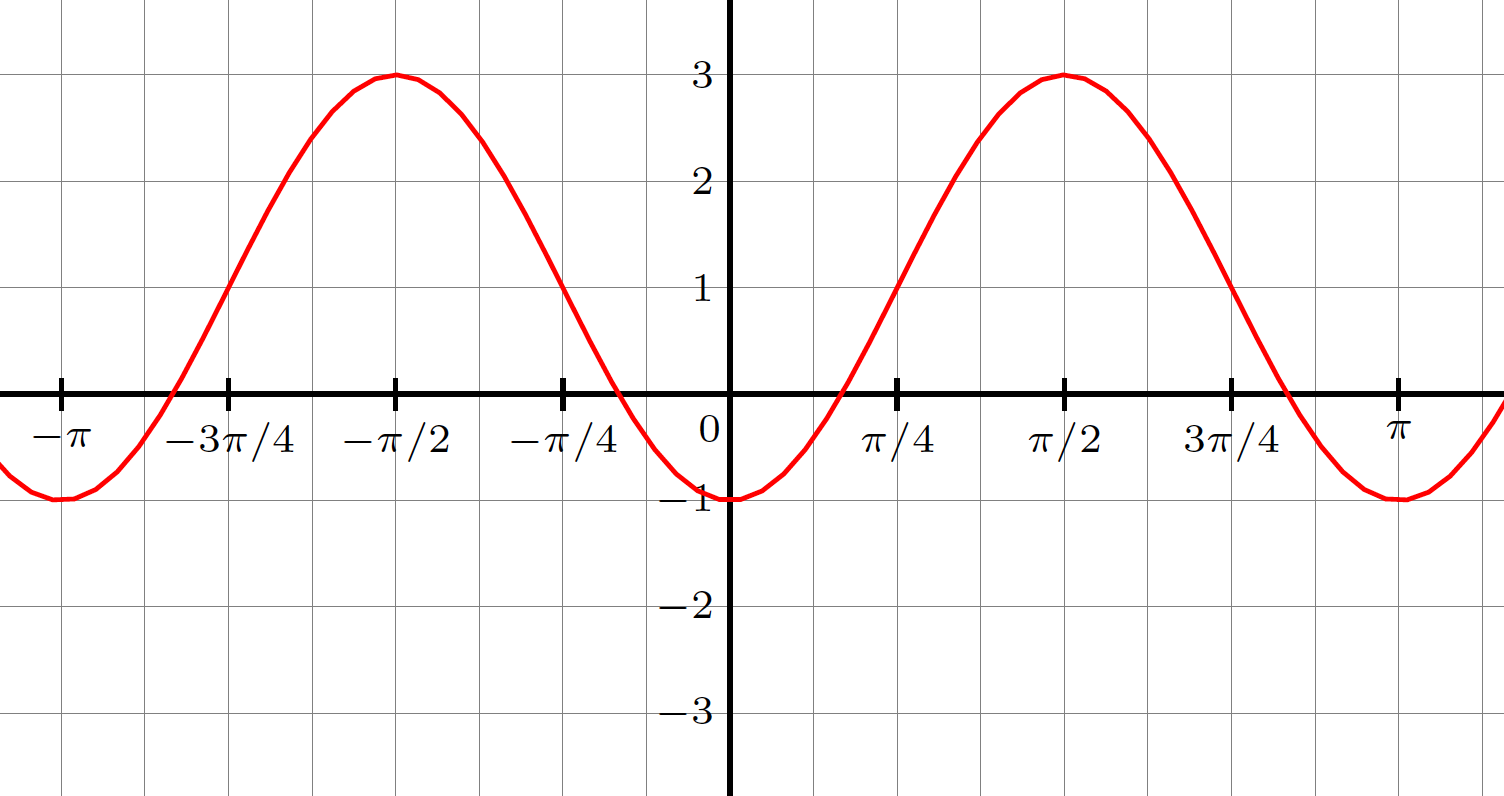
Since we are graphing sinθ\sin{\theta} , then we begin on an Y-Average\color{red}\text{Y-Average} of (π4,1)\Bigg(\displaystyle\frac{\pi}{4},1\Bigg)

Count 2 spaces to the right and plot the Y-Maximum\color{red}\text{Y-Maximum} at (π2,3)\Bigg(\displaystyle\frac{\pi}{2},3\Bigg)

Count 2 spaces to the right and plot the Y-Average\color{red}\text{Y-Average} of (3π4,1)\Bigg(\displaystyle\frac{3\pi}{4},1\Bigg)

Count 2 spaces to the right and plot the Y-Minimum\color{red}\text{Y-Minimum} of (π,1)(\pi,-1)


Count 2 spaces to the right and plot the Y-Average\color{red}\text{Y-Average} of (5π4,1)\Bigg(\displaystyle\frac{5\pi}{4},1\Bigg)

PAGE BREAK

Continue on with this pattern in both directions,
0:00 / 0:00

Example: Transformations of Sinusoidal Functions

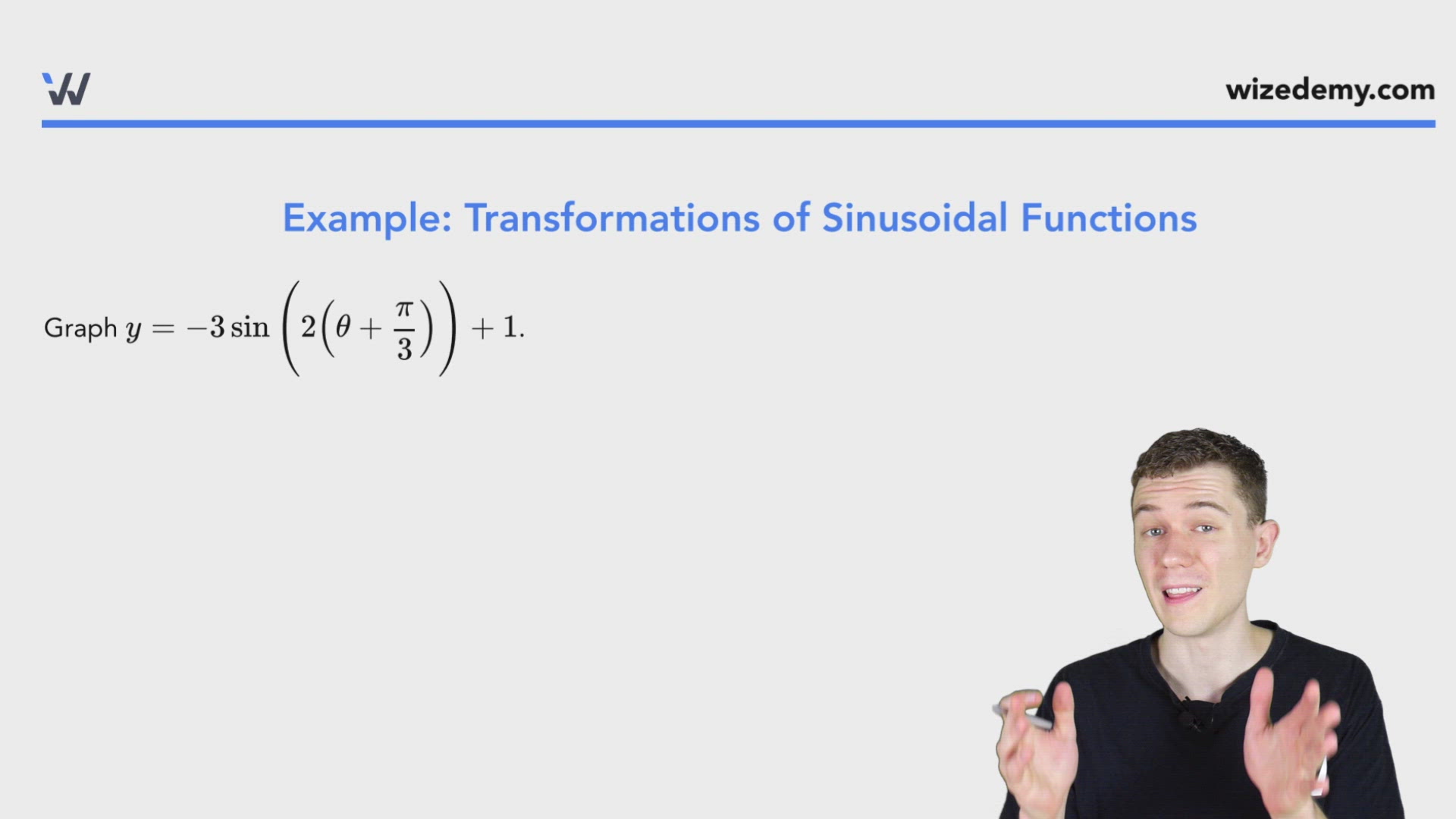
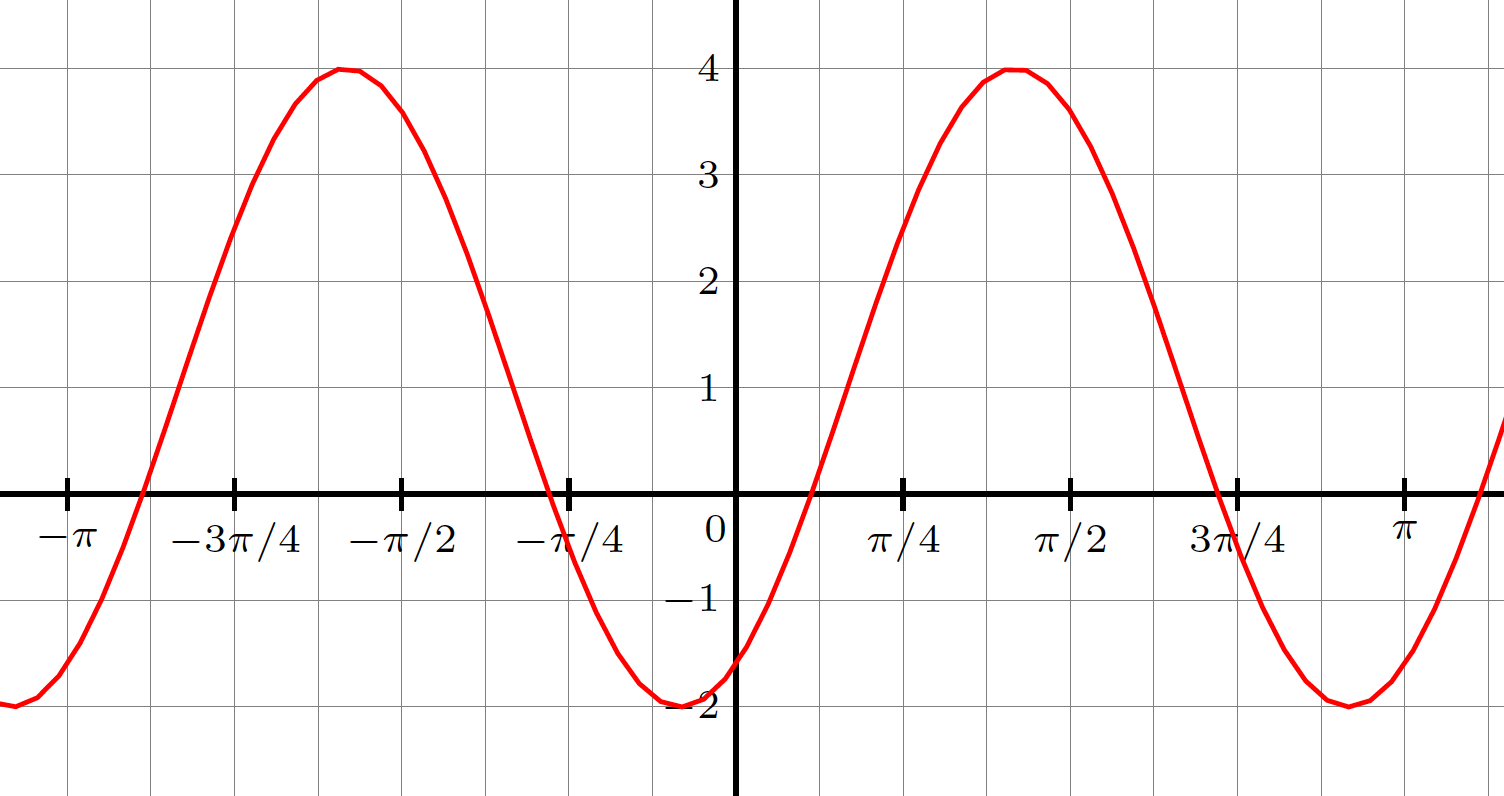
Graph y=3sin(2(θ+π3))+1y=-3\sin\Bigg(2\Big(\theta+\displaystyle\frac{\pi}{3}\Big)\Bigg)+1.


Step 1.
Find the period.

P=2π2=πP=\displaystyle\frac{2\pi}{2}=\pi

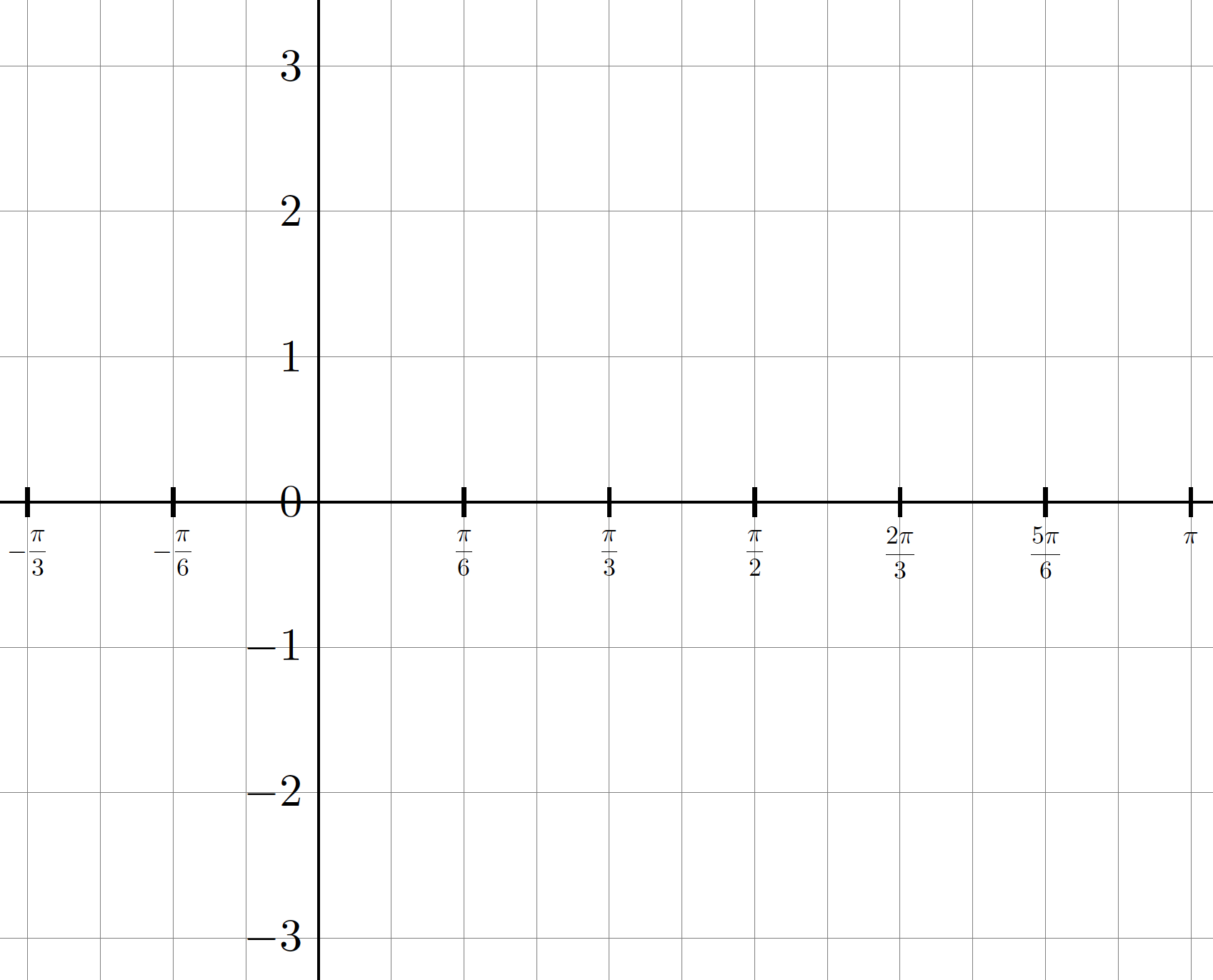
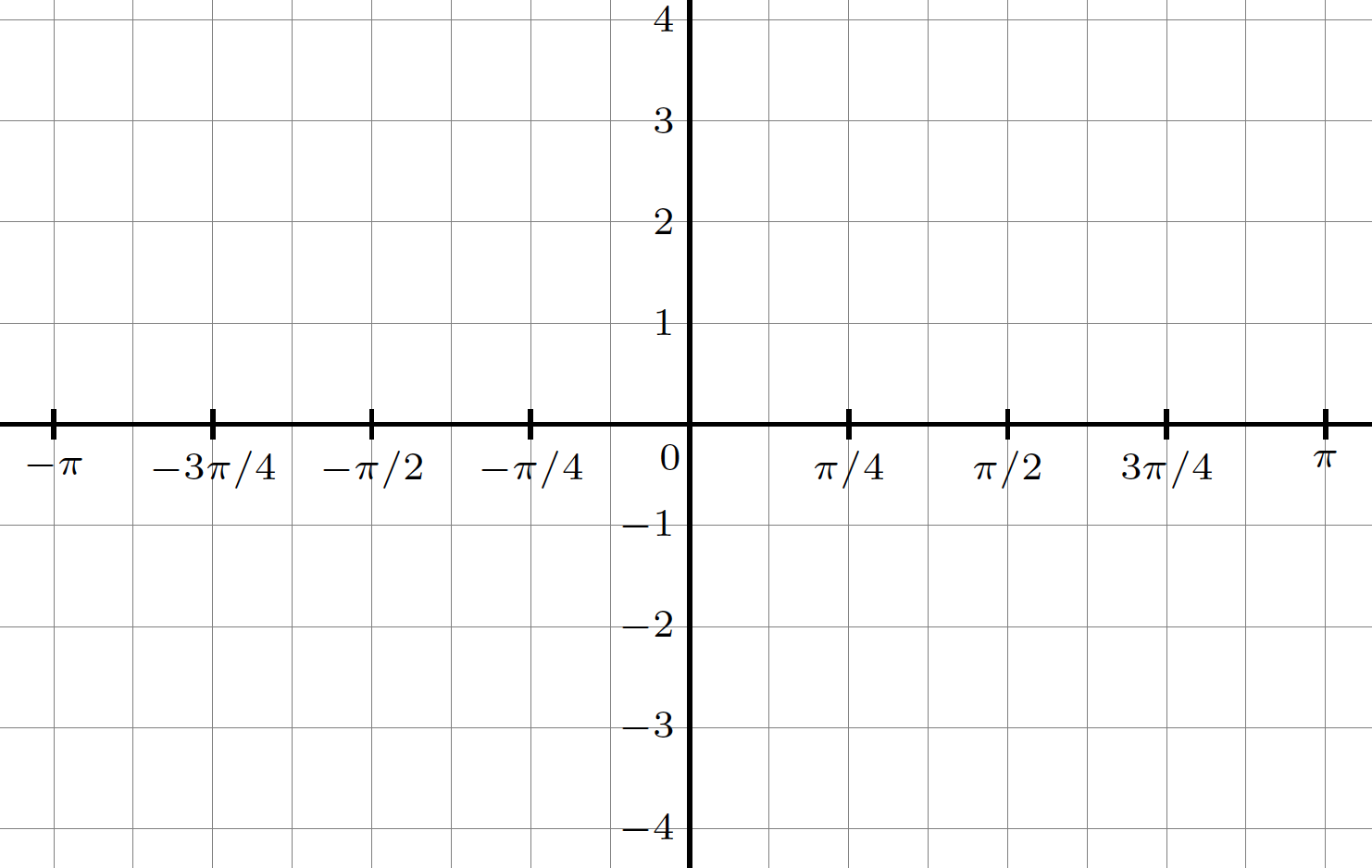
Count 8 spaces from the origin (left & right).
Label the period.
Label the rest of the graph.

Step 2.
Find the amplitude.

a=3a=3


Step 3.
Find the vertical displacement.

k=1k=1


Step 4.
Identify the YMaximum, Yaverage, YMinimum\colorThree{Y-\text{Maximum},~Y-\text{average},~Y-\text{Minimum}}.

Y-Min=(3)+1=4\text{Y-Min}=-(-3)+1=4

Y-Avg=1\text{Y-Avg}=1

Y-Max=3+1=2\text{Y-Max}=-3+1=-2


Step 5.
Identify the phase shift and determine how many units to the left or right the function must move.

The phase shift is π3\displaystyle\frac{\pi}{3} units left.

Therefore,

h=π3(π÷8)=83h=\displaystyle\frac{\frac{\pi}{3}}{(\pi\div{8})}=\displaystyle\frac{8}{3}

This means that π3\displaystyle\frac{\pi}{3} is 83\displaystyle\frac{8}{3} units left of the origin.


Step 6.

Since we are graphing sinθ\sin{\theta} , then we begin on an Y-Average\color{red}\text{Y-Average} of (π3,1)\Bigg(-\displaystyle\frac{\pi}{3},1\Bigg)

Count 2 spaces to the right and plot the Y-Maximum\color{red}\text{Y-Maximum} at (π12,2)\Bigg(-\displaystyle\frac{\pi}{12},-2\Bigg)

Count 2 spaces to the right and plot the Y-Average\color{red}\text{Y-Average} of (π6,1)\Bigg(\displaystyle\frac{\pi}{6},1\Bigg)

Count 2 spaces to the right and plot the Y-Minimum\color{red}\text{Y-Minimum} of (5π6,4)\Bigg(\displaystyle\frac{5\pi}{6},4\Bigg)


Count 2 spaces to the right and plot the Y-Average\color{red}\text{Y-Average} of (2π3,1)\Bigg(\displaystyle\frac{2\pi}{3},1\Bigg)

Continue on with this pattern in both directions.
0:00 / 0:00

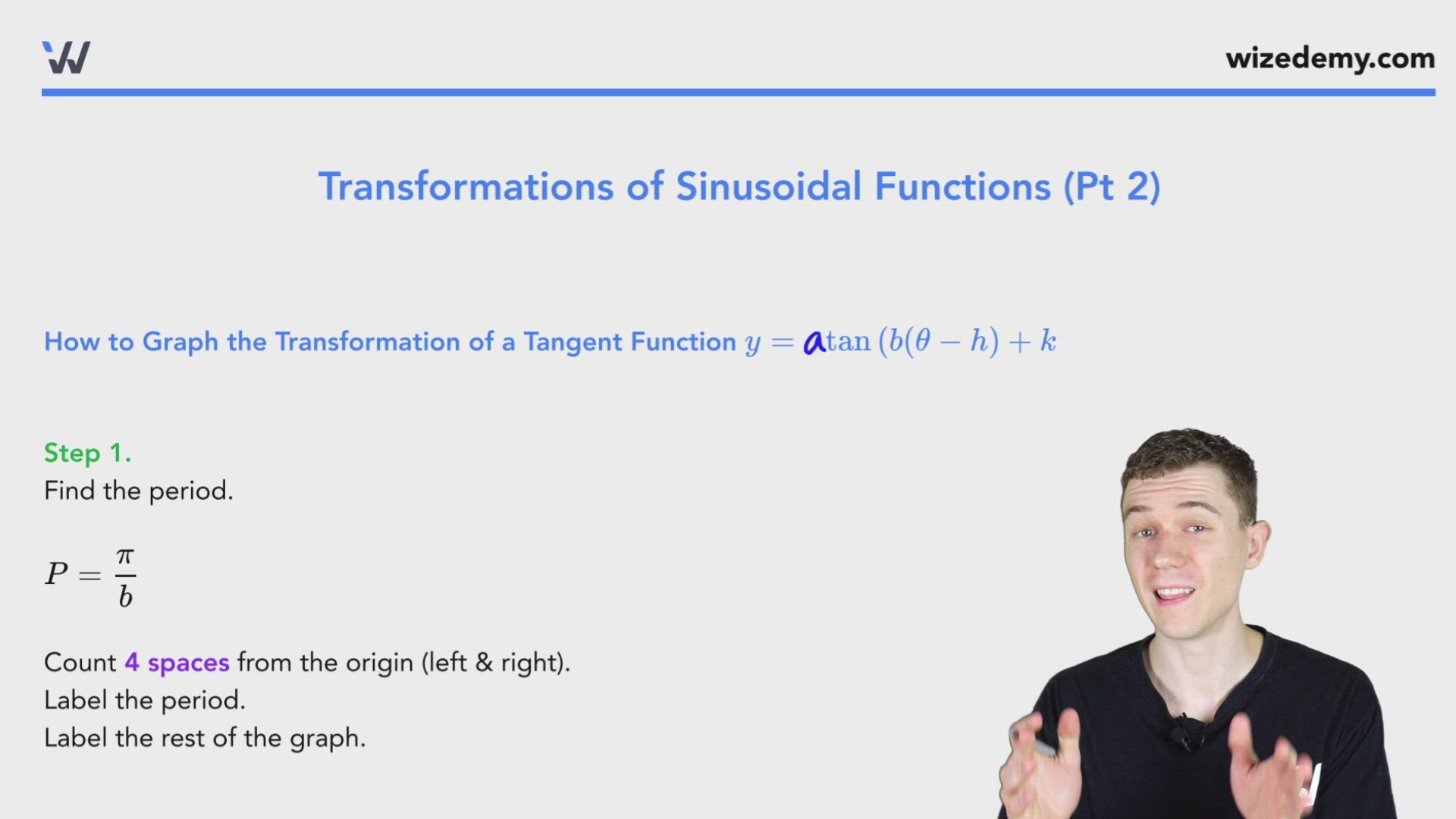
Transformations of Sinusoidal Functions (Pt 2)


How to Graph the Transformation of a Tangent Function y=atan(b(θh)+k\colorOne{y=a\tan{(b(\theta-h)+k}}


Step 1.
Find the period.

P=πbP=\displaystyle\frac{\pi}{b}

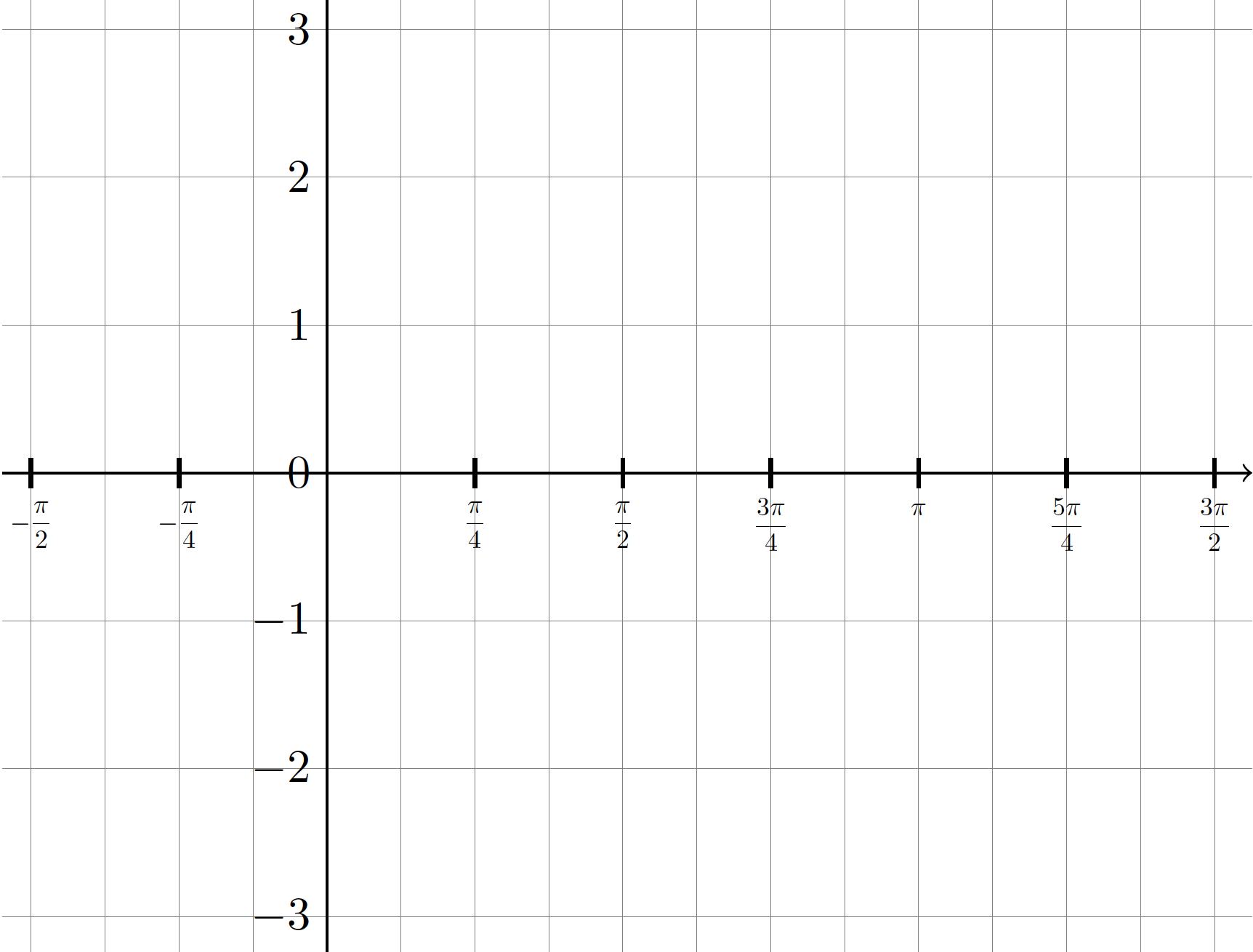
Count 4 spaces from the origin (left & right).
Label the period.
Label the rest of the graph.

Step 2.
Identify the phase shift and calculate how many units left/right the shift is.

h=Phase Shift(Period÷4)h=\displaystyle\frac{\text{Phase Shift}}{(\text{Period}\div4)}


Step 3.
Identify the x-intercepts.

(0,0)±πn, nW    (0b+h ,0)±πbn, nW(0,0)\pm{}\pi{}n,~n\in\mathbb{W}~~{\color{red}\rightarrow}~~\Bigg(\displaystyle\frac{0}{\colorThree{b}}+{\colorThree{h}}~,0\Bigg)\pm{}\displaystyle\frac{\pi}{\colorThree{b}}{}n,~n\in\mathbb{W}


PAGE BREAK

Step 4.
Identify the vertical asymptotes.

(π2,0)±πn, nW    ((π2÷b)+h ,0)±πbn, nW\Bigg(\displaystyle\frac{\pi}{2},0\Bigg)\pm{}\pi{}n,~n\in\mathbb{W}~~{\color{red}\rightarrow}~~\Bigg(\Big(\displaystyle\frac{\pi}{2}\div{\colorThree{b}}\Big)+{\colorThree{h}}~,0\Bigg)\pm{}\displaystyle\frac{\pi}{\colorThree{b}}{}n,~n\in\mathbb{W}


Step 5.
The points (π4,1)  &  (π4,1) ±πn,  nW\Bigg(\displaystyle-\frac{\pi}{4},-1\Bigg)~~\&~~\Bigg(\displaystyle\frac{\pi}{4},1\Bigg)~\pm{}\pi{}n,~~n\in\mathbb{W} are on the graph of y=tanθy=\tan{\theta}.

Find the points on the transformed function.

((π4÷b)+h,1a+k)  &  ((π4÷b+h,1a+k) ±πbn,  nW\Bigg(\Big(\displaystyle-\frac{\pi}{4}\div{\colorThree{b}}\Big)+\colorThree{h},-1\colorThree{a}+\colorThree{k}\Bigg)~~\&~~\Bigg(\Big(\displaystyle\frac{\pi}{4}\div{\colorThree{b}}+\colorThree{h},1\colorThree{a}+\colorThree{k}\Bigg)~\pm{}\displaystyle\frac{\pi}{\colorThree{b}}n,~~n\in\mathbb{W}

Step 6.

Graph.

Begin with an x-intercept\color{red}\text{x-intercept}
Count 2 units right and draw a vertical asymptote\color{red}\text{vertical asymptote}
Count 2 units right and draw an x-intercept\color{red}\text{x-intercept}
Count 2 units right and draw a vertical asymptote\color{red}\text{vertical asymptote}
Count 2 units right and draw an x-intercept\color{red}\text{x-intercept}
Continue this pattern right/left.

PAGE BREAK
Example

Let's look at y=2tan2(θπ16)y=2\tan{2(\theta-\frac{\pi}{16})}.

Step 1.

P=π2P=\displaystyle\frac{\pi}{2}

Count 4 spaces from the origin (left & right).
Label the period.
Label the rest of the graph.


Step 2.

h=π16(π2÷4)=0.5h=\displaystyle\frac{\frac{\pi}{16}}{(\frac{\pi}{2}\div4)}=0.5

Therefore, π16\displaystyle\frac{\pi}{16} is 0.5 units right.


Step 3.

X-intercepts:

(02+π16, 0)±π2n, nW    (π16,0)±π2n, nW\Bigg(\displaystyle\frac{0}{2}+\displaystyle\frac{\pi}{16},~0\Bigg)\pm{}\displaystyle\frac{\pi}{2}n,~n\in\mathbb{W}~~{\color{red}\rightarrow}~~\Bigg(\displaystyle\frac{\pi}{16},0\Bigg)\pm{}\displaystyle\frac{\pi}{2}n,~n\in\mathbb{W}


PAGE BREAK

Step 4.

Vertical asymptotes:

(π2÷2+π16)±π2n, nW    5π16±π2n, nW\Bigg(\displaystyle\frac{\pi}{2}\div{2}+\displaystyle\frac{\pi}{16}\Bigg)\pm{}\displaystyle\frac{\pi}{2}n,~n\in\mathbb{W}~~{\color{red}\rightarrow}~~\displaystyle\frac{5\pi}{16}\pm{}\displaystyle\frac{\pi}{2}n,~n\in\mathbb{W}


Step 5.

(π4,1)  &  (π4,1) ±πn,  nW      (π16,2)  &  (3π16,2) ±π2n,  nW\Bigg(\displaystyle-\frac{\pi}{4},-1\Bigg)~~\&~~\Bigg(\displaystyle\frac{\pi}{4},1\Bigg)~\pm{}\pi{}n,~~n\in\mathbb{W}~~~{\color{red}\rightarrow}~~~\Bigg(\displaystyle-\frac{\pi}{16},-2\Bigg)~~\&~~\Bigg(\displaystyle\frac{3\pi}{16},2\Bigg)~\pm{}\frac{\pi}{2}{}n,~~n\in\mathbb{W}


Step 6.

Graph.

Begin with an x-intercept\color{red}\text{x-intercept} at (π16,0)\Bigg(\displaystyle\frac{\pi}{16},0\Bigg)
Count 2 units right and draw a vertical asymptote\color{red}\text{vertical asymptote} at x=5π16x=\displaystyle\frac{5\pi}{16}
Count 2 units right and draw an x-intercept\color{red}\text{x-intercept} at (9π16,0)\Bigg(\displaystyle\frac{9\pi}{16},0\Bigg)
Count 2 units right and draw a vertical asymptote\color{red}\text{vertical asymptote} at x=13π16x=\displaystyle\frac{13\pi}{16}
Count 2 units right and draw an x-intercept\color{red}\text{x-intercept} (17π16,0)\Bigg(\displaystyle\frac{17\pi}{16},0\Bigg)
Count 2 units right and draw a vertical asymptote\color{red}\text{vertical asymptote} at x=21π16x=\displaystyle\frac{21\pi}{16}
Continue this pattern right/left.

PAGE BREAK

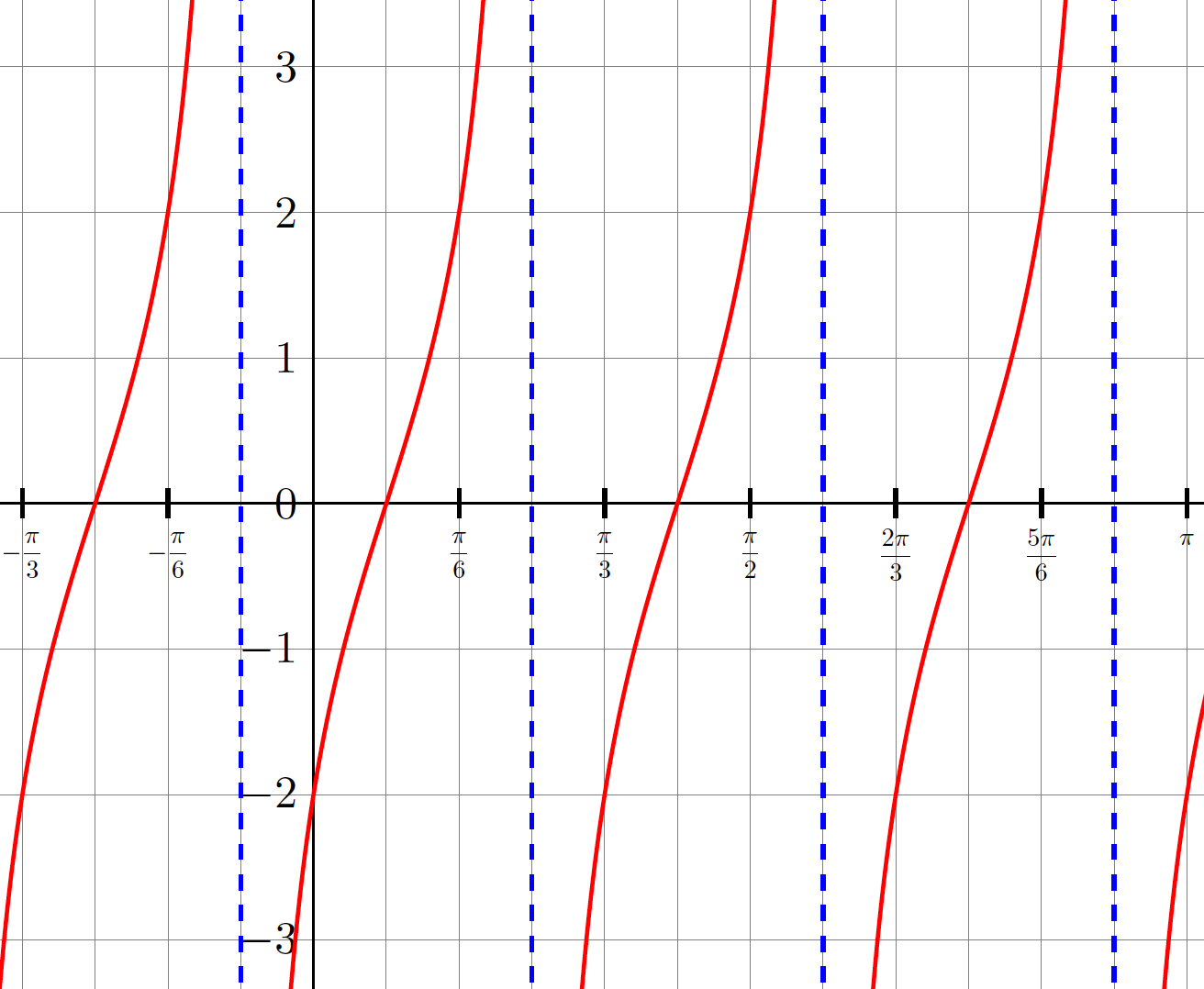
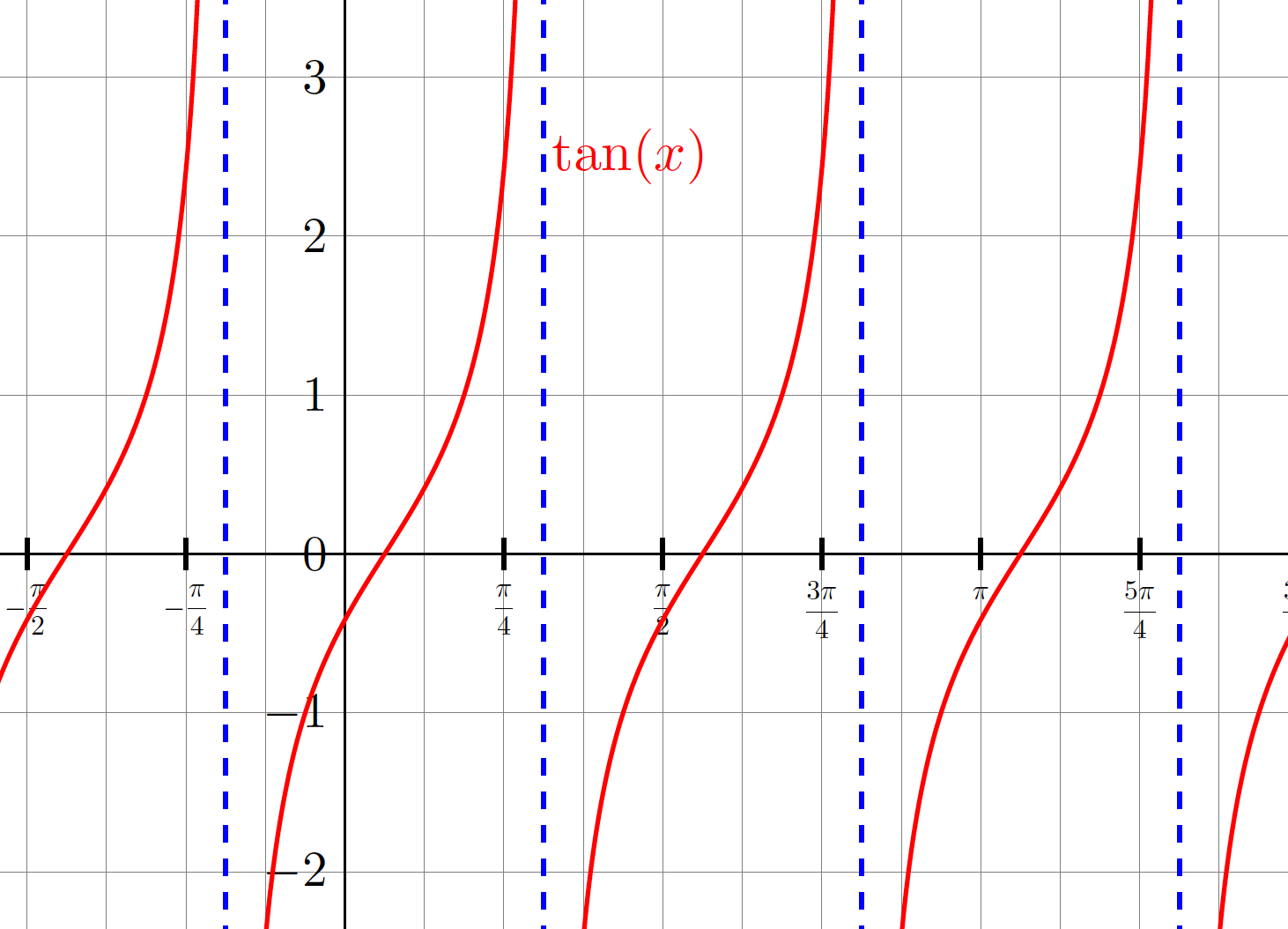
Plot the points from Step 5 and connect the dots, trending towards the asymptotes.
0:00 / 0:00

Example: Transformations of Sinusoidal Functions

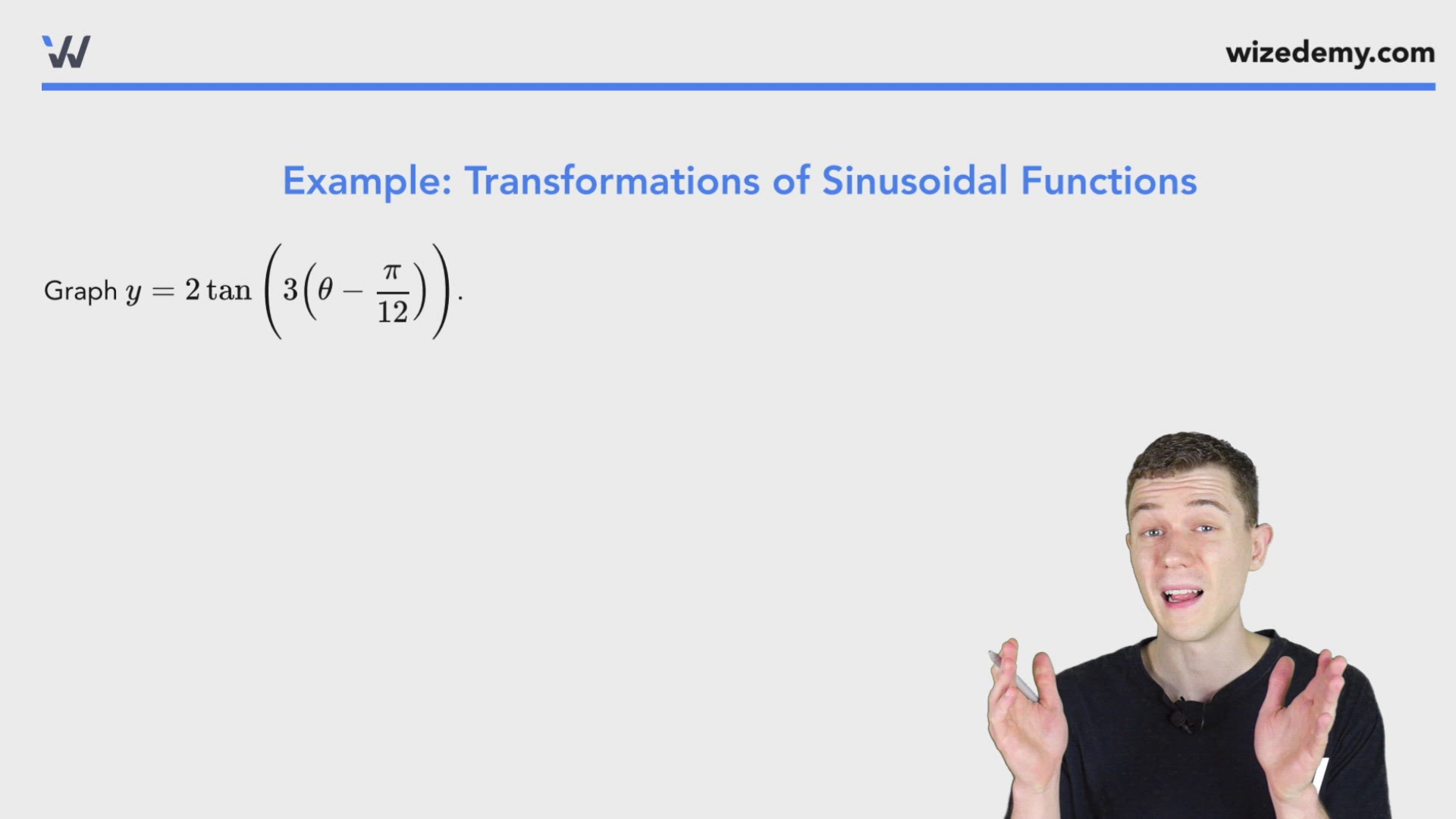
Graph y=2tan(3(θπ12))y=2\tan\Bigg(3\Big(\theta-\displaystyle\frac{\pi}{12}\Big)\Bigg).


Step 1.

P=π3P=\displaystyle\frac{\pi}{3}

Count 4 spaces from the origin (left & right).
Label the period.
Label the rest of the graph.


Step 2.


h=π12π3÷4=1h=\displaystyle\frac{\frac{\pi}{12}}{\frac{\pi}{3}\div4}=1 unit to the right.


Step 3.

(03+π12, 0)±π3n, nW    (π12,0)±π3n, nW\Bigg(\displaystyle\frac{0}{3}+\displaystyle\frac{\pi}{12},~0\Bigg)\pm{}\displaystyle\frac{\pi}{3}n,~n\in\mathbb{W}~~{\color{red}\rightarrow}~~\Bigg(\displaystyle\frac{\pi}{12},0\Bigg)\pm{}\displaystyle\frac{\pi}{3}n,~n\in\mathbb{W}


Step 4.

(π2÷3+π12)±π3n, nW    π4±π3n, nW\Bigg(\displaystyle\frac{\pi}{2}\div{3}+\displaystyle\frac{\pi}{12}\Bigg)\pm{}\displaystyle\frac{\pi}{3}n,~n\in\mathbb{W}~~{\color{red}\rightarrow}~~\displaystyle\frac{\pi}{4}\pm{}\displaystyle\frac{\pi}{3}n,~n\in\mathbb{W}


Step 5.

(π4,1)  &  (π4,1) ±πn,  nW      (0,2)  &  (π6,2) ±π3n,  nW\Bigg(\displaystyle-\frac{\pi}{4},-1\Bigg)~~\&~~\Bigg(\displaystyle\frac{\pi}{4},1\Bigg)~\pm{}\pi{}n,~~n\in\mathbb{W}~~~{\color{red}\rightarrow}~~~\Big(0,-2\Big)~~\&~~\Bigg(\displaystyle\frac{\pi}{6},2\Bigg)~\pm{}\frac{\pi}{3}{}n,~~n\in\mathbb{W}


Step 6.

Graph.

Begin with an x-intercept\color{red}\text{x-intercept} at (π12,0)\Bigg(\displaystyle\frac{\pi}{12},0\Bigg)
Count 2 units right and draw a vertical asymptote\color{red}\text{vertical asymptote} at x=π4x=\displaystyle\frac{\pi}{4}
Count 2 units right and draw an x-intercept\color{red}\text{x-intercept} at (5π12,0)\Bigg(\displaystyle\frac{5\pi}{12},0\Bigg)
Count 2 units right and draw a vertical asymptote\color{red}\text{vertical asymptote} at x=7π12x=\displaystyle\frac{7\pi}{12}
Count 2 units right and draw an x-intercept\color{red}\text{x-intercept} (3π4,0)\Bigg(\displaystyle\frac{3\pi}{4},0\Bigg)
Count 2 units right and draw a vertical asymptote\color{red}\text{vertical asymptote} at x=11π12x=\displaystyle\frac{11\pi}{12}
Continue this pattern right/left.
Plot the points from Step 5 and connect the dots, trending towards the asymptotes.
Practice: Transformations of Sinusoidal Functions

The following is a table of values describing a sinusoidal relationship between xx and y.y.

xπ12π45π127π123π4y05050\begin{array}{|c|c|c|c|c|c|}\hline\\ \textbf{x}&\displaystyle\frac{\pi}{12}&\displaystyle\frac{\pi}{4}&\displaystyle\frac{5\pi}{12}&\displaystyle\frac{7\pi}{12}&\displaystyle\frac{3\pi}{4}\\\\\hline\\ \textbf{y}&0&-5&0&5&0\\\\\hline \end{array}

What function best describes the tables of values?


Practice: Transformations of Sinusoidal Functions

Let y=cosθy=\cos{\theta} undergo the following transformations:
  • A vertical compression by a factor of 12\displaystyle\frac{1}{2}
  • A horizontal compression by a factor of 14\displaystyle\frac{1}{4}
  • A phase shift/horizontal translation of 3π16\displaystyle\frac{3\pi}{16} units left
Which of the following graphs best displays the graph of the transformed function?

Practice: Transformations of Sinusoidal Functions

If (π4,3)\Bigg(\displaystyle\frac{\pi}{4}, 3\Bigg) is on the function y=2cos2(θπ3)3y=2\cos{2\Big(\theta-\displaystyle\frac{\pi}{3}\Big)}-3, what point must be on the function y=cosθy=\cos{\theta}?


Extra Practice