Wize High School Grade 12 Pre-Calculus Textbook > Logarithmic Functions
Using Logarithms to Solve Exponential Equations
Popular Courses
Grade 12 Advanced Functions
Ontario High School
Grade 12 Pre-Calculus/Functions
Canada High School
MATH 208
Concordia University
Algebra II
US High School
Math 30-1
Alberta High School
Pre-Calculus 12
British Columbia High School
MATH 206
Concordia University
QMS 110
Toronto Metropolitan University
MATH 201
Concordia University
MA129
Wilfrid Laurier University
MTH 103
Michigan State University
MATH 22
Pennsylvania State University
MAC 1140
University of Florida
MATH 150
Texas A&M University
MAT 170
Arizona State University - Tempe
MAT 012
University of California - Davis
MAC 1105
Florida State University
MATH 1148
Ohio State University
MTH 103A
Michigan State University
MTH 116
Michigan State University

0:00 / 0:00
Using Logarithms to Solve Exponential Equations
When an exponential equation cannot be solved by expressing both sides as the same base, then logarithms can be used to solve for the solution.
Since logarithmic functions are the inverse of exponential functions, logarithms can be used to solve for the exponent.
Example
If , then x is:
0:00 / 0:00
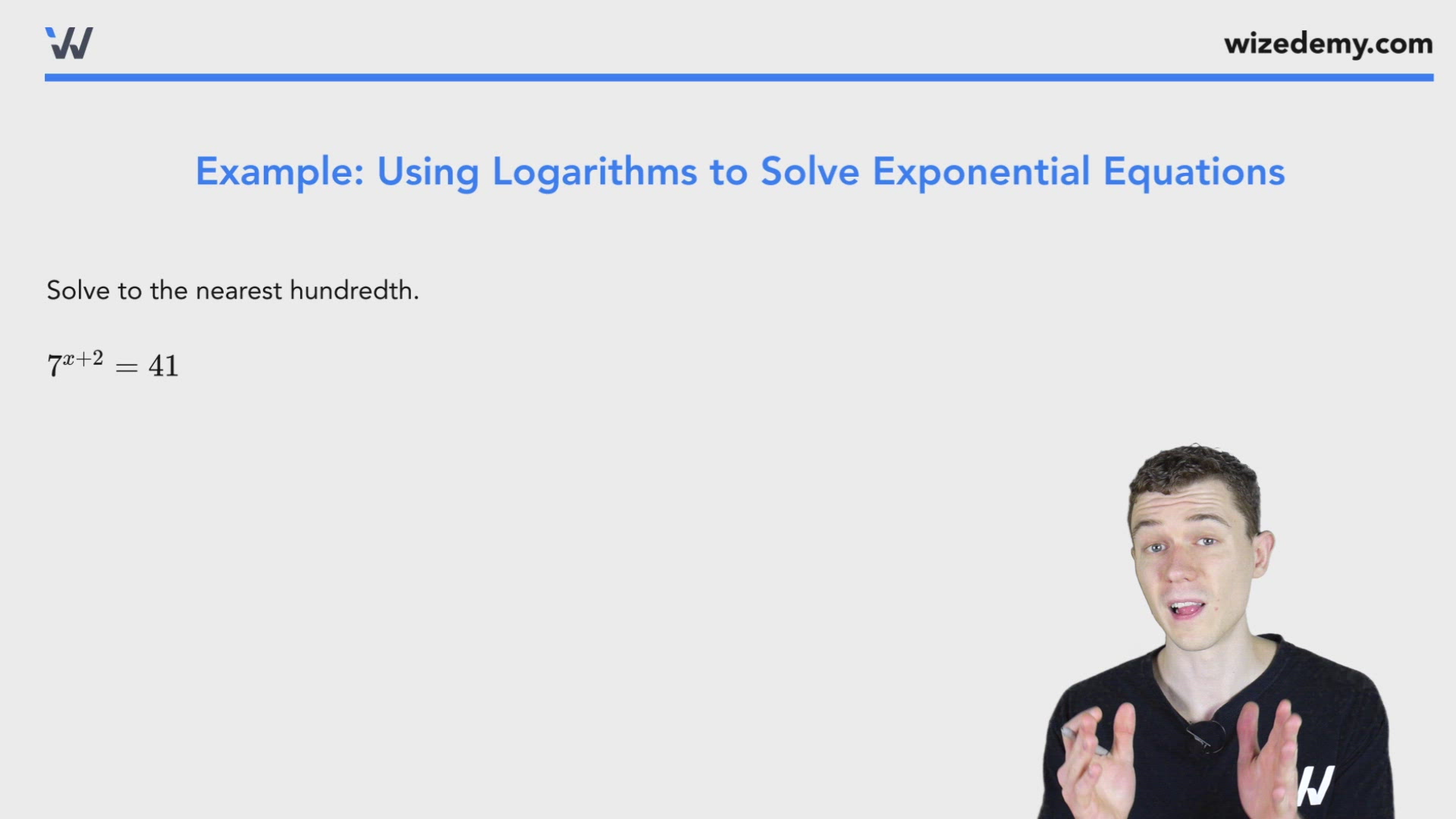
Example: Using Logarithms to Solve Exponential Equations
Solve to the nearest hundredth.
Practice: Using Logarithms to Solve Exponential Equations
Solve to the nearest hundredth.
Practice: Using Logarithms to Solve Exponential Equations
Find x.
Practice: Using Logarithms to Solve Exponential Equations
Solve for x to the nearest hundredth.