Wize High School Algebra II Textbook (Common Core) > Quadratic Equations & Complex Numbers
Solving Quadratic Inequalities in Two Variables

0:00 / 0:00
Solving Quadratic Inequalities in Two Variables
A quadratic inequality in two variables looks something like this: .
*The inequality can be any one of .
The solution to an inequality in two variables is an entire region!
Example
The solution region of is the shaded region above the parabola (since the inequality is "greater than"):
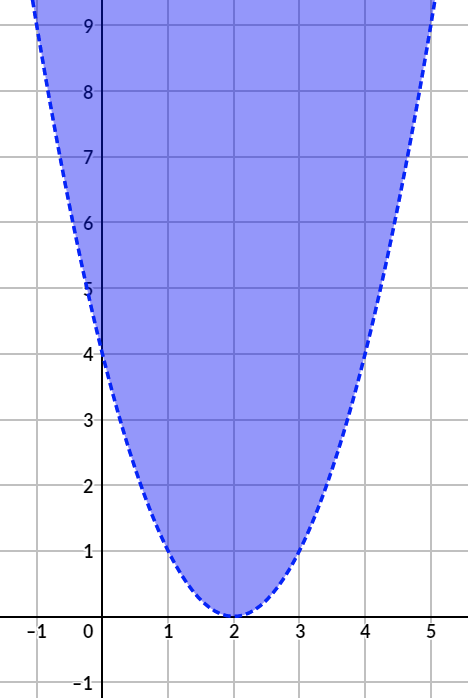
The boundary is a dashed parabola since the inequality is strictly greater than (not greater than or equal to).
Every point in the shaded region satisfies the inequality! (Not including the dashed boundary line.)
Check: Use a test point in the solution region and plug it into the inequality .
Let's try , so we sub in :
Since , the point satisfies the inequality.

0:00 / 0:00
Example: Solving Quadratic Inequalities in Two Variables
Consider the quadratic inequality .
a) Graph the solution region.
Start by graphing the boundary line (change the inequality into an equality):
Completing the square yields the vertex form:
We can plot the vertex at . The multiplied in front means we reflect the parabola vertically and stretch by a factor of 2.
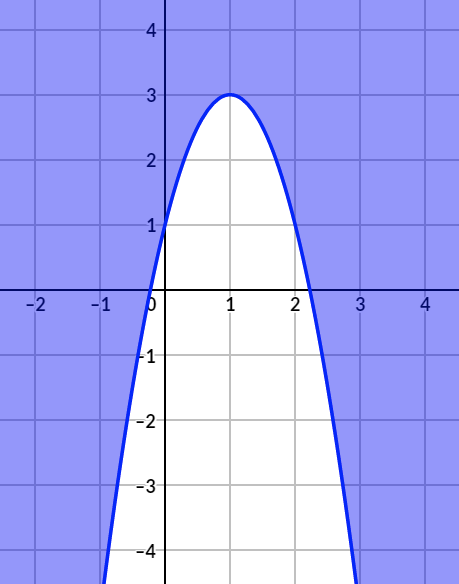
Note: Since the inequality is "greater than or equal to", the boundary line is solid. We shade the region above the boundary line.
b) Does the point satisfy the inequality?
Method 1: Graph
Looking at the graph, the point falls outside the solution region (unshaded), so it does NOT satisfy the inequality.
Method 2: Using the Inequality
Using and substituting the coordinates :
But , therefore the point does NOT satisfy the inequality.
Practice: Solving Quadratic Inequalities in Two Variables
Select all of the inequalities for which the point is a solution.
Practice: Solving Inequalities in Two Variables
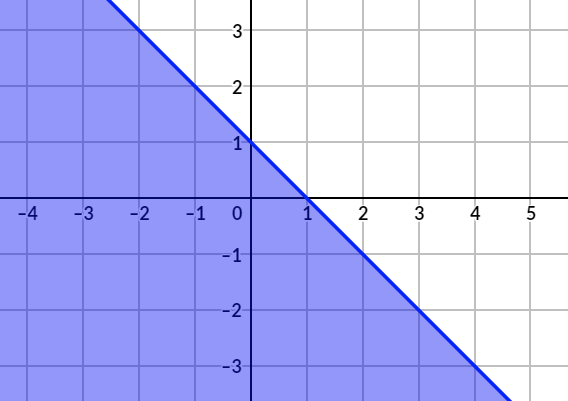
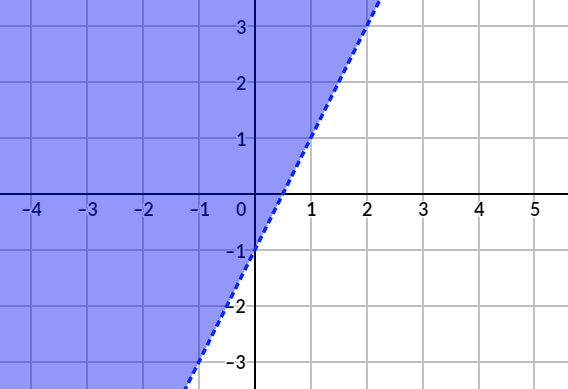
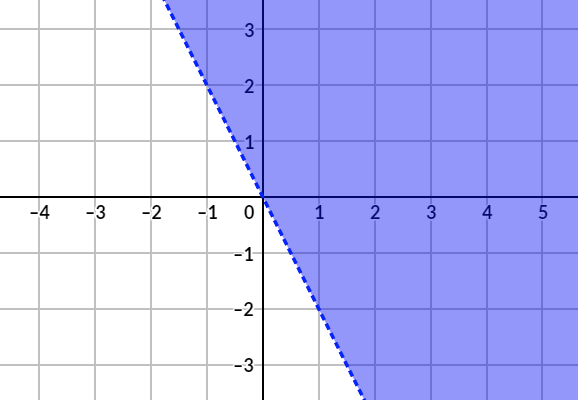
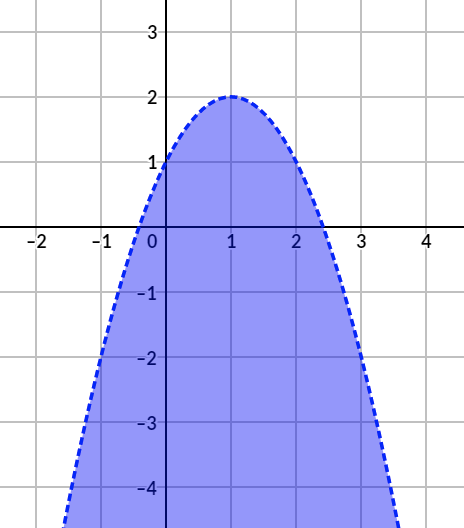
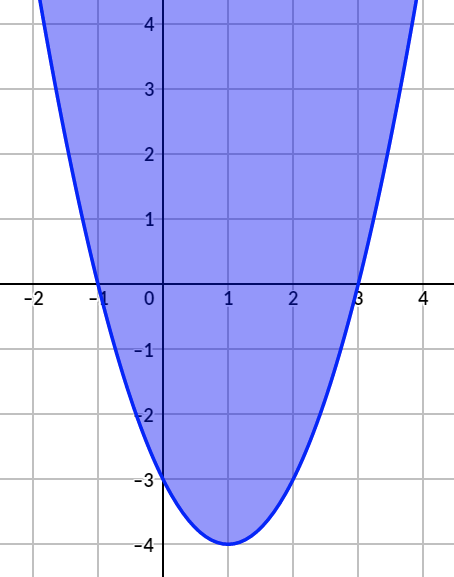
Match the graph of each solution region with the corresponding inequality.
Try graphing each inequality on your own!
A.
B.
C.
D.
E.