Create a free account to get started

Unlock full course notes by signing up

  • Video lessons taught by top educators
  • Practice questions with guided solutions
  • Written review notes for reference
  • Expert answers anytime from course tutors

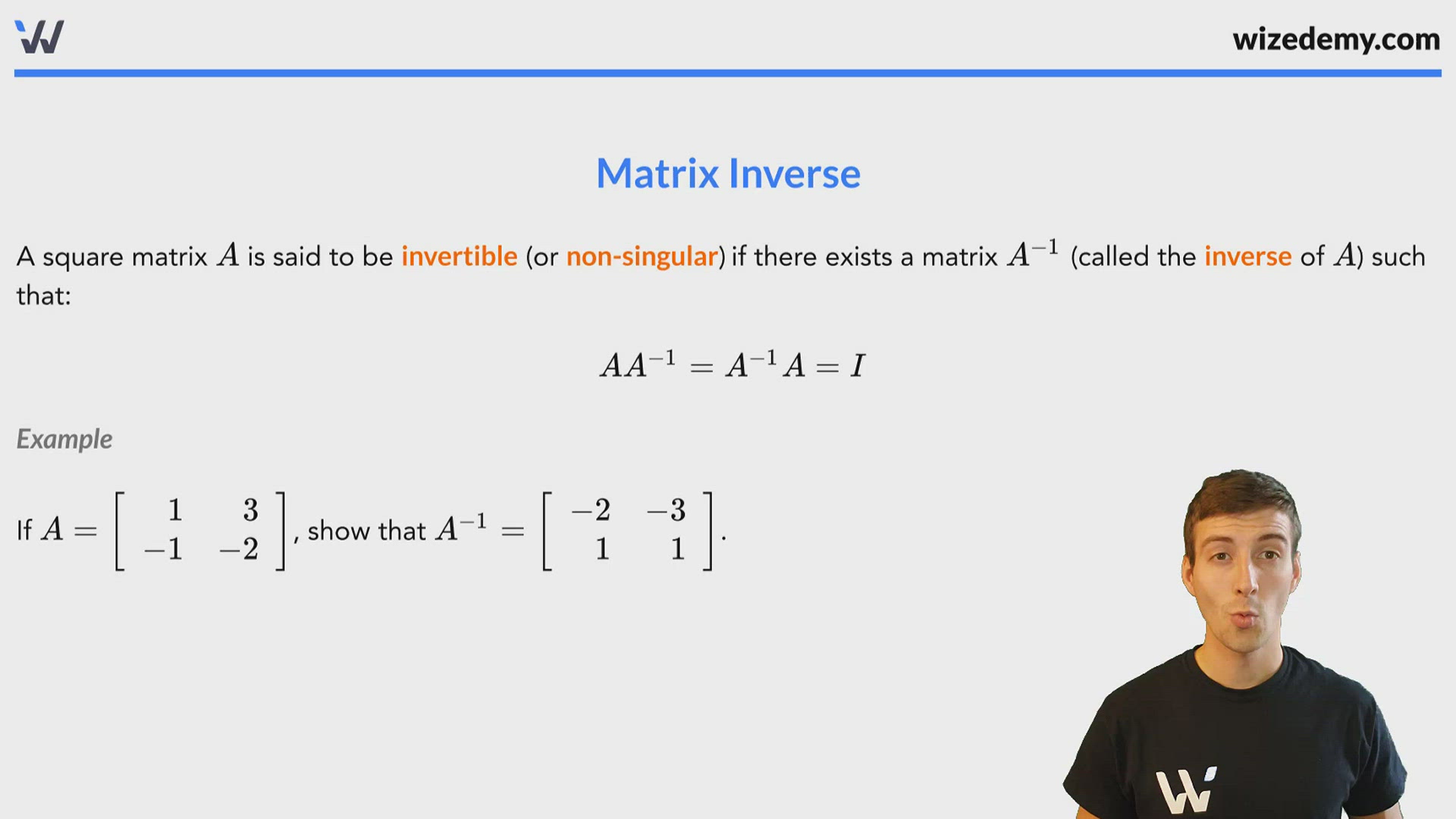
Matrix Inverse

A square matrix AA is said to be invertible (or non-singular) if there exists a matrix A−1A^{-1} (called the inverse of AA) such that:

AA−1=A−1A=IAA^{-1}=A^{-1}A=I

Example

If A=[13−1−2]A= \left[ \begin{array}{rr} 1&3\\ -1&-2 \end{array} \right], show that A−1=[−2−311]A^{-1}= \left[ \begin{array}{rr} -2&-3\\ 1&1 \end{array} \right].

AA−1=[13−1−2][−2−311]=[1001]=I✓AA^{-1}= \left[ \begin{array}{rr} 1&3\\ -1&-2 \end{array} \right] \left[ \begin{array}{rr} -2&-3\\ 1&1 \end{array} \right] = \left[ \begin{array}{rr} 1&0\\ 0&1 \end{array} \right] =I \quad \colorThree{\checkmark}

A−1A=[−2−311][13−1−2]=[1001]=I✓A^{-1}A= \left[ \begin{array}{rr} -2&-3\\ 1&1 \end{array} \right] \left[ \begin{array}{rr} 1&3\\ -1&-2 \end{array} \right] = \left[ \begin{array}{rr} 1&0\\ 0&1 \end{array} \right] =I \quad \colorThree{\checkmark}


Analogy With Real Numbers

Consider the real number product 18(8) = 8−1(8) = 1\dfrac{1}{8}(8) \ =\ 8^{-1}(8) \ =\ 1.

8−18^{-1} is the multiplicative inverse of 88: it is the unique number that multiplies 88 to get a product of 11.

Recall that II is the matrix equivalent of the number 11 for multiplication (since AI=IA=AAI=IA=A).

Just like with real numbers, if we want to "cancel out" a matrix with multiplication, we multiply by its inverse: A−1A=IA^{-1}A = I.

Properties of the Matrix Inverse

Let A, BA,\ B be invertible matrices and let k∈Rk \in \reals.

  • (A−1)−1=A(A^{-1})^{-1}=A
  • (kA)−1=1kA−1(kA)^{-1}=\frac{1}{k}A^{-1}
  • (AT)−1=(A−1)T(A^T)^{-1}=(A^{-1})^T
  • (AB)−1=B−1A−1(AB)^{-1}=B^{-1}A^{-1}
  • A−1A^{-1} is unique

Create a free account to get started

Unlock full course notes by signing up

  • Video lessons taught by top educators
  • Practice questions with guided solutions
  • Written review notes for reference
  • Expert answers anytime from course tutors

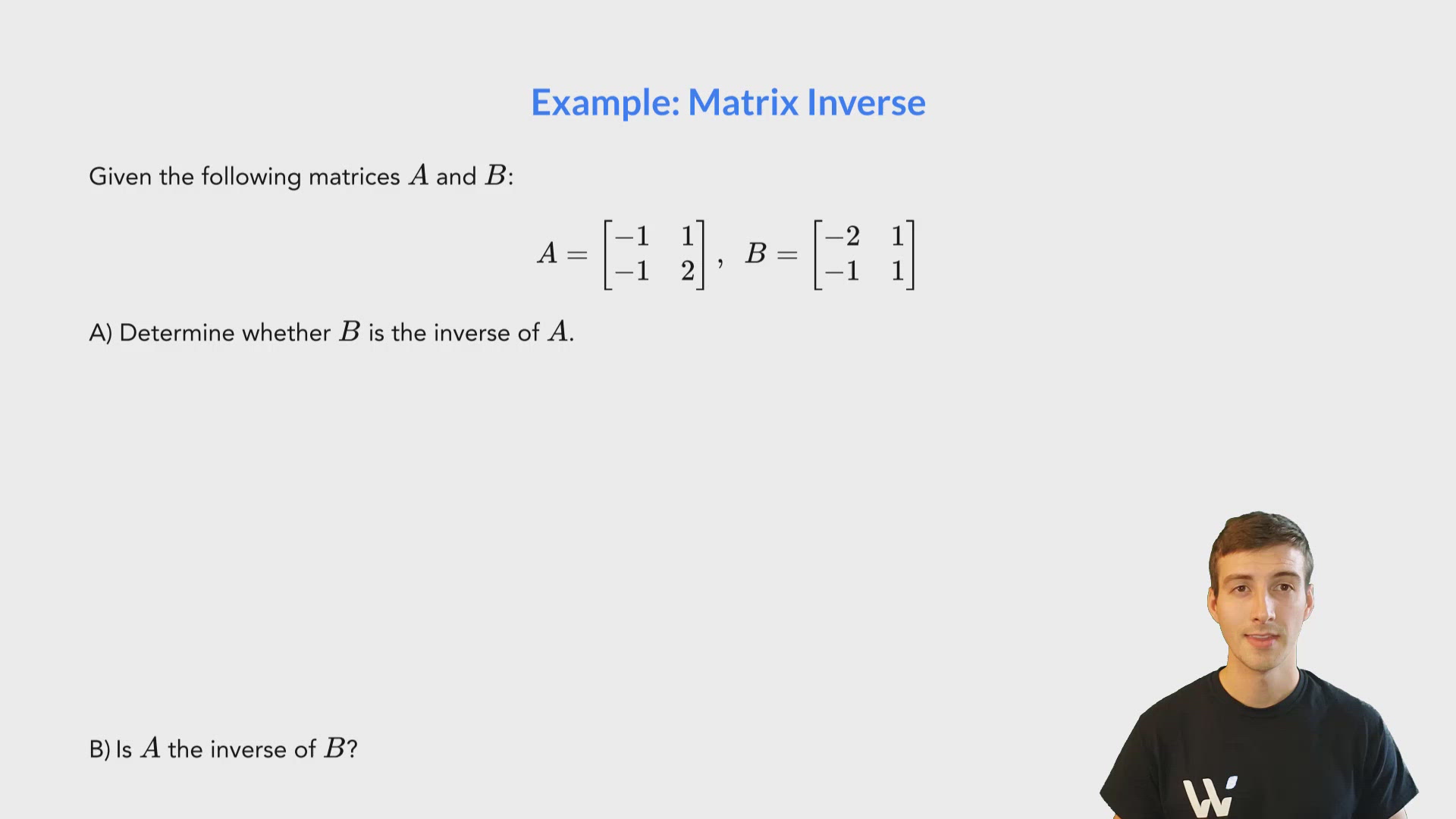
Example: Matrix Inverse

Given the following matrices AA and BB:

A=[−11−12],  B=[−21−11]A=\begin{bmatrix}-1 & 1\\-1 & 2\end{bmatrix},\ \ B=\begin{bmatrix}-2 & 1\\-1 & 1\end{bmatrix}

A) Determine whether BB is the inverse of AA.

Multiply the matrices together, and if the product is the identity, then they are inverse:

AB=[−11−12][−21−11]=[1001]=IAB=\begin{bmatrix}-1 & 1\\-1 & 2\end{bmatrix}\begin{bmatrix}-2 & 1\\-1 & 1\end{bmatrix}=\begin{bmatrix}1 & 0\\0 & 1\end{bmatrix}=I

BA=[−21−11][−11−12]=[1001]=IBA=\begin{bmatrix}-2 & 1\\-1 & 1\end{bmatrix}\begin{bmatrix}-1 & 1\\-1 & 2\end{bmatrix}=\begin{bmatrix}1 & 0\\0 & 1\end{bmatrix}=I

So BB is indeed the inverse of AA (B=A−1B=A^{-1}).

B) Is AA the inverse of BB?

Yes, AA is also the inverse of BB:

Since B=A−1B=A^{-1}, it follows that B−1=(A−1)−1=AB^{-1}=(A^{-1})^{-1} = A.

If A=[abcdefghi]A= \begin{bmatrix} a&b&c\\ d&e&f\\ g&h&i \end{bmatrix} is an invertible matrix and C=AA−1C=AA^{-1}, find the first row of CC .

Choose an answer

Create a free account to get started

Unlock full course notes by signing up

  • Video lessons taught by top educators
  • Practice questions with guided solutions
  • Written review notes for reference
  • Expert answers anytime from course tutors

If [1ax2by0cz]\left[\begin{array}{c} 1&a&x\\ 2&b&y\\ 0&c&z \end{array}\right] is the inverse of the matrix[1p0−3q42r1]\left[\begin{array}{c} 1&p&0\\ -3&q&4\\ 2&r&1 \end{array}\right], find the value of rr.

Your answers

Create a free account to get started

Unlock full course notes by signing up

  • Video lessons taught by top educators
  • Practice questions with guided solutions
  • Written review notes for reference
  • Expert answers anytime from course tutors

Extra Practice