Wize University Linear Algebra Textbook > Matrices
Matrix Inverse
Popular Courses
MATH 211
University of Calgary
MATH 1229A/B
Western University
Algebra II
US High School
Linear Algebra
University Study Guides
MATH 133
McGill University
MATH 1ZC3
McMaster University
MATH 152
University of British Columbia
MATH 1600A/B
Western University
Linear Algebra
General Course
MATH 204
Concordia University
MAT188H1
University of Toronto
MATH 125
University of Alberta
Linear Algebra
University Study Guides
NMM 1411A/B
Western University
SC/MATH 1506 3.00
York University
APSC 174
Queen's University
MTH 141
Toronto Metropolitan University
MATH 151
University of Victoria
MATH 102
University of Alberta
MATH 115
University of Waterloo
0:00 / 0:00
Matrix Inverse
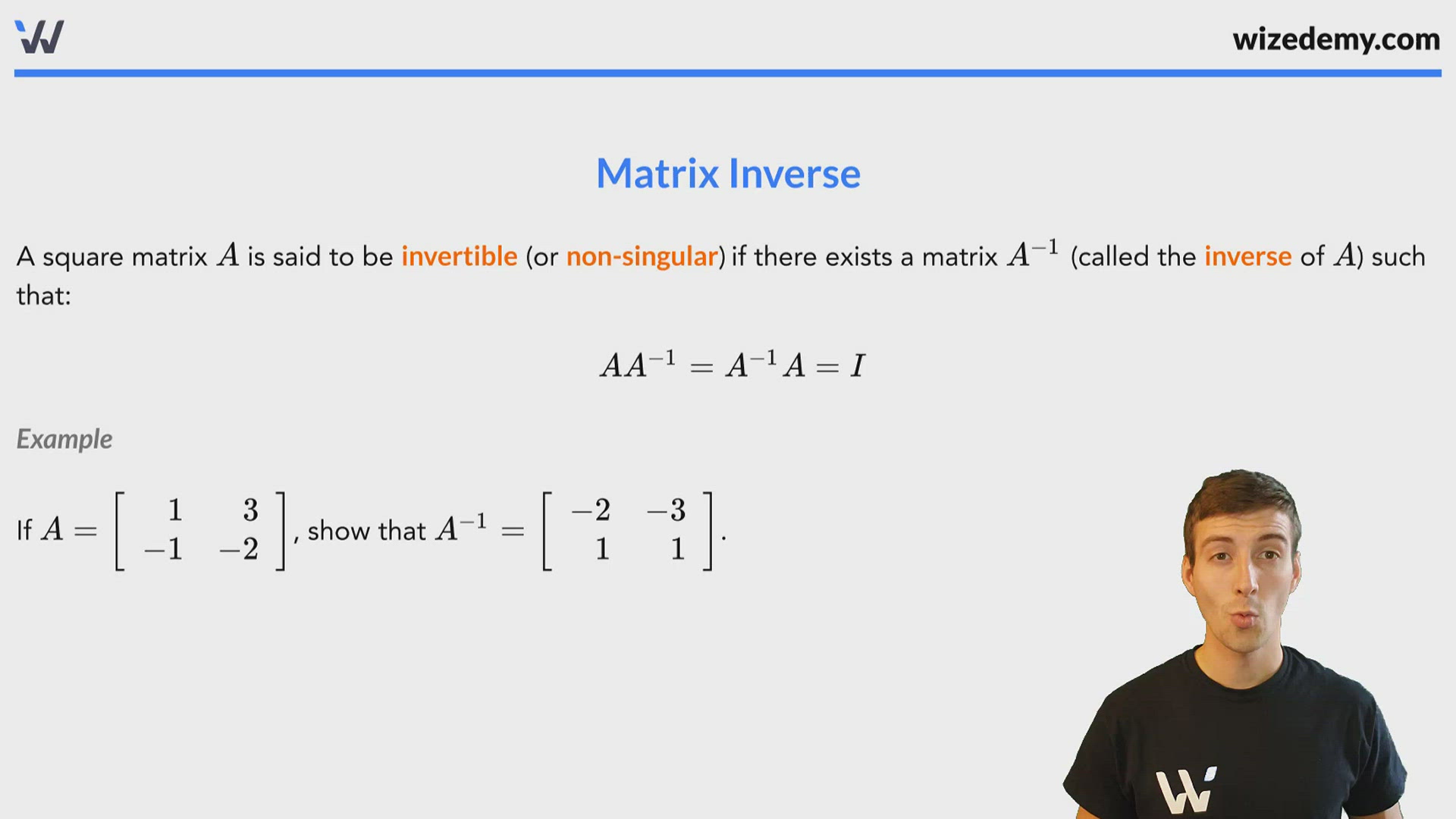
A square matrix is said to be invertible (or non-singular) if there exists a matrix (called the inverse of ) such that:
Example
If , show that .
Analogy With Real Numbers
Consider the real number product .
is the multiplicative inverse of : it is the unique number that multiplies to get a product of .
Recall that is the matrix equivalent of the number for multiplication (since ).
Just like with real numbers, if we want to "cancel out" a matrix with multiplication, we multiply by its inverse: .
Properties of the Matrix Inverse
Let be invertible matrices and let .
- is unique
0:00 / 0:00
Example: Matrix Inverse
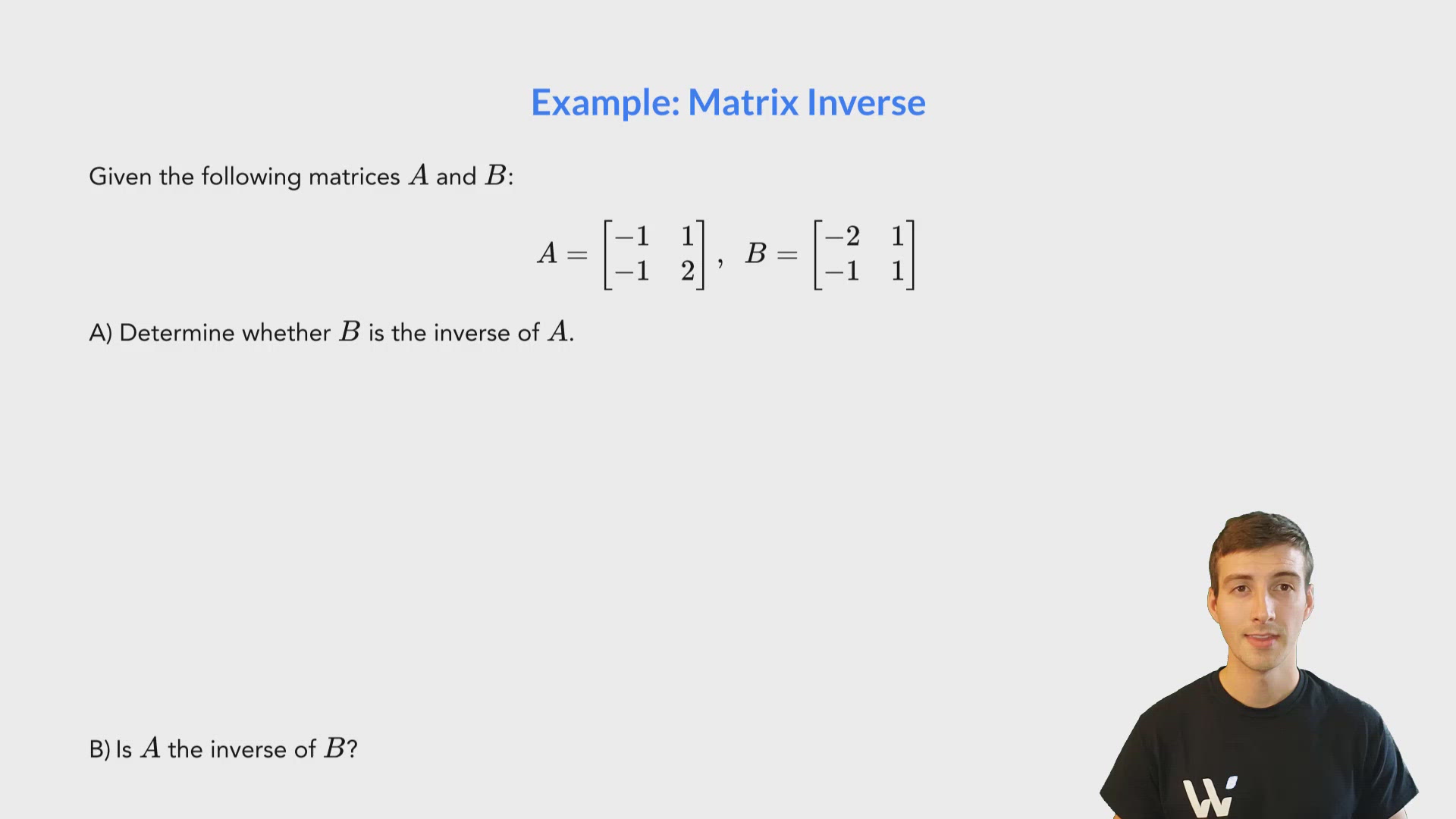
Given the following matrices and :
A) Determine whether is the inverse of .
Multiply the matrices together, and if the product is the identity, then they are inverse:
So is indeed the inverse of ().
B) Is the inverse of ?
Yes, is also the inverse of :
Since , it follows that .
If is an invertible matrix and , find the first row of .
If is the inverse of the matrix, find the value of .