Create a free account to get started

Unlock full course notes by signing up

  • Video lessons taught by top educators
  • Practice questions with guided solutions
  • Written review notes for reference
  • Expert answers anytime from course tutors

Solving Matrix Equations

Matrix Multiplication

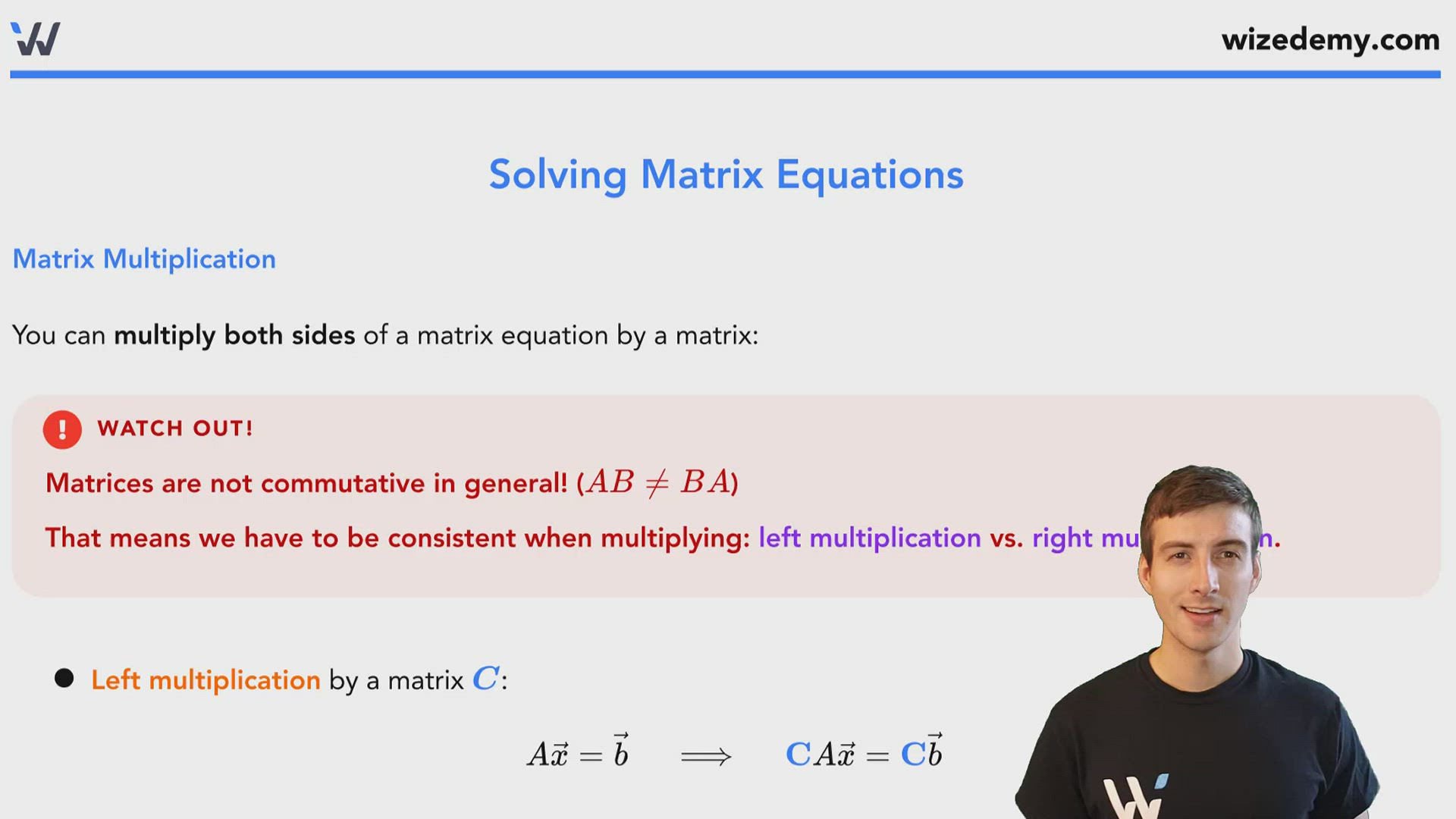
You can multiply both sides of a matrix equation by a matrix:


  • Left multiplication by a matrix C\colorOne{\bm C}:

Ax⃗=b⃗  ⟹  CAx⃗=Cb⃗A\vec x=\vec b \quad\implies\quad \colorOne{\mathbf{C}}A\vec x =\colorOne{\mathbf{C}}\vec b

  • Right multiplication by a matrix C\colorOne{\bm C} :

Ax⃗=b⃗  ⟹  Ax⃗C=b⃗CA\vec x=\vec b \quad\implies\quad A\vec x\colorOne{\mathbf{C}}=\vec b\colorOne{\mathbf{C}}

Solving Linear Systems Using Inverse

Write the matrix equation for the linear system: Ax⃗=b⃗A \vec x = \vec b.


Rearrange to solve for x⃗\vec x, the solution vector, by cancelling AA on the LHS:

Ax⃗=b⃗A−1A⏟=I x⃗=A−1b⃗Ix⃗=A−1b⃗\begin{aligned} A \vec x &= \vec b\\[0.5em] \underbrace{\colorOne{A^{-1}}A}_{=I} \ \vec x &= \colorOne{A^{-1}}\vec b\\[0.5em] I \vec x &= A^{-1}\vec b \end{aligned}

x⃗=A−1b⃗\boxed{\quad \vec x = A^{-1}\vec b \quad}

Steps

  1. Write the system of linear equations as a matrix equation 𝐴x⃗=b⃗𝐴\vec{x} = \vec b.
  2. Find A−1A^{-1}.
  3. The solution is x⃗=A−1b\vec x=A^{-1}b.


Create a free account to get started

Unlock full course notes by signing up

  • Video lessons taught by top educators
  • Practice questions with guided solutions
  • Written review notes for reference
  • Expert answers anytime from course tutors

Example: Solving Linear Systems Using Inverse

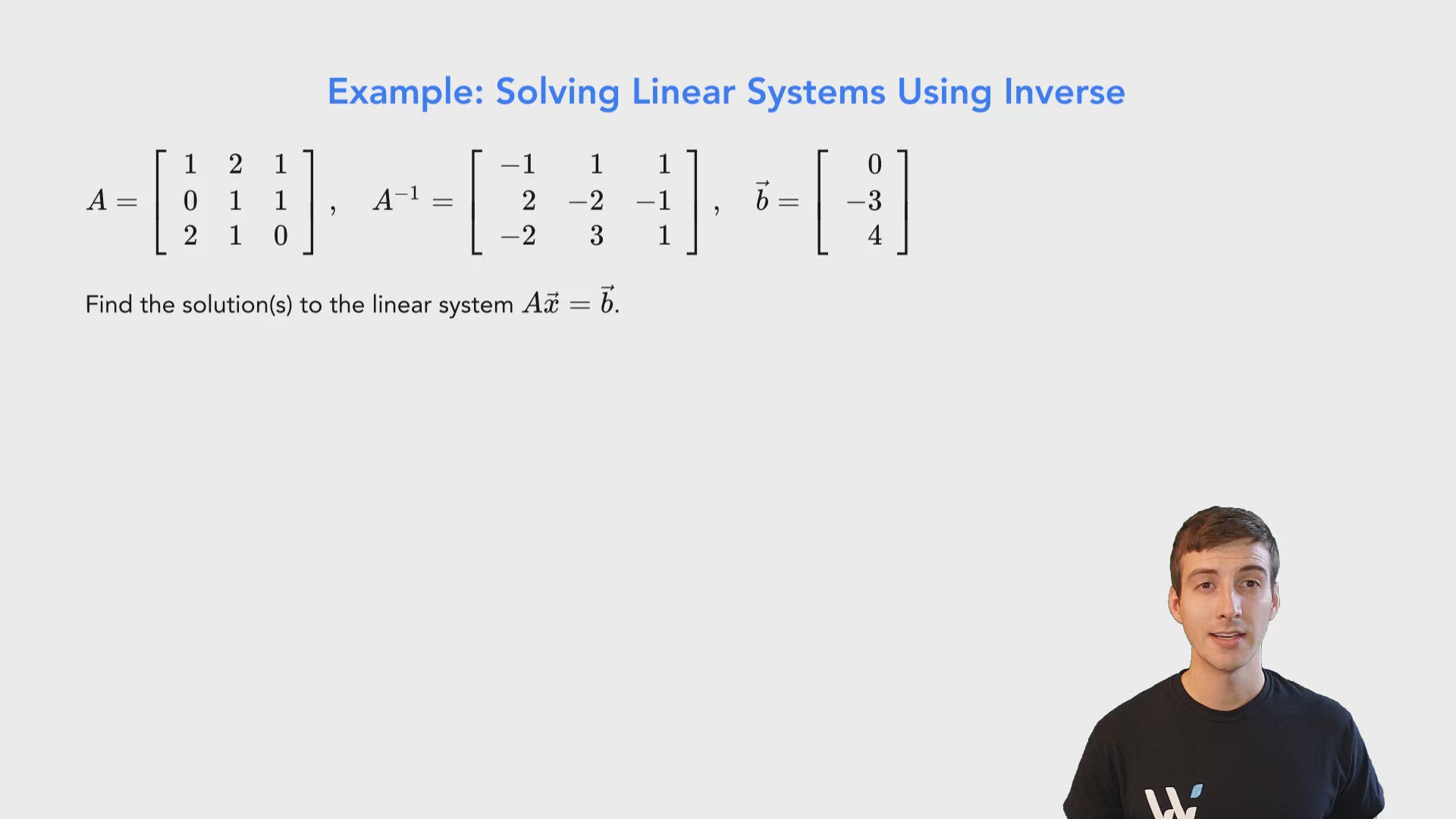
A=[121011210],A−1=[−1112−2−1−231],b⃗=[0−34]A= \left[\begin{array}{rrr} 1&2&1\\ 0&1&1\\ 2&1&0 \end{array}\right] ,\quad A^{-1}= \left[\begin{array}{rrr} -1&1&1\\ 2&-2&-1\\ -2&3&1 \end{array}\right] ,\quad \vec b= \left[\begin{array}{r} 0\\ -3\\ 4 \end{array}\right]

Find the solution(s) to the linear system Ax⃗=b⃗A \vec x = \vec b.

The linear system we want to solve can be written:

x+2y+z=0y+z=−32x+y=4\begin{array}{rcr} x+2y+z&=&0\\[0.5em] y+z&=&-3\\[0.5em] 2x+y&=&4 \end{array}

In matrix form, we have:

Ax⃗=b⃗  ⟹  [121011210][xyz]=[0−34]A\vec x = \vec b \quad\implies\quad \left[\begin{array}{rrr} 1&2&1\\ 0&1&1\\ 2&1&0 \end{array}\right] \left[\begin{array}{c} x\\ y\\ z \end{array}\right] = \left[\begin{array}{r} 0\\ -3\\ 4 \end{array}\right]

We have been given the inverse of AA, so AA must be invertible.


Ax⃗=b⃗  ⟹  x⃗=A−1b⃗  ⟹  [xyz]=[−1112−2−1−231][0−34]  ⟹  [xyz]=[12−5]\begin{array}{rrcll} A \vec x = \vec b &\quad \implies \quad& \vec x &=& A^{-1}\vec b\\[1em] &\quad \implies \quad& \left[\begin{array}{r} x\\ y\\ z \end{array}\right] &=& \left[\begin{array}{rrr} -1&1&1\\ 2&-2&-1\\ -2&3&1 \end{array}\right] \left[\begin{array}{r} 0\\ -3\\ 4 \end{array}\right]\\[2em] &\quad \implies \quad& \left[\begin{array}{r} x\\ y\\ z \end{array}\right] &=& \boxed{ \left[\begin{array}{r} 1\\ 2\\ -5 \end{array}\right] } \end{array}

Create a free account to get started

Unlock full course notes by signing up

  • Video lessons taught by top educators
  • Practice questions with guided solutions
  • Written review notes for reference
  • Expert answers anytime from course tutors

Example: Solving Matrix Equations

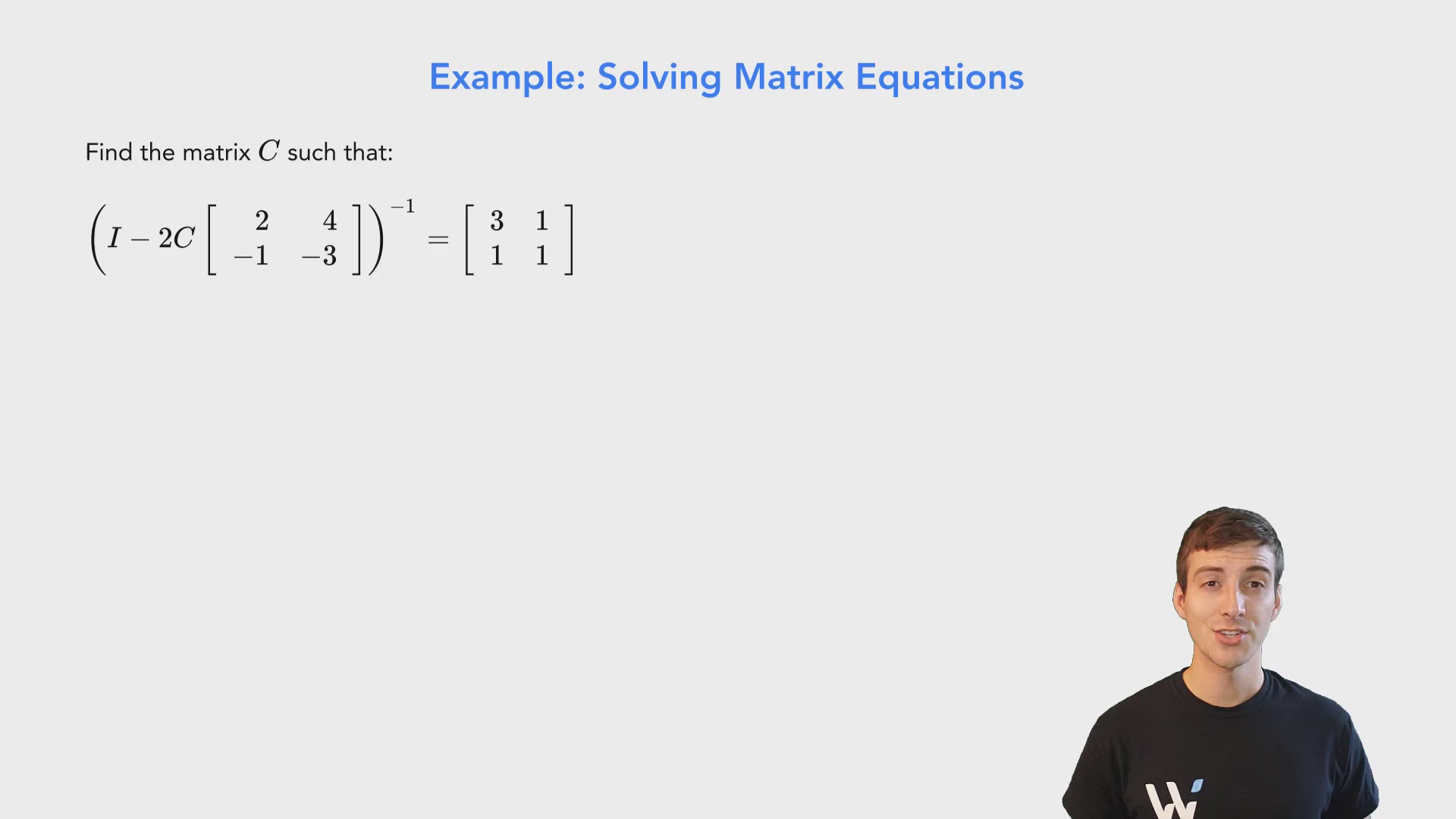
Find the matrix CC such that:

(I−2C[24−1−3])−1=[3111]\left( I-2C \left[\begin{array}{rr} 2&4\\ -1&-3 \end{array}\right] \right)^{-1} = \left[\begin{array}{rr} 3&1\\ 1&1 \end{array}\right]

Writing the equation symbolically:

(I−2CA)−1=B\left(I-2CA\right)^{-1} =B, where A=[24−1−3],B=[3111]A= \left[\begin{array}{rr} 2&4\\ -1&-3 \end{array}\right] ,\quad B= \left[\begin{array}{rr} 3&1\\ 1&1 \end{array}\right]

Take the inverse of both sides to cancel the inverse on the LHS:

I−2CA=B−1I-2CA =B^{-1}

We are trying to isolate CC, so subtract II from both sides:

−2CA=B−1−I-2CA=B^{-1}-I

Multiply both sides by the scalar −12-\dfrac{1}{2}:

CA=−12(B−1−I)CA = -\dfrac{1}{2}(B^{-1}-I)

Right multiply both sides by A−1A^{-1} to cancel AA on the LHS:

CAA−1=−12(B−1−I)A−1  ⟹  CI=−12(B−1−I)A−1  ⟹    C=−12(B−1−I)A−1\begin{aligned} CA\colorOne{A^{-1}} &= -\dfrac{1}{2}(B^{-1}-I) \colorOne{A^{-1}}\\[1em] \implies \quad C\colorOne{I} &= -\dfrac{1}{2}(B^{-1}-I) \colorOne{A^{-1}}\\[1em] \implies \quad \ \ C &= -\dfrac{1}{2}(B^{-1}-I)\colorOne{A^{-1}} \end{aligned}

We can now compute CC (use the formula for 2×22 \times 2 matrices to find B−1, A−1B^{-1}, \ A^{-1}):

B−1=[3111]−1=12[1−1−13]=[12−12−1232]B^{-1} = \left[\begin{array}{rr}3&1\\1&1\end{array}\right]^{-1} = \dfrac{1}{2}\left[\begin{array}{rr}1&-1\\-1&3\end{array}\right] = \left[\begin{array}{rr}\frac{1}{2}&-\frac{1}{2}\\[0.5em]-\frac{1}{2}&\frac{3}{2}\end{array}\right]

−12(B−1−I) = −12([12−12−1232]−[1001]) = −12[−12−12−1212] = [141414−14]-\dfrac{1}{2}(B^{-1}-I) \ =\ -\dfrac{1}{2}\left(\left[\begin{array}{rr}\frac{1}{2}&-\frac{1}{2}\\[0.5em]-\frac{1}{2}&\frac{3}{2}\end{array}\right]-\left[\begin{array}{rr}1&0\\[0.5em]0&1\end{array}\right]\right) \ =\ -\dfrac{1}{2}\left[\begin{array}{rr}-\frac{1}{2}&-\frac{1}{2}\\[0.5em]-\frac{1}{2}&\frac{1}{2}\end{array}\right] \ =\ \colorOne{ \left[\begin{array}{rr}\frac{1}{4}&\frac{1}{4}\\[0.5em]\frac{1}{4}&-\frac{1}{4}\end{array}\right] }

A−1=[24−1−3]−1=1−2[−3−412]=[322−12−1]A^{-1}=\left[\begin{array}{rr}2&4\\-1&-3\end{array}\right]^{-1} = \dfrac{1}{-2}\left[\begin{array}{rr}-3&-4\\1&2\end{array}\right] = \colorTwo{ \left[\begin{array}{rr}\frac{3}{2}&2\\[0.5em]-\frac{1}{2}&-1\end{array}\right] }

C = −12(B−1−I)A−1 = [141414−14][322−12−1] = [14141234]C \ =\ \colorOne{-\dfrac{1}{2}(B^{-1}-I)} \colorTwo{A^{-1}} \ =\ \colorOne{ \left[\begin{array}{rr}\frac{1}{4}&\frac{1}{4}\\[0.5em]\frac{1}{4}&-\frac{1}{4}\end{array}\right] } \colorTwo{ \left[\begin{array}{rr}\frac{3}{2}&2\\[0.5em]-\frac{1}{2}&-1\end{array}\right] } \ =\ \left[\begin{array}{rr}\frac{1}{4}&\frac{1}{4}\\[0.5em]\frac{1}{2}&\frac{3}{4}\end{array}\right]

∴ C=[14141234]\therefore \ \boxed{C=\left[\begin{array}{rr}\frac{1}{4}&\frac{1}{4}\\[0.5em]\frac{1}{2}&\frac{3}{4}\end{array}\right]}


Solve the following system of linear equations using the inverse of the coefficient matrix.

3x+4y=1−2x−y=0\begin{array}{rrr} 3x+4y&=&1\\ -2x-y&=&0 \end{array}

Choose an answer

Create a free account to get started

Unlock full course notes by signing up

  • Video lessons taught by top educators
  • Practice questions with guided solutions
  • Written review notes for reference
  • Expert answers anytime from course tutors

Let [3−104]\begin{bmatrix} 3&-1\\ 0&4 \end{bmatrix} be the inverse of the matrix [abcd]\begin{bmatrix} a&b\\c&d \end{bmatrix}.


Find the solution to the following system of linear equations:

ax+by=−2cx+dy=2\begin{array}{rrr} ax+by&=&-2\\ cx+dy&=&2 \end{array}

Choose an answer

Create a free account to get started

Unlock full course notes by signing up

  • Video lessons taught by top educators
  • Practice questions with guided solutions
  • Written review notes for reference
  • Expert answers anytime from course tutors

Solve for AA in the following equation:

A[−122−5]=I2−[2−302]A \left[ \begin{array}{rr} -1&2\\ 2&-5 \end{array} \right] = I_2- \left[ \begin{array}{rr} 2&-3\\ 0&2 \end{array} \right]

[Fill in the entries for matrix AA]

Create a free account to get started

Unlock full course notes by signing up

  • Video lessons taught by top educators
  • Practice questions with guided solutions
  • Written review notes for reference
  • Expert answers anytime from course tutors

Extra Practice