Wize University Linear Algebra Textbook > Determinants
Basics of Determinants
Popular Courses
MATH 211
University of Calgary
MATH 1229A/B
Western University
Algebra II
US High School
Linear Algebra
University Study Guides
MATH 133
McGill University
MATH 1ZC3
McMaster University
MATH 152
University of British Columbia
MATH 1600A/B
Western University
Linear Algebra
General Course
MATH 204
Concordia University
MAT188H1
University of Toronto
MATH 125
University of Alberta
Linear Algebra
University Study Guides
SC/MATH 1025 3.00
York University
APSC 174
Queen's University
MTH 141
Toronto Metropolitan University
MATH 102
University of Alberta
MATH 115
University of Waterloo
MATH 1B03
McMaster University
ADM 1305
University of Ottawa
0:00 / 0:00
Basics of Determinants
Determinant Definition
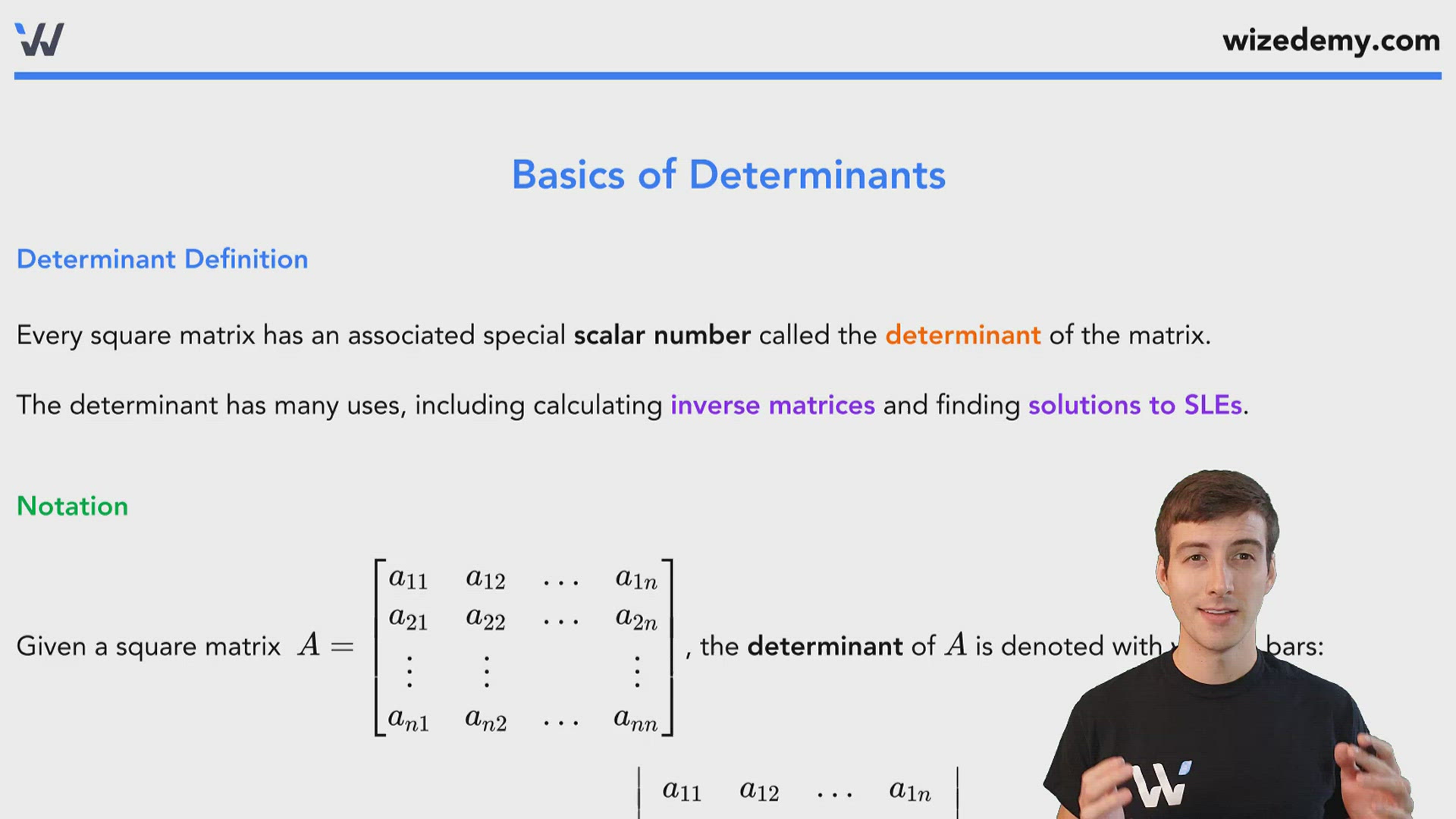
Every square matrix has an associated special scalar number called the determinant of the matrix.
The determinant has many uses, including calculating inverse matrices and finding solutions to SLEs.
Notation
Given a square matrix , the determinant of is denoted with vertical bars:
Calculating Determinants of Small Matrices
- matrix:
- matrix:
Determinant Properties
Let and be square matrices.
- If has a zero row or zero column, then
- If two rows or two columns are scalar multiples of one another, then
Note: In general, .
Triangular Matrices
- Upper triangular matrix: all entries under the main diagonal are 0s. Example:
- Lower triangular matrix: all entries above the main diagonal are 0s. Example:
- Diagonal matrix: both upper and lower triangular. All entries that are not on the main diagonal are 0s. Example:
Wize Tip
If a square matrix is triangular then the determinant is the product of the entries on the main diagonal:
0:00 / 0:00
Example: Basics of Determinants
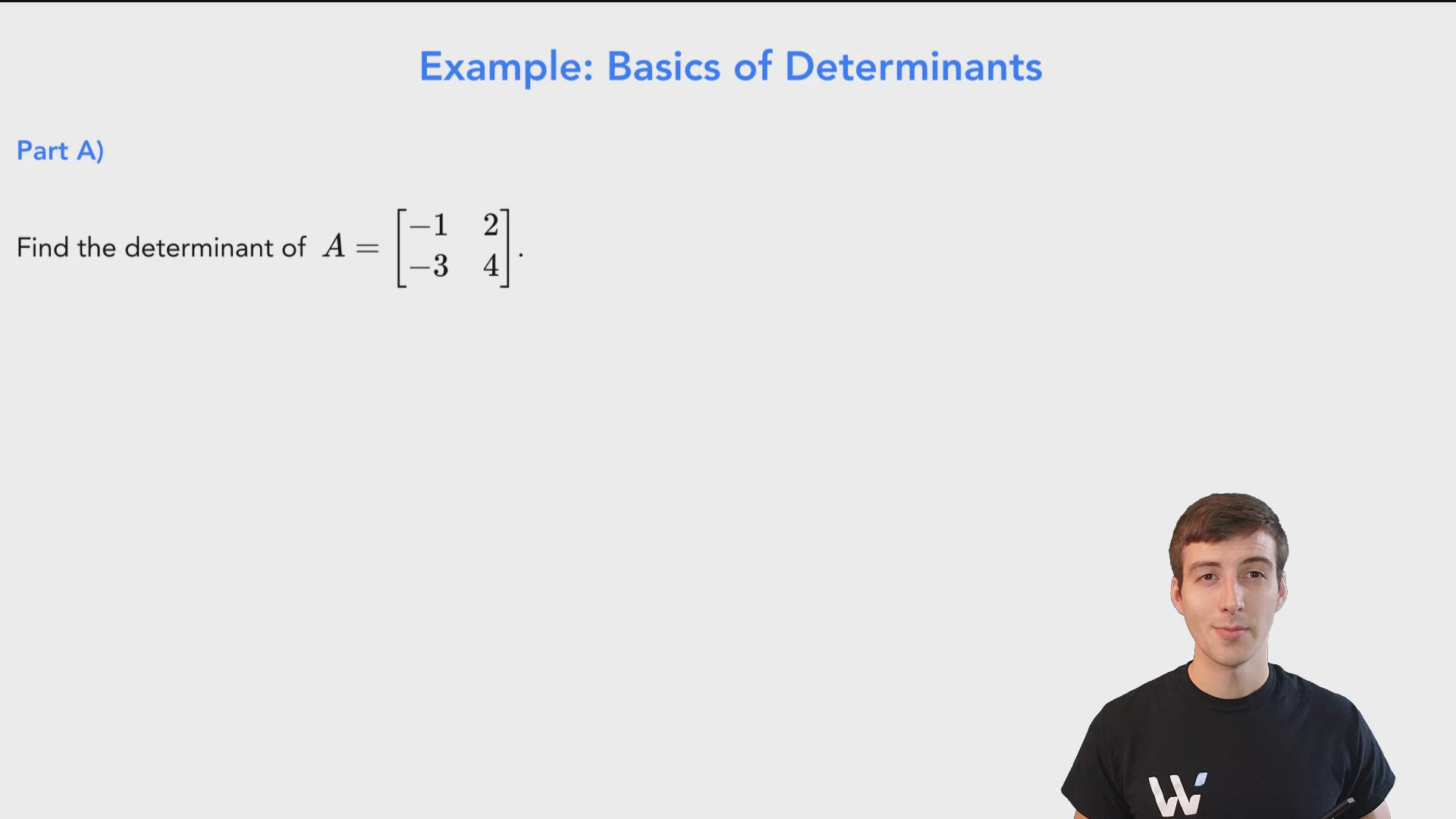
Part A)
Find the determinant of .
Part B)
Find the determinant of .
Notice that is lower triangular (0s above the main diagonal).
Then its determinant is the product of the diagonal entries.
Part C)
Given and , find without using matrix multiplication.
Using determinant properties:
- Since the product is a matrix, we must raise the scalar to the power of .
So we can compute:
Note: since it contains rows (and columns) that are scalar multiples of one another.
Exam Tip
Before computing determinants, inspect whether any rows/columns are scalar multiples of one another.
If so, you know the determinant is 0.
Let be an invertible matrix with , and let .
If , calculate .
Answer the following true/false questions.
True or False?
Given and , then .