Wize University Linear Algebra Textbook > Determinants
Determinants and EROs
Popular Courses
MATH 211
University of Calgary
MATH 1229A/B
Western University
Linear Algebra
University Study Guides
MATH 1ZC3
McMaster University
MATH 152
University of British Columbia
MATH 1600A/B
Western University
Linear Algebra
General Course
MATH 204
Concordia University
MAT188H1
University of Toronto
Linear Algebra
University Study Guides
APSC 174
Queen's University
MATH 115
University of Waterloo
MATH 1B03
McMaster University
ADM 1305
University of Ottawa
MAT223H1
University of Toronto
MATH-1270
University of Windsor
MATH 1210
University of Manitoba
MATH-1250
University of Windsor
MATH 223
McGill University
MATH 111
Queen's University
0:00 / 0:00
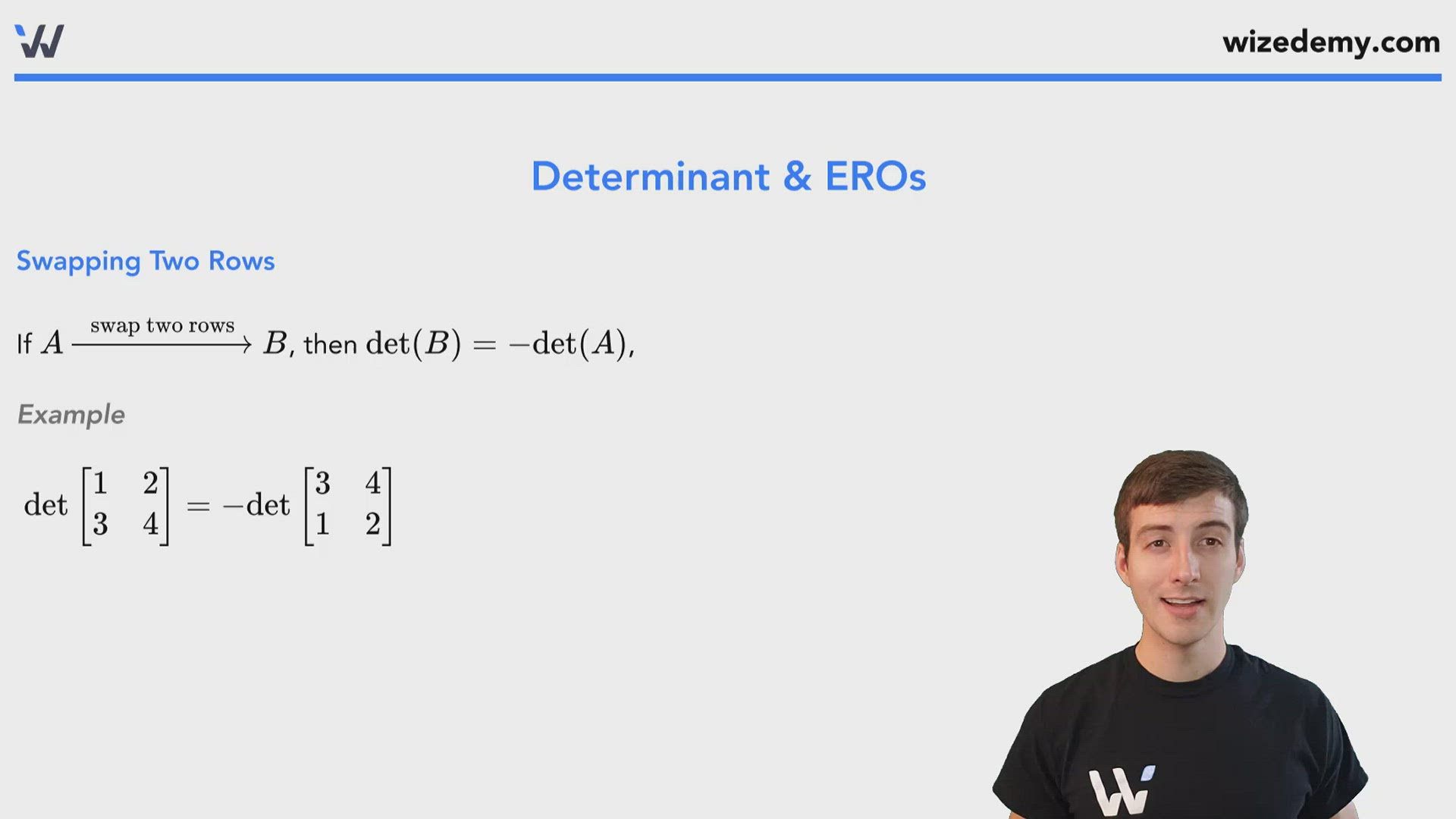
Determinant & EROs
Swapping Two Rows
If , then ,
Example
Multiplying a Row by a Non-Zero Constant
If , then .
Example
Adding a Multiple of One Row to Another Row
If , then
Example
Wize Tip
These determinant properties hold even if the operations are performed on the columns instead of the rows.
0:00 / 0:00
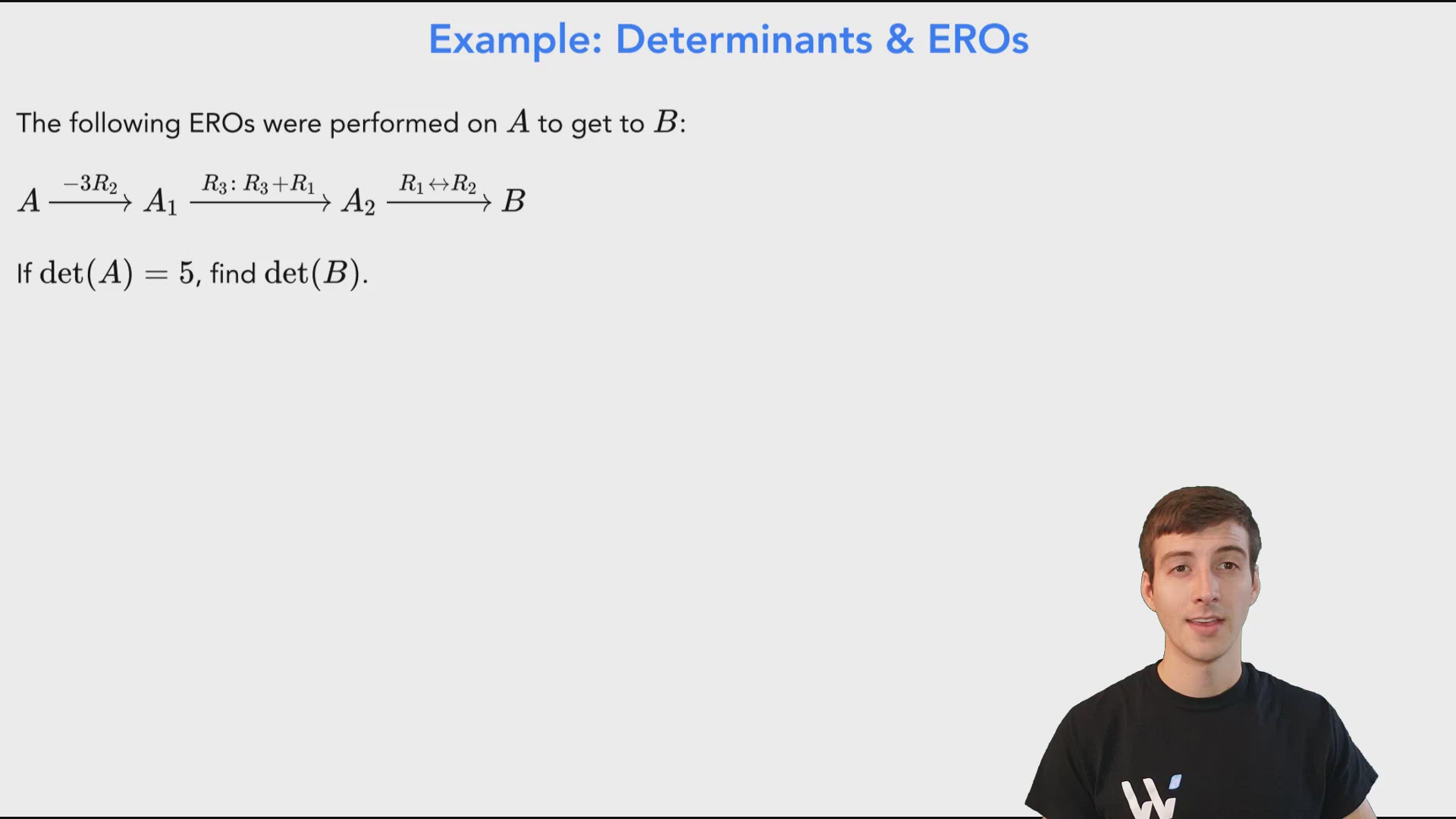
Example: Determinants & EROs
The following EROs were performed on to get to :
If , find .
Let's work backward, starting from .
Swapping rows means the determinant is negated (multiply by -1):
Next, we added a multiple of one row to another which does not change the determinant:
Then we multiplied a row by -3, so the determinant is multiplied by -3:
Putting it all together:
If , find .