Wize University Calculus 1 Textbook > Pre-Calculus (Review)
Inverse Trigonometric Functions
Popular Courses
CALCULUS 1000A/B
Western University
Calculus 1
University Study Guides
AP Calculus (AB) Exam Prep Course
AP Exam Prep
Algebra II
US High School
MATH 1LS3
McMaster University
MATH 249
University of Calgary
MATH 265
University of Calgary
MATH 275
University of Calgary
Calculus 1
General Course
MATH 140
McGill University
MATH 121
Queen's University
MAT135H1
University of Toronto
MATH*1080
University of Guelph
MATH 134
University of Alberta
Calculus 1
University Study Guides
MAT 1320
University of Ottawa
MATH 100
University of Alberta
MATH 203
Concordia University
MTH 140
Toronto Metropolitan University
SC/MATH 1013 3.00
York University

0:00 / 0:00
Inverse Trigonometric Functions
Inverse Sine Function

Inverse Cosine Function

Inverse Tangent Function

Inverse Tangent has horizontal asymptotes at
Dealing with Inverse Trig Functions
If you are given a question with different trig functions like
- let
- then we have
- Draw a triangle based on this
0:00 / 0:00
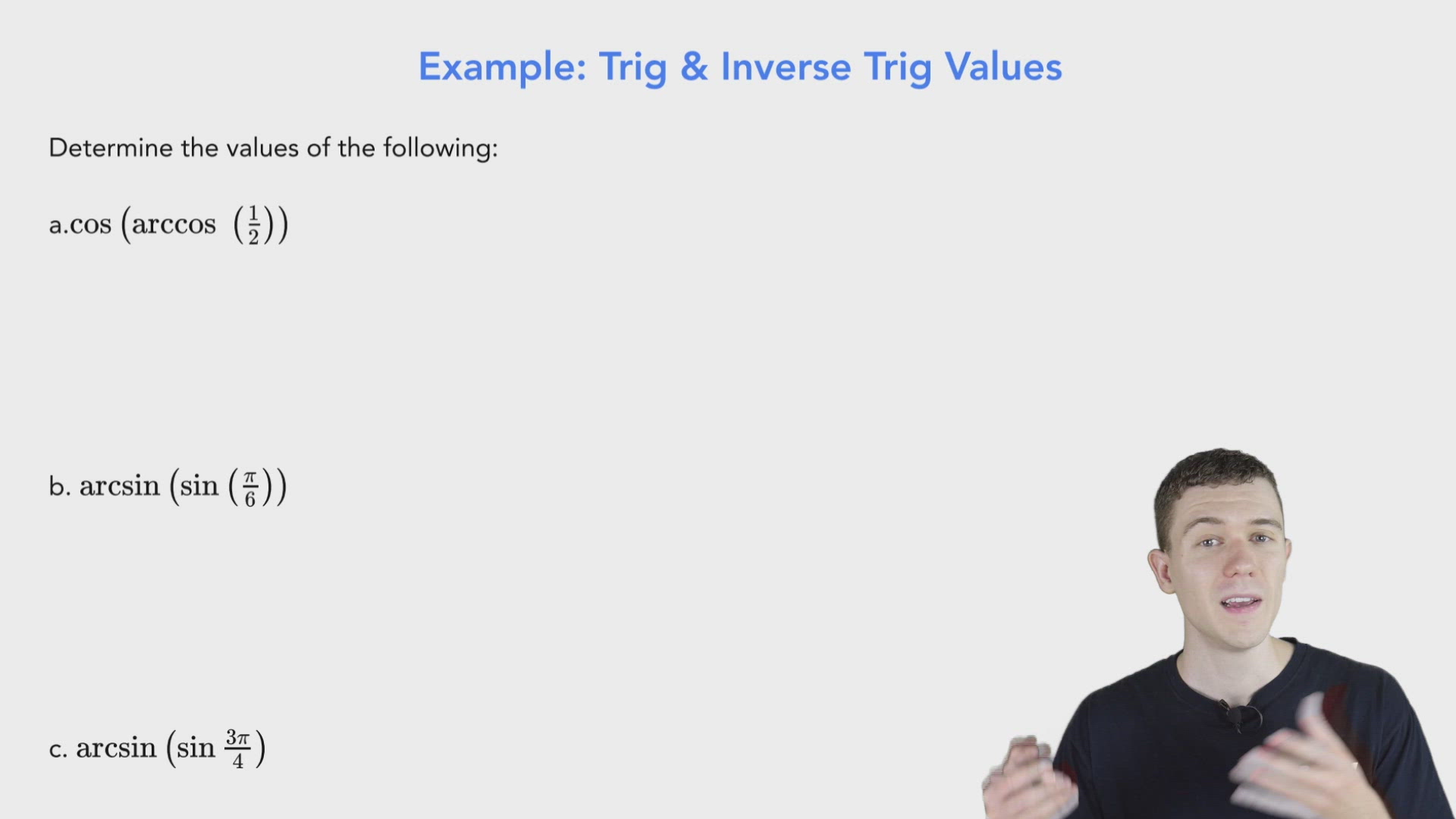
Example: Trig & Inverse Trig Values
Determine the values of the following:
a.
The domain of is .
You can use the cancellation rule directly since the argument is in
Therefore, this evaluates to .
b.
The range of is .
You can use the cancellation rule directly since the argument is in
Therefore, this evaluates to
c.
The range of is
Cancellation rule does not work in this case because the argument is not in
We need to find an angle in such that .
Notice that (quadrant 2) is positive, so the angle we're looking for is in quadrant 1.
Therefore, the angle we need is
d. .
*Recall that
The domain of is . Notice that 0 is in that domain.
Let ,
Then .
Since the range of is , we get that .
Putting this back into the 𝑠𝑖𝑛 function, .
Find the exact value of
Find the exact value of