Wize University Statistics Textbook > Probability
Probability of Dependent Events (Conditional Probability)
Popular Courses
MATH 208
Concordia University
COMM 214
Concordia University
STAT 151
University of Alberta
Statistics
General Course
Intro to Statistics
University Study Guides
COMM 215
Concordia University
Geometry
US High School
STAT 213
University of Calgary
DATASCI 1000A/B
Western University
STA 100
University of California - Davis
Grade 12 Data Management
Ontario High School
High School Statistics
US High School
STAT 200
University of British Columbia
Intro to Statistics
University Study Guides
STATS 2035
Western University
STAT 161
University of Alberta
STAT 263
Queen's University
STAT*2040
University of Guelph
ENDG 319
University of Calgary
ECON 221
Concordia University

0:00 / 0:00
Probability of Dependent Events (Conditional Probability)
Events A and B are dependent if the occurrence of one has an affect on the probability of the occurrence of the other.
Conditional Probability
The probability that event A will occur given that event B has already occured is called the "conditional probability of event A given event B", and is denoted by .
Note: is the probability that event B will occur given that event A already occured.
Wize Concept
If events A and B are independent, then the occurence of one has no affect on the probability of the occurence of the other.
Then,
Multiplication Rule
For any two events A and B, we have the following multiplication rules:

Wize Concept
If events A and B are independent, then and .
Therefore, if A and B are independent, we have the following multiplication rule:
We can rewrite these rules by isolating for the conditional probability, giving us the following formulas for conditional probability:

Example
There are 6 possible outcomes of a fair die. Sample space
Find .
There is only 1 outcome {5} that are in both A and B out of the sample space of 6 possible outcomes {1,2,3,4,5,6}
So,
There are 3 outcomes {1,3,5} that are in the sample space of 6 possible outcomes {1,2,3,4,5,6}
So,
Therefore,
0:00 / 0:00
Conditional Probability: Tree Diagram
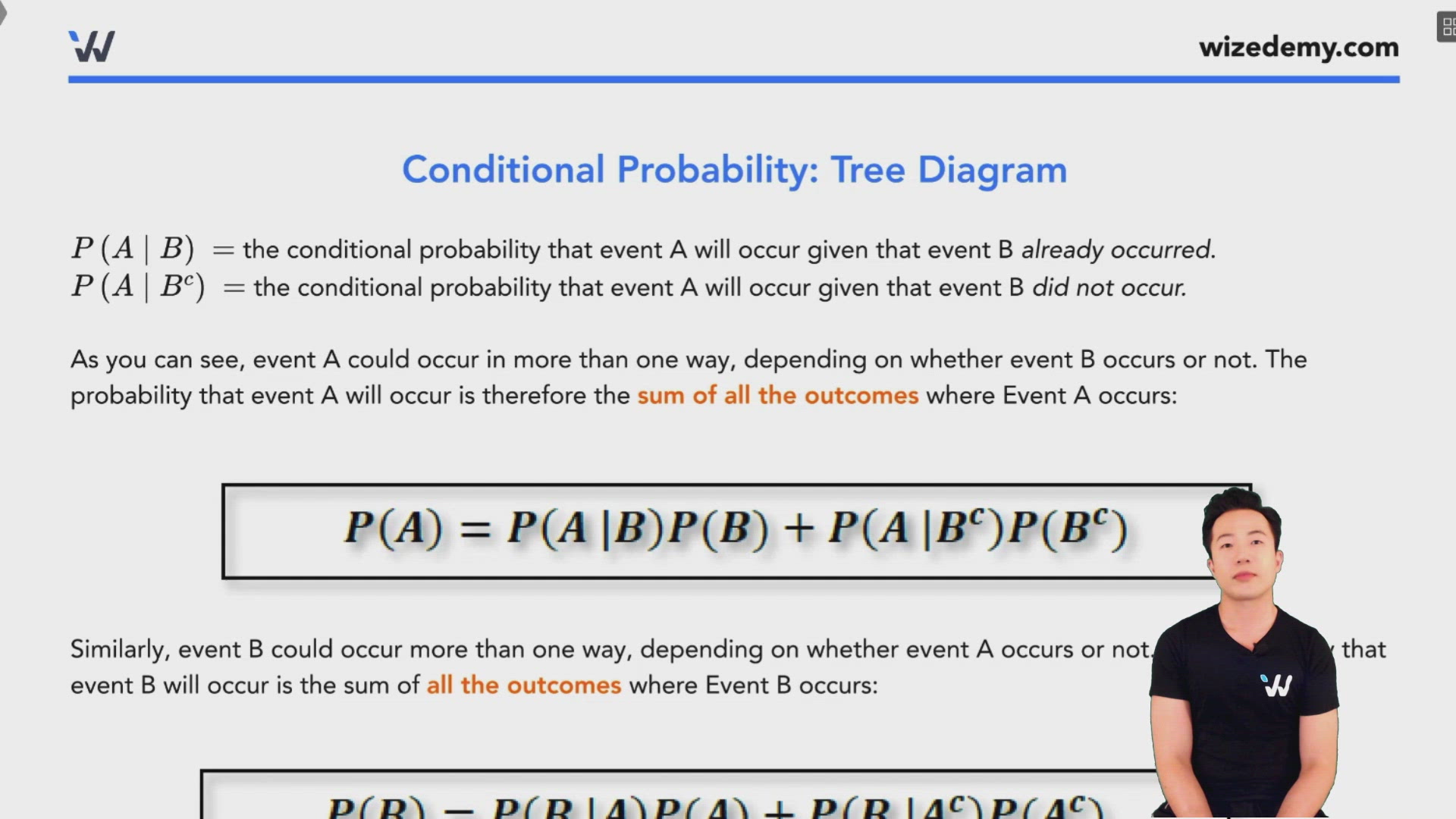
the conditional probability that event A will occur given that event B already occurred.
the conditional probability that event A will occur given that event B did not occur.
As you can see, event A could occur in more than one way, depending on whether event B occurs or not. The probability that event A will occur is therefore the sum of all the outcomes where Event A occurs:

Similarly, event B could occur more than one way, depending on whether event A occurs or not. The probability that event B will occur is the sum of all the outcomes where Event B occurs:

Tree Diagram
A tree diagram shows all the possible outcomes and can help you visualize the problem. It consists of branches that are labeled with probabilities.
Suppose A and B are two dependent events, the following tree diagram shows all the possible outcomes:

Notice that Event B occurs twice:
- given that Event A occurs; and
- given that Event Ac occurs.
Therefore, the probability of Event B occurring is the sum of the two probabilities that Event B occurs:

0:00 / 0:00
Bayes’ Theorem
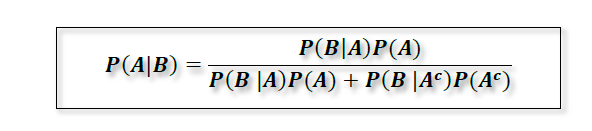
Bayes’ Theorem describes the probability of an event based on conditions that might be related to the event. In other words, suppose we already know the outcome is true and wish to infer the prior probability of the event.
Examples
- Mr. Smith is diagnosed with appendicitis. What’s the probability that he is older than 30 years old?
- Julia agreed to a second date with Richard. What’s the probability that he paid for dinner?
- Paul adopted a cat. What’s the probability that the cat is black?
Bayes' Theorem formula
Example

Find P(A|B):
0:00 / 0:00
Example: Bayes' Theorem
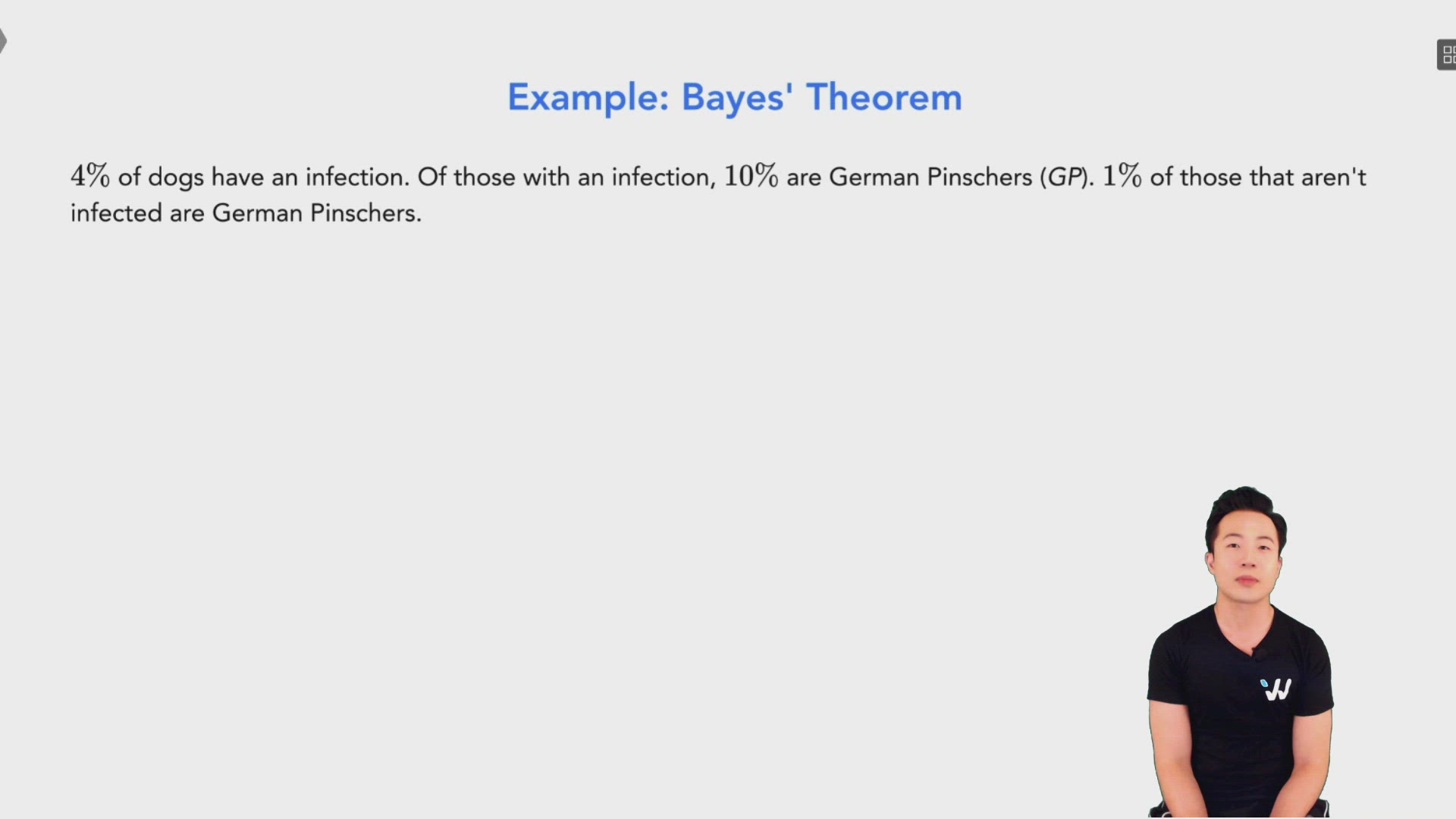
of dogs have an infection. Of those with an infection, are German Pinschers (GP). of those that aren't infected are German Pinschers.
Tree diagram:

(a) If we randomly select a dog, what is the probability that it's a German Pinscher?
(b) Phoebe owns a German Pinscher. What is the probability that her dog is infected?
Bayes' Theorem:
Alternatively, you can use the tree diagram instead of the Bayes' Theorem formula:
- We can find the numerator by following the I and GP branches:
- We already found the denominator in part a):
Therefore, the probability is
Katie could put a ball in either Slot A or Slot B and hopes to win a prize. The ball will bounce around and will either land in a winning box or the losing box. Suppose she puts the ball in Slot A 40% of the time; Slot B 60% of the time. If she puts the ball in Slot A, the ball lands in the winning box 15% of the time. If she puts the ball in Slot B, the ball lands in the losing box through the first channel 60% of the time and into the same losing box through the second channel 20% of the time. See illustration below:
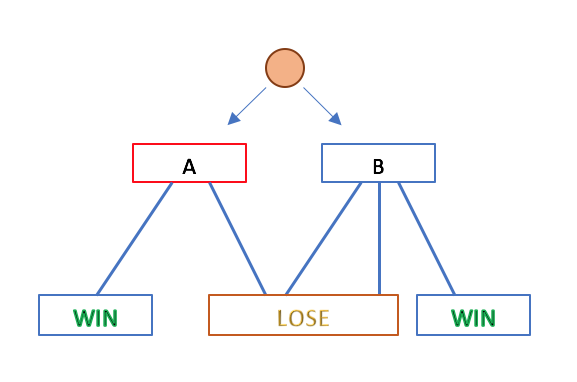
Katie won. What is the probability that she put the ball in Slot A?