Wize University Statistics Textbook > Probability
Probability Problems
Popular Courses
MATH 208
Concordia University
COMM 214
Concordia University
STAT 151
University of Alberta
Statistics
General Course
Intro to Statistics
University Study Guides
COMM 215
Concordia University
Geometry
US High School
STAT 213
University of Calgary
DATASCI 1000A/B
Western University
STA 100
University of California - Davis
Grade 12 Data Management
Ontario High School
High School Statistics
US High School
STAT 200
University of British Columbia
Intro to Statistics
University Study Guides
STATS 2035
Western University
STAT 161
University of Alberta
STAT 263
Queen's University
STAT*2040
University of Guelph
ENDG 319
University of Calgary
ECON 221
Concordia University

0:00 / 0:00
Example: Solving for Probability Using Contingency Table
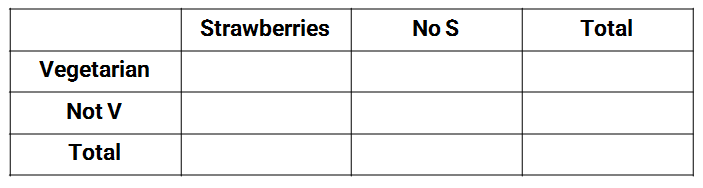
40% of children eat strawberries. Of those that eat strawberries, 80% are vegetarian. Half of those that don’t eat strawberries are vegetarian.
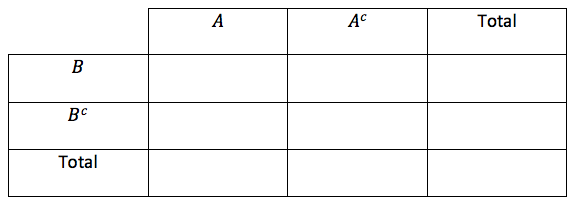
Use the following contingency table to help you solve the questions below:
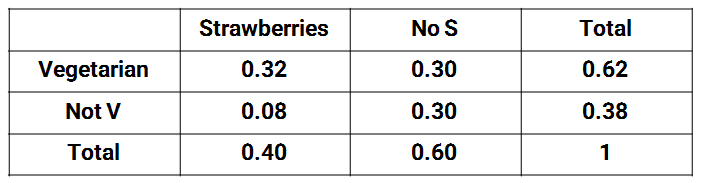
a) If we randomly select someone, what is the probability that he/she eats strawberries and is vegetarian?
0.32
b) What is the probability we pick someone that’s not vegetarian and doesn’t eat strawberries?
0.30
c) If we randomly select a vegetarian, what is the probability that he/she eats strawberries?
d) If we randomly select someone that doesn’t eat strawberries, what is the probability that he/she is vegetarian?
0:00 / 0:00
Example: Dependent Events
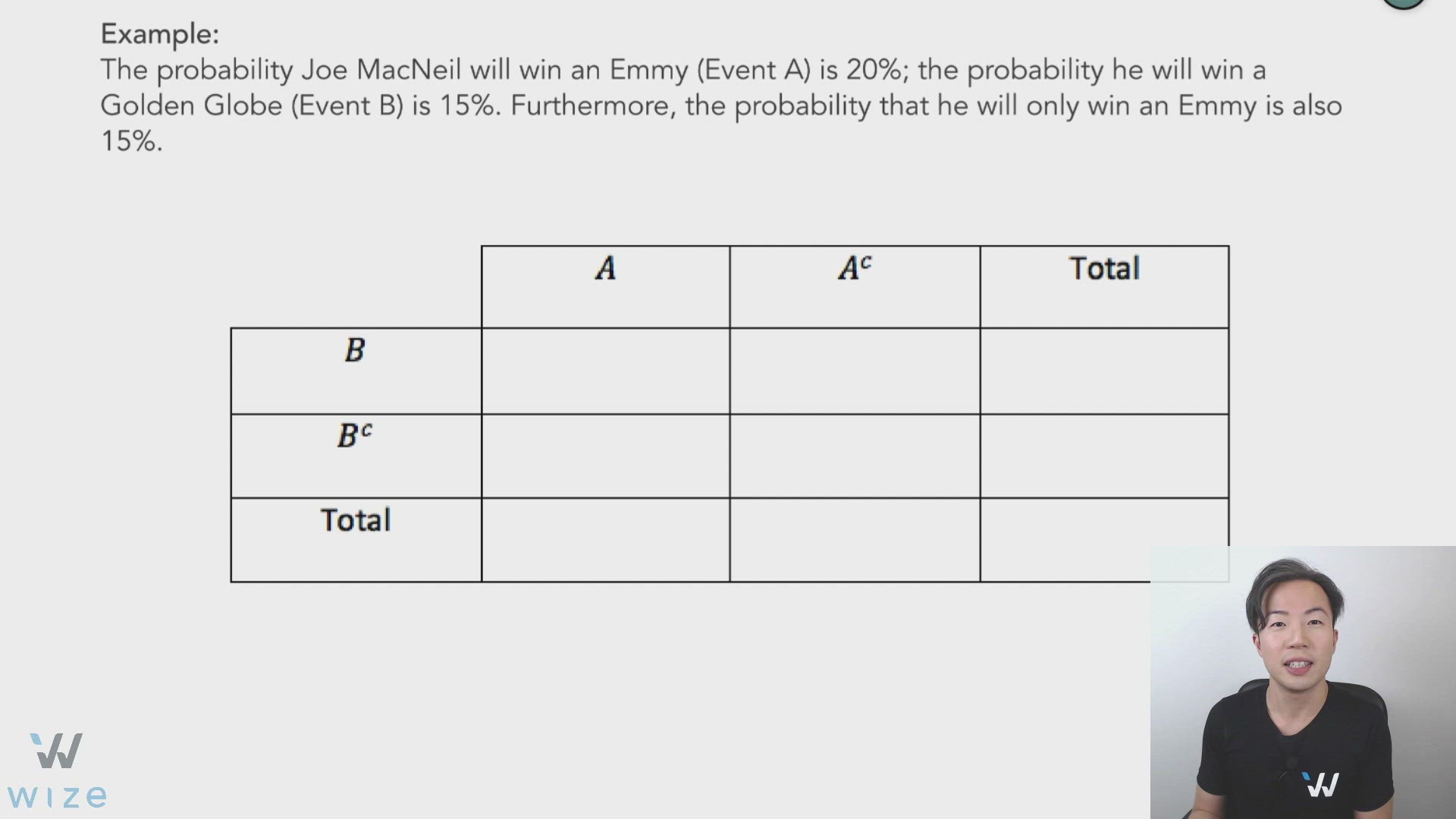
The probability Joe MacNeil will win an Emmy (Event A) is 20%; the probability he will win a Golden Globe (Event B) is 15%. Furthermore, the probability that he will only win an Emmy is also 15%.
Use the following contingency table to help you solve the questions below:
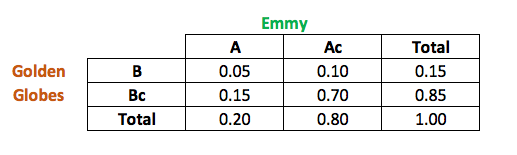
(a) What's the probability that he will win both an Emmy and a Golden Globe?
(b) Are winning an Emmy and winning a Golden Globe independent events?
If the events are independent, then
Since , they are not independent events.
(c) What is the probability that Joe will win an Emmy or a Golden Globe?
(d) If he does not win an Emmy, what is the probability that he will win a Golden Globe?

0:00 / 0:00
Example: Probability Distribution Table
The number of defective phones in a sample of 5 varies according to the following probability table:
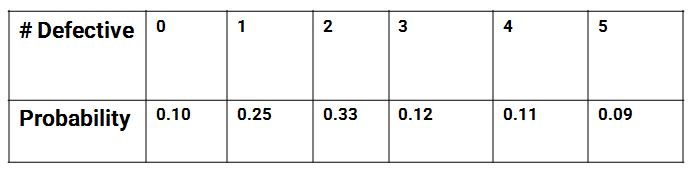
(a) What is the probability that at least 3 will be defective?
(b) At least 4 are defective. What is the probability that exactly four are defective?
(c) What is the probability that at most 3 are defective, given that at least 2 are defective?
Key: We already know that at least 2 are defective. So to paraphrase: "Given that at 2 or 3 or 4 or 5 are defective, what's the probability that up to 3 are defective?" This eliminates 0 or 1 being defective.
Given that P(A) = 0.6, P(B) = 0.5, and P(Bc|Ac)= 0.8, fill in this contingency table to help answer the following questions.
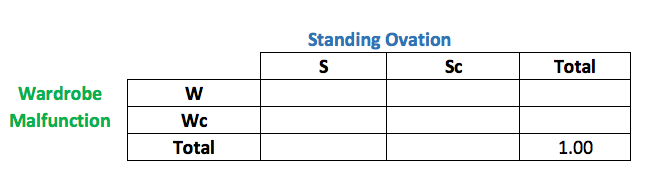
Gloria is an opera singer. The probability that she will get a standing ovation is 60%. The probability that she will have a wardrobe malfunction is 20%. The probability that she will only get a standing ovation is 55%.
Fill in this contingency table to help answer the questions that follow.