Create a free account to get started

Unlock full course notes by signing up

  • Video lessons taught by top educators
  • Practice questions with guided solutions
  • Written review notes for reference
  • Expert answers anytime from course tutors

Summary of Key Definitions

It is important to understand the differences between complement, mutually exclusive, intersection, independent, and union!


"Complement"
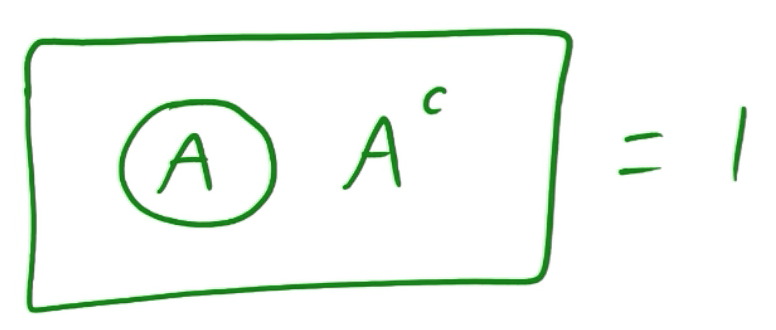
P(A)+P(Ac)=1P(A)+P(A^c)=1


Image illustrating Summary of Key Definitions

The probability of Event A and the probability of Event not-A add up to 100%.


"Mutually Exclusive" (or Disjoint)

P(A∩B)=0P(A\cap B)=0


Image illustrating Summary of Key Definitions

Event A and Event B do not overlap.


"Intersection"
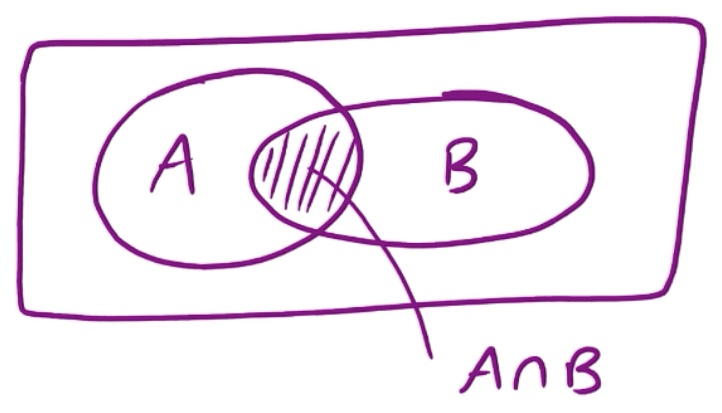
P(A∩B)P(A\cap B)


Image illustrating Summary of Key Definitions


Event A and Event B overlap. Intersection is the opposite of mutually exclusive.


"Independent"
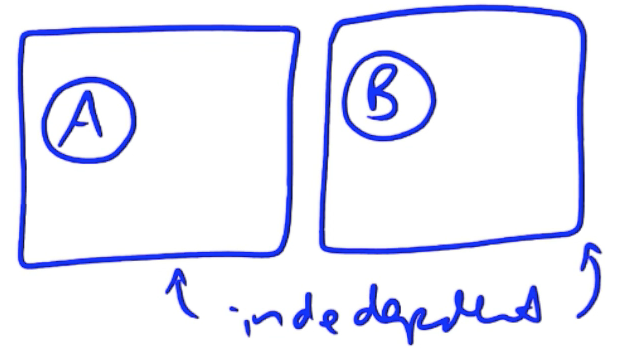
P(A)⋅P(B)=P(A∩B)P(A)\cdot P(B)=P(A\cap B)


Image illustrating Summary of Key Definitions


The occurrence of Event A does not affect the occurrence of Event B, and vice versa.


"Union"
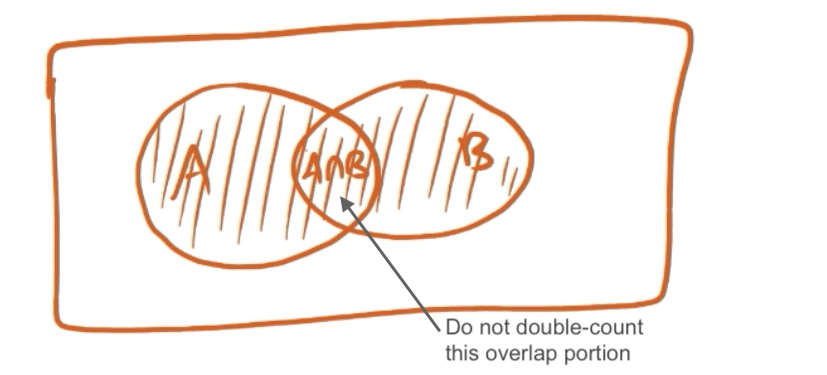
P(A∪B)=P(A)+P(B)−P(A∩B)P(A\cup B)=P(A)+P(B)-P(A\cap B)


Image illustrating Summary of Key Definitions


When Event A and Event B overlap, you need to subtract the overlap portion to avoid double-counting.