Create a free account to get started

Unlock full course notes by signing up

  • Video lessons taught by top educators
  • Practice questions with guided solutions
  • Written review notes for reference
  • Expert answers anytime from course tutors

Matrix Transpose

The transpose of matrix AA, denoted by ATA^T, is obtained by changing its columns into rows (and vice-versa).

Example

A=[abcdefghi],AT=[adgbehcfi]A= \begin{bmatrix} \colorOne{a}&\colorOne{b}&\colorOne{c}\\[0.5em] \colorTwo{d}&\colorTwo{e}&\colorTwo{f}\\[0.5em] g&h&i \end{bmatrix}, \quad A^T=\begin{bmatrix} \colorOne{a}&\colorTwo{d}&g\\[0.5em] \colorOne{b}&\colorTwo{e}&h\\[0.5em] \colorOne{c}&\colorTwo{f}&i \end{bmatrix}

In general: (aT)ij=aji(a^T)_{ij}=a_{ji}

In other words, entry (i,j)(i,j) in AA will become entry (j,i)(j,i) in ATA^T


Properties of the Transpose

Let AA and BB be matrices, and let k∈Rk \in \reals.

  • (AT)T=A(A^T)^T=A
  • (A+B)T=AT+BT(A+B)^T=A^T+B^T
  • (AB)T=BTAT(AB)^T=B^TA^T
  • (kA)T=k(AT)(kA)^T=k(A^T)

Create a free account to get started

Unlock full course notes by signing up

  • Video lessons taught by top educators
  • Practice questions with guided solutions
  • Written review notes for reference
  • Expert answers anytime from course tutors

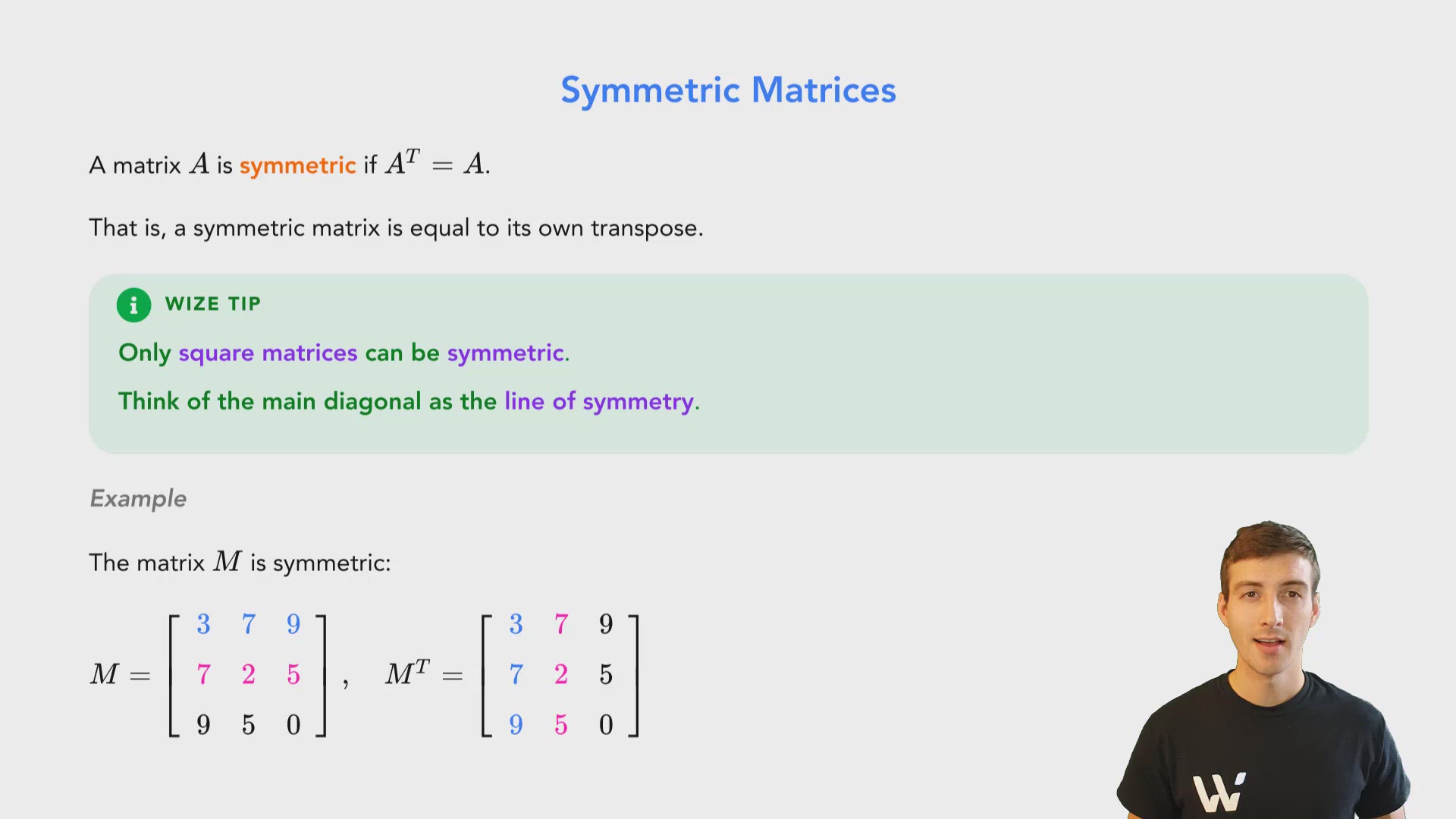
Symmetric Matrices

A matrix AA is symmetric if AT=AA^T = A.

That is, a symmetric matrix is equal to its own transpose.

Example

The matrix MM is symmetric:

M=[379725950],MT=[379725950]M= \left[\begin{array}{rrr} \colorOne{3}&\colorOne{7}&\colorOne{9}\\[0.5em] \colorTwo{7}&\colorTwo{2}&\colorTwo{5}\\[0.5em] 9&5&0\\ \end{array} \right] , \quad M^T = \left[ \begin{array}{rrr} \colorOne{3}&\colorTwo{7}&9\\[0.5em] \colorOne{7}&\colorTwo{2}&5\\[0.5em] \colorOne{9}&\colorTwo{5}&0\\ \end{array} \right]

Skew-Symmetric Matrix

A matrix is skew-symmetric if AT=−AA^T=-A (the transpose is equal to the negative of the matrix).


Example

The matrix PP is skew-symmetric:

P=[01−5−10−115110]P=\left[\begin{array}{rrr} 0&1&-5\\[0.5em] -1&0&-11\\[0.5em] 5&11&0\\ \end{array}\right]

Notice that PT=−PP^T=-P:

PT=[01−5−10−115110]T=[0−151011−5−110]=(−1)⋅[01−5−10−115110]=−PP^T=\left[\begin{array}{rrr} \colorOne{0}&\colorOne{1}&\colorOne{-5}\\[0.5em] \colorTwo{-1}&\colorTwo{0}&\colorTwo{-11}\\[0.5em] 5&11&0\\ \end{array}\right]^T = \left[\begin{array}{rrr} \colorOne{0}&\colorTwo{-1}&5\\[0.5em] \colorOne{1}&\colorTwo{0}&11\\[0.5em] \colorOne{-5}&\colorTwo{-11}&0\\ \end{array}\right] =(-1)\cdot\left[\begin{array}{rrr} 0&1&-5\\[0.5em] -1&0&-11\\[0.5em] 5&11&0\\ \end{array}\right] =-P

Create a free account to get started

Unlock full course notes by signing up

  • Video lessons taught by top educators
  • Practice questions with guided solutions
  • Written review notes for reference
  • Expert answers anytime from course tutors

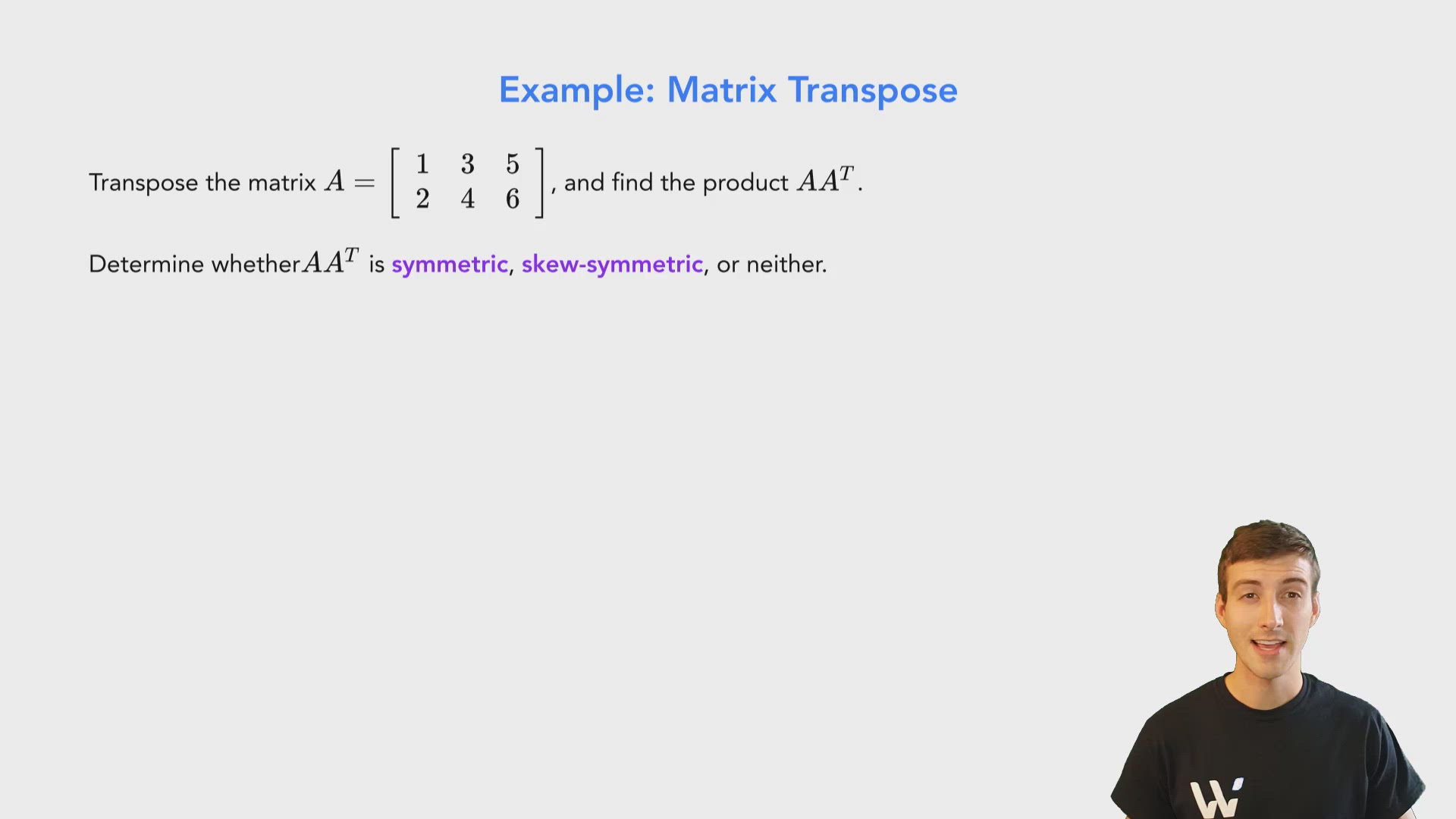
Example: Matrix Transpose

Transpose the matrix A=[135246]A=\left[\begin{array}{rrr}1 & 3 & 5\\2 & 4 &6\end{array}\right], and find the product AATAA^T.

Determine whether AATAA^T is symmetric, skew-symmetric, or neither.

AT=[123456]A^T=\left[\begin{array}{rr} 1 & 2\\3&4\\5 & 6\end{array}\right]

AAT=[135246][123456]=[35444456]AA^T = \left[\begin{array}{rrr}1 & 3 & 5\\2 & 4 &6\end{array}\right] \left[\begin{array}{rr}1 & 2\\3&4\\5&6\\\end{array}\right] = \left[\begin{array}{rr}35 & 44\\44&56\end{array}\right]

Since this matrix is symmetric across the main diagonal, and since the transpose is equal to itself, AATAA^T is symmetric.

Note: (AAT)T=(AT)T(A)T=AAT(\colorOne{AA^T})^T = (A^T)^T(A)^T=\colorOne{AA^T}, so given any matrix AA, AATAA^T is always symmetric.

Mark Yourself Question

  1. Grab a piece of paper and try this problem yourself.
  2. When you're done, check the "I have answered this question" box below.
  3. View the solution and report whether you got it right or wrong.

Prove that for any square matrix AA, the matrix A−ATA-A^T is skew-symmetric.

Create a free account to get started

Unlock full course notes by signing up

  • Video lessons taught by top educators
  • Practice questions with guided solutions
  • Written review notes for reference
  • Expert answers anytime from course tutors

Given C=[431]C = \left[ \begin{array}{rrr} 4 & 3 & 1 \end{array} \right] and D=[131245]D = \left[ \begin{array}{rrr} 1 & 3 & 1\\ 2 & 4 & 5\\ \end{array} \right], find the following entries.

Your answers

Create a free account to get started

Unlock full course notes by signing up

  • Video lessons taught by top educators
  • Practice questions with guided solutions
  • Written review notes for reference
  • Expert answers anytime from course tutors

Extra Practice