0:00 / 0:00

Binomial x Binomial

There are a few methods for multiplying two binomials together.

FOIL Method

Some teachers will teach the FOIL method.
  • F: First
  • O: Outside
  • I: Inside
  • L: Last
PAGE BREAK
Example (Foil)
Multiply the binomials (3x+1)(2x6)(3x+1)(-2x-6).

F:(3xFirst+1)(2xFirst6))=(3x)(2x)   ...O:(3xOutside+1)(2x6Outside)=(3x)(2x)+(3x)(6)+   ...I:(3x+1Inside)(2xInside6)=(3x)(2x)+(3x)(6)+(+1)(2x)   ...L:(3x+1Last)(2x6Last)(3x)(2x)+(3x)(6)+(+1)(2x)+(+1)(6)\begin{array}{rl} F:&(\underbrace{\bct{3x}}_{\text{First}}+1)(\underbrace{\bct{-2x}}_{\text{First}}-6))\\\\ =&\bct{(3x)(-2x)}~~~...\\\\\\\\ O:&(\underbrace{\bcth{3x}}_\text{Outside}+1)(-2x\underbrace{\bcth{-6}}_\text{Outside})\\\\ =&\bct{(3x)(-2x)}+\bcth{(3x)(-6)}+~~~...\\\\\\\\ I:&(3x\underbrace{\bcf{+1}}_\text{Inside})(\underbrace{\bcf{-2x}}_\text{Inside}-6)\\\\ =&\bct{(3x)(-2x)}+\bcth{(3x)(-6)}+\bcf{(+1)(-2x)}~~~...\\\\\\\\ L:&(3x\underbrace{\bcfi{+1}}_\text{Last})(-2x\underbrace{\bcfi{-6}}_\text{Last})\\\\ &\bct{(3x)(-2x)}+\bcth{(3x)(-6)}+\bcf{(+1)(-2x)}+\bcfi{(+1)(-6)}\\\\\\ \end{array}

Finally, we simplify the answer:
(3x)(2x)+(3x)(6)+(+1)(2x)+(+1)(6)=6x2+18x+2x+6=6x2+20x6\begin{array}{rccccccc} &\bct{(3x)(-2x)}&+&\bcth{(3x)(-6)}&+&\bcf{(+1)(-2x)}&+&\bcfi{(+1)(-6)}\\\\ =&\bct{-6x^2}&+&\bcth{-18x}&+&\bcf{-2x}&+&\bcfi{-6}\\\\ =&-6x^2&+&&-20x&&-6 \end{array}

So, the answer is 6x220x6-6x^2-20x-6, which is a trinomial.
PAGE BREAK

Distributive Method

Instead of remembering FOIL, we can use the distributive method ("hand-shake" rule) that helps us multiply any polynomials together, not just binomials!



Distributive Method: Every term in the first bracket needs to be multiplied by every term in the second bracket.

PAGE BREAK
Example (Distributive Method)
Multiply the binomials (3x+1)(2x6)(3x+1)(-2x-6).

(3x  +1)(2x 6)=(3x)(2x)  +  (3x)(6)  +  (+1)(2x)+(+1)(6)=6x2  18x+2x  6Grouping the like terms:=6x220x6\begin{array}{rccc} &(\bct{3x}~~\bcth{+1})(-2x~-6)\\\\ =&\bct{(3x)}(-2x)~~+~~\bct{(3x)}(-6)&~~+~~&\bcth{(+1)}(-2x)+\bcth{(+1)}(-6)\\\\ =&\bct{-6x^2~~-18x}&+&\bcth{-2x~~-6}\\\\ &\text{Grouping the like terms:}\\ =&-6x^2-20x-6 \end{array}
0:00 / 0:00

Multiplying Binomials Using Algebra Tiles

We can visualize how to multiply binomials by using an area model (using algebra tiles)

Example
(3x+1)(2x6)(3x+1)(-2x-6)


So, the answer is 6x22x18x6-6x^2-2x-18x-6, which simplifies to 6x220x6-6x^2-20x-6.

0:00 / 0:00

Example: Multiplying Binomials

Expand and simplify the following

a) (3h2)(4h+5)\left(-3h-2\right)\left(4h+5\right)

FOIL Method

First: (3h)(4h)=12h2(-3h)\left(4h\right)=-12h^2
Outside: (3h)(5)=15h(-3h)\left(5\right)=-15h
Inside: (2)(4h)=8h(-2)\left(4h\right)=-8h
Last: (2)(5)=10(-2)\left(5\right)=-10

Write these terms in a line:
=12h215h8h10=-12h^2-15h-8h-10

Combine like terms (simplify):
=12h223h10=-12h^2-23h-10

Distributive Method

Multiply 3h-3h from the first bracket with all temrs in the second bracket, then multiply 2-2 from the first bracket with all terms in the second bracket.

=(3h)(4h)+(3h)(+5)+(2)(4h)+(2)(+5)=12h215h8h10=12h223h10\begin{array}{rccccccc} =&(\bct{-3h})(4h)&+&(\bct{-3h})(+5)&+&(\bcth{-2})(4h)&+&(\bcth{-2})(+5)\\\\ =&-12h^2&&-15h&&-8h&&-10\\\\ =&-12h^2&&&-23h&&&-10 \end{array}

Using either method, we see that this simplifies to 12h223h10\boxed{-12h^2-23h-10}.

PAGE BREAK
b) y=3(x1)2+4y=3\left(x-1\right)^2+4

First rewrite this:
y=3(x1)(x1)+4y=3\left(x-1\right)\left(x-1\right)+4

Use either the FOIL or distributive method to expand the brackets:
y=3(x2xx+1)+4y=3\left(x^2-x-x+1\right)+4
y=3(x22x+1)+4y=3\left(x^2-2x+1\right)+4

Then multiply the 33 in and simplify.
y=3x26x+3+4y=3x^2-6x+3+4
y=3x26x+7\boxed{y=3x^2-6x+7}
0:00 / 0:00

Example: Multiplying Polynomials

At the National Gallery of Canada, a piece of art work is to be mounted on a solid steel backdrop (frame).
This is done so that a steel boarder with a constant width will show around the art.


1. If the artwork measures 120cm by 85cm, create a function that describes the area of the steel backdrop (frame) in terms of the width of the border that will be seen x.

The area of the steel backdrop frame is the area of the big rectangle subtract the area of the smaller rectangle (the piece of art):
Areabig rectangle=Length×Width=(85+2x)(120+2x)\text{Area}_\text{big rectangle}=\text{Length}\times\text{Width}=(85+2x)(120+2x)
Areasmall rectangle=Length×Width=(85)(120)\text{Area}_\text{small rectangle}=\text{Length}\times\text{Width}=(85)(120)

Therefore, the area of the steel backdrop (frame) is (85+2x)(120+2x)(85)(120)(85+2x)(120+2x)-(85)(120)

2. Simplify the function by multiplying and combining any like terms

A(x)=(85+2x)(120+2x)(85)(120)=(85)(120)+(85)(2x)+(2x)(120)+(2x)(2x)(85)(120)=(85)(120)+(85)(2x)+(2x)(120)+(2x)(2x)(85)(120)=170x+240x+4x2=4x2+410x\begin{aligned} A(x) &= (85+2x)(120+2x)-(85)(120)\\ &= (85)(120)+(85)(2x)+(2x)(120)+(2x)(2x)-(85)(120)\\ &= \cancel{(85)(120)}+(85)(2x)+(2x)(120)+(2x)(2x)\cancel{-(85)(120)}\\ &=170x+240x+4x^2\\ &=4x^2+410x \end{aligned}

Practice: Multiplying Binomials

Expand and simplify the following:

a) (3x+5)(7x3)\left(3x+5\right)\left(7x-3\right).

b) (3x1)2(3x-1)^2

Practice: Multiplying Binomials

Here's a blueprint of a patio that Mariel wants to build.
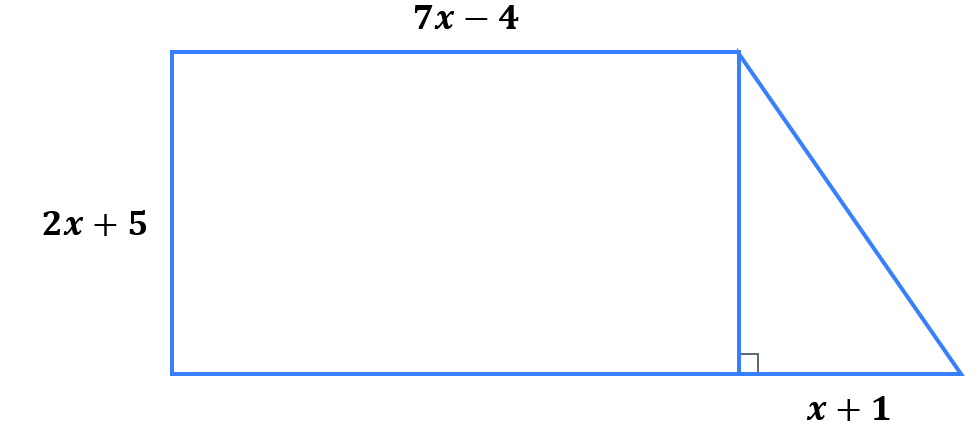

a) Writen an expression represending the area of the patio.

b) If x=2 ftx=2~\text{ft}, determine the total area of the patio.

Practice: Multiplying Binomials

Fill in the blanks.

a) (3x+1)(2x+(3x+1)(2x+
)) =6x2+15x+2x+5=6x^2+15x+2x+5


b) (2x+3)(3x+(-2x+3)(3x+
)) =6x2+2x+9x3=-6x^2+2x+9x-3


c) ((
+3)(3x5)+3)(-3x-5)=12x2+11x15=12x^2+11x-15


d) (x+(-x+
))(2x5)(2x-5)=2x2+11x+=-2x^2+11x+