Wize High School Grade 10 Math Textbook > Factoring Polynomials
Common Factoring
Popular Courses
Grade 10 Math
Canada High School
Algebra I
US High School
DAT
General Course
Grade 10 Principles of Mathematics
Ontario High School
Math 10C
Alberta High School
Foundations of Math and Pre-Calculus 10
British Columbia High School
Grade 10 Foundations of Mathematics
Ontario High School
MATH 1148
Ohio State University
MATH 0098
Baton Rouge Community College
0:00 / 0:00
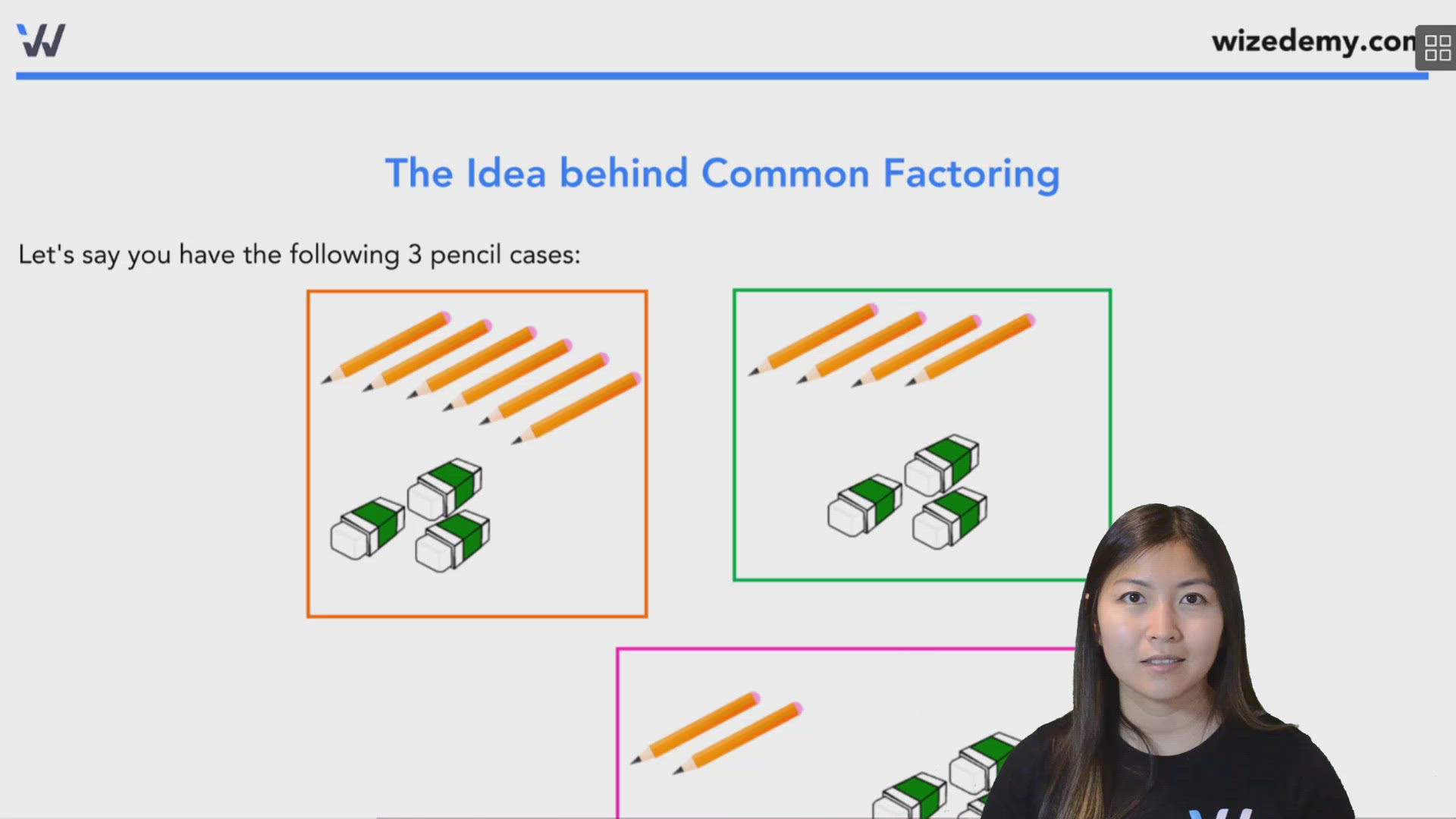
The Idea behind Common Factoring
Let's say you have the following 3 pencil cases:
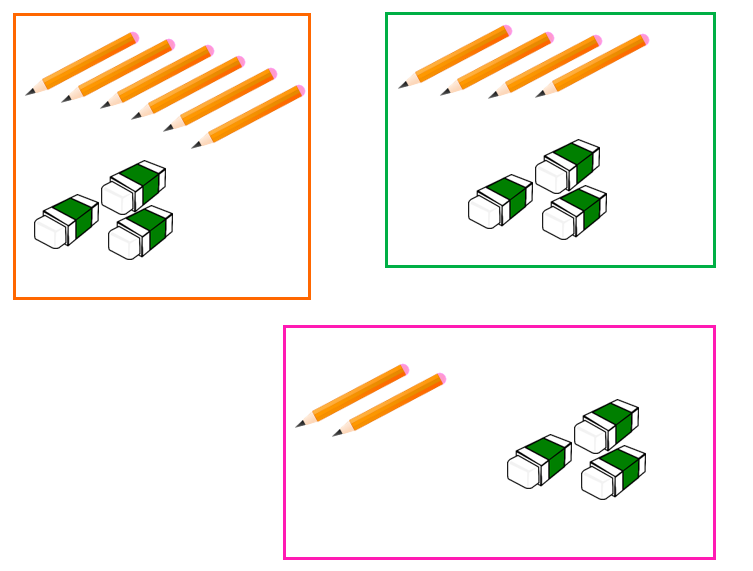
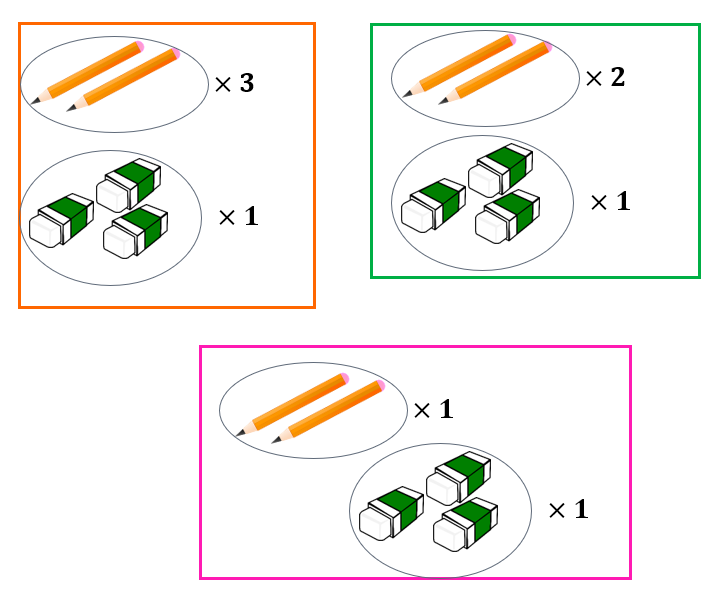
It's clear that there are items in common (the same) between all 3 pencil cases. How can we simplify this picture using numbers?
Wize Tip
When thinking about common factoring, you want to "take out" (divide out) the largest common item as possible!
Factoring with Numbers
Given any number , its factors are divisors of (meaning numbers that "go into very nicely").
*Note: We usually only consider integer factors!
Example 1
Given the number 24, its factors are -1, 1, -2, 2, -3, 3, -4, 4, -6, 6, -8, 8, -12, 12, -24, and 24.
So, we can rewrite 24 as follows
- -1 (-24)
- 1(24)
- -2 (-12)
- 2 (12)
- -3 (-8)
- 3 (8)
- ...
Example 2
Identify the greatest common factor between the following terms, then rewrite the expression by dividing out the greatest common factor.
a)
5 (1 + 5)
b)
3 (2 - 5) or -3 (-2 + 5)
c)
4 (-2 - 5) or -4 (-2 + 5)
d)
-4 (2 + 5)

0:00 / 0:00
Common Factoring
When given a polynomial, we can use common factoring to "take out" (divide out) any common terms.
How to common factor?
- Identify the greatest common factor between all of the terms →
- Divide the entire polynomial by this greatest common factor →
- Rewrite the polynomial in factored form →
Wize Tip
This is the "reverse" of multiplying a monomial by a polynomial!
We can always check our answer by expanding the factored form to see if we end up with the original polynomial
Example 1
Identify the greatest common factor between the following terms, then factor each polynomial.
a)
1. Greatest common factor: .
2. Dividing each term by :
3. The factored form:
Check:
b)
Greatest common factor: .
Dividing each term by :
The factored form:
Check:
c)
Greatest common factor: .
Dividing each term by :
The factored form:
Check:
d)
Greatest common factor: .
Dividing each term by :
The factored form:
Check:
Example 2
Factor the following polynomials
a)
Greatest common factor: .
Dividing each term by :
The factored form:
Check:
b)
Greatest common factor: .
Dividing each term by :
The factored form:
Check:
Practice: Greatest Common Factors
Identify the greatest common factors between the following terms.
a) and
b) and
c) and
d) and
e) and

0:00 / 0:00
Example: Common Factoring
Factor the following polynomials
a)
Watch Out!
The GCF must be a factor of ALL of the terms!
Even though is a common factor of the first two terms and , it is NOT a common factor of the last term, so it is NOT a GCF of all of the terms!
1. Greatest common factor: .
2. Dividing each term by :
3. The factored form:
Check:
b)
1. Greatest common factor: .
2. Dividing each term by :
3. The factored form:
Check:
*In later sections, you will learn how to further factor this polynomial!
c)
1. Greatest common factor: .
2. Dividing each term by :
3. The factored form:
Check:
d)
1. Greatest common factor: .
2. Dividing each term by :
3. The factored form:
Check:
e)
1. Greatest common factor: .
2. Dividing each term by :
3. The factored form:
Check:
Practice: Common Factoring
Factor the following polynomials.
a)
b)
c)
Practice: Common Factoring
Identify the greatest common factor between terms, then factor the polynomial.
0:00 / 0:00
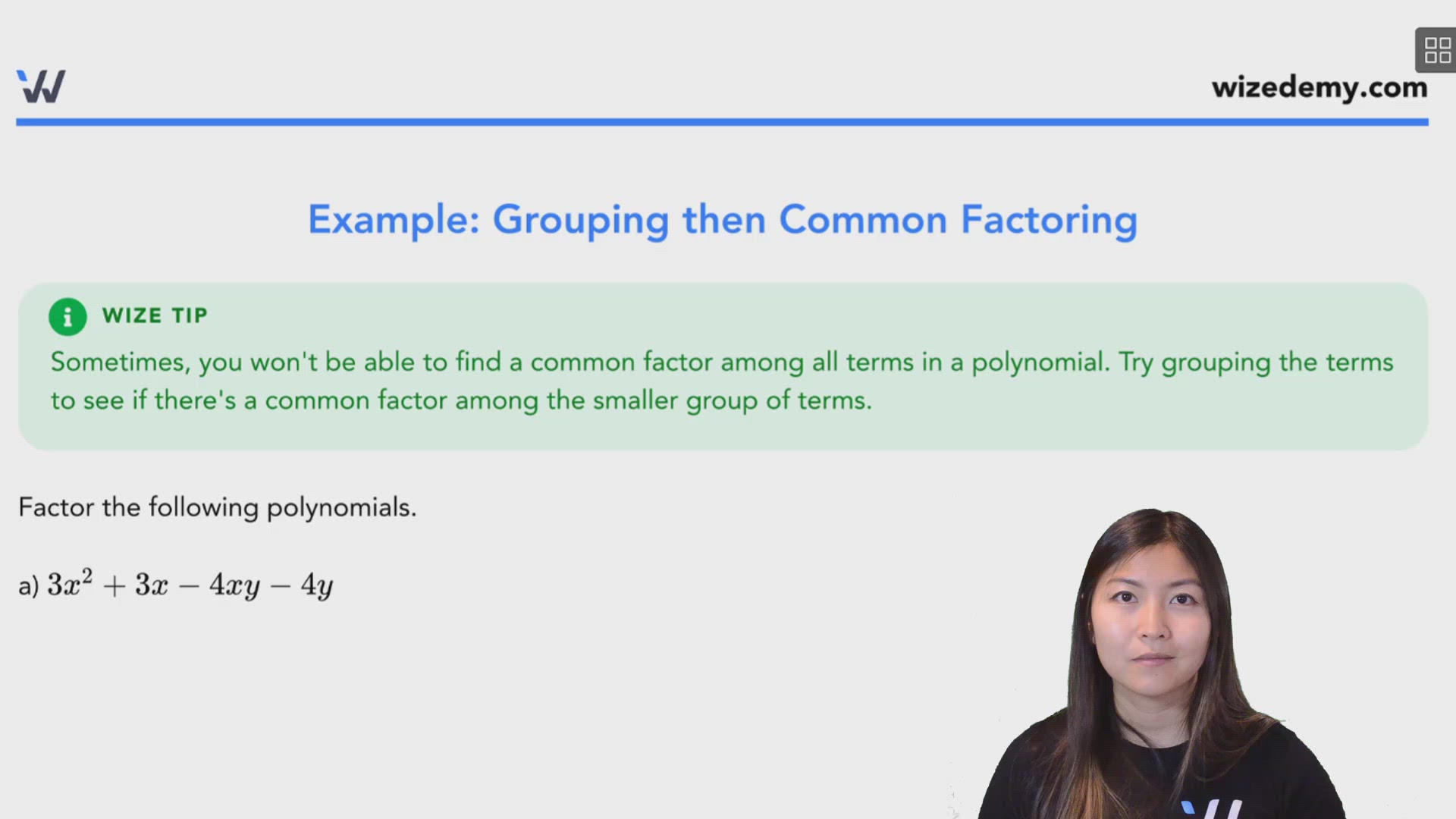
Example: Grouping then Common Factoring
Wize Tip
Sometimes, you won't be able to find a common factor among all terms in a polynomial. Try grouping the terms to see if there's a common factor among the smaller group of terms.
Factor the following polynomials.
a)
Grouping the first two terms and the last two terms together:
Group 1:
1. Greatest common factor: .
2. Dividing each term by :
3. The factored form:
Group 2:
1. Greatest common factor: .
2. Dividing each term by :
3. The factored form:
So, factoring in pairs, we get .
Notice that there's another common factor of between these two terms! Factoring further, we see that
b)
Grouping the first two terms and the last two terms together:
Group 1:
1. Greatest common factor: .
2. Dividing each term by :
3. The factored form:
Group 2:
1. Greatest common factor: .
2. Dividing each term by :
3. The factored form:
So, factoring in pairs, we get .
Notice that there's another common factor of between these two terms! Factoring further, we see that ,
Practice: Common Factoring by Grouping
Factor the polynomial .
Practice: Common Factoring
Factor the following polynomials.
a)
b)
c)
d)
e)
f)