Wize High School Grade 11 Math Textbook > Systems of Linear & Quadratic Equations
Solving Systems of Equations
0:00 / 0:00
Solving Systems of Equations
A system of equations is a set of equations involving the same variables.
The solution to a system of equations is a point of intersection (POI).
We can solve systems of equations involving either graphically or algebraically.
Solving Graphically
Given two functions, we can graph both of them and look for points of intersection.
Once you've found the point(s), sub the values into each equation to check your answer!
Example 1
Solve the following system by graphing:
We can graph the linear function :
The slope is , and the y-intercept is .
Then, graph the quadratic function .
It is a parabola in vertex form: it's been reflected vertically, and translated up 4 units.
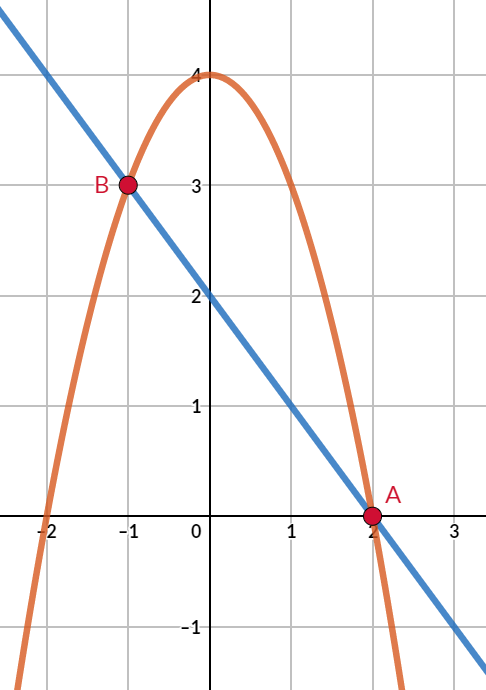
There are two points POIs: and .
Let's check . One way is to plug in just the x-value, , into each equation:
When we sub in , the result is indeed in both cases.
Let's check using a different method. This time, we'll plug in both the x and y-values.
Solving Algebraically
To solve without graphing, we can use substitution or elimination.
These methods work the same way with quadratic functions as they do with linear functions!
Example 2
Solve the same problem as before algebraically:
Given in this form , we already know one variable in terms of another.
That means we can easily substitute the expression for from Equation 1 into Equation 2:
Now let's bring everything over to the lefthand side (LHS) and factor:
Then sub these values back into either equation (pick the easiest one!) to find the y-value.
Using Equation 1:
gives us , so the POI is .
gives us , so the POI is .
0:00 / 0:00
Example: Solving Systems of Equations
Kira and Jose are throwing balls at one another and trying to make them collide in the air.
Kira throws a ping pong ball first, where the height of the ball in inches is modelled by and is in seconds.
Jose throws a rubber ball 1 second later, and the height of that ball in inches is given by .
Assuming their aim was accurate, where and when will the balls collide?
Method 1: Solving Graphically
To graph the height of the balls, we complete the square:
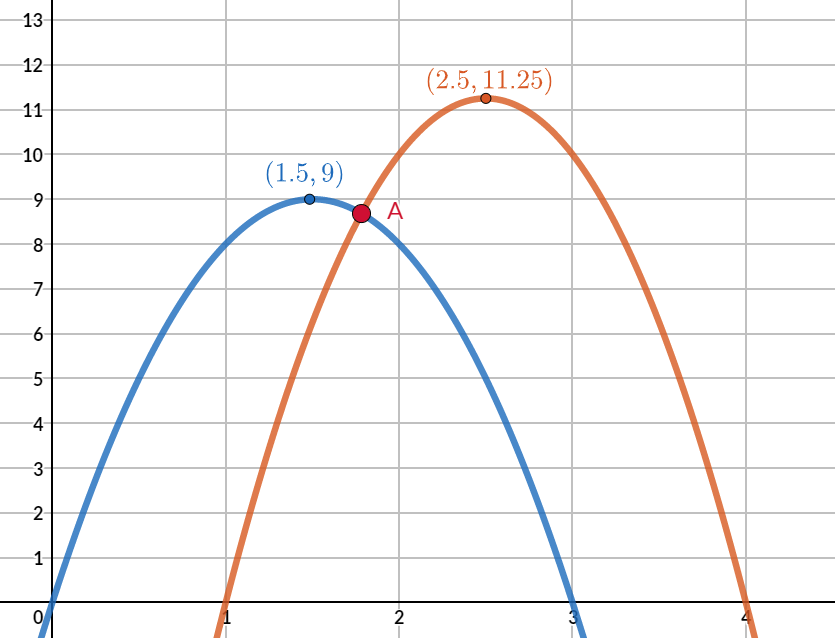
Graphing software tells us the point of intersection is approximately . Check this answer yourself!
Method 2: Algebraically (Elimination)
We've seen how to use substitution in an example in the theory lesson. Now let's try elimination.
The trick is to make sure terms with the same degree are aligned, and to eliminate the dependent variable (the vertical axis -- the one that is not squared). In this case, we eliminate by subtracting:
Now we use the quadratic formula to solve for :
Notice that we actually missed a POI when using the graphing method, but the missing point is far below the x-axis (underground!).
Lastly, we can plug in the time into either equation to find the height at that time:
Therefore, the balls collide at the point , meaning after 1.783s, they hit each other at a height of 8.68 inches.
Practice: Solving Systems of Equations
Without solving algebraically, how many points of intersection are there between the following functions?
Practice: Solving Systems of Equations
Solve the following system of equations:
Practice: Solving Systems of Equations
A wholesaler purchases products in bulk.
The price of a certain product decreases quadratically with the number of items purchased according to the formula:
However, after purchasing a certain number of items, the price drops linearly according to the formula:
a) After how many items does the change in pricing occur?
b) What is the price of an item at this point?
c) Is the wholesaler buying these items happy when the price changes, or not?
Practice: Solving Systems of Equations
A clubhouse has a secret code involving two integers. The door of the clubhouse has the following riddle:
What are the two integers that form the secret code?
I would love to see you come up with a problem involving finding a solution to a system of equations!
Feel free to type it out (or attach a picture) in the Ask a Question box. Your question might be featured with a full video solution!