Wize High School Grade 12 Pre-Calculus Textbook > Trigonometric (Sinusoidal) Graphs
Applications of Trigonometric Functions
Popular Courses
Grade 12 Advanced Functions
Ontario High School
Grade 12 Pre-Calculus/Functions
Canada High School
Algebra II
US High School
Math 30-1
Alberta High School
Pre-Calculus 12
British Columbia High School
MATH 1149
Ohio State University
MAC 1140
University of Florida
MATH 150
Texas A&M University
MATH 41
Pennsylvania State University
MAC 1105
Florida State University
MAT 012
University of California - Davis
MTH 103A
Michigan State University
MTH 116
Michigan State University
MAC 1147
University of Florida
MATH 140
San Diego State University
MA 15800
Purdue University
MAC 1140C
University of Central Florida
MAC 1114C
University of Central Florida
MATH 102
California State University - Northridge
M 305G
The University of Texas at Austin
0:00 / 0:00
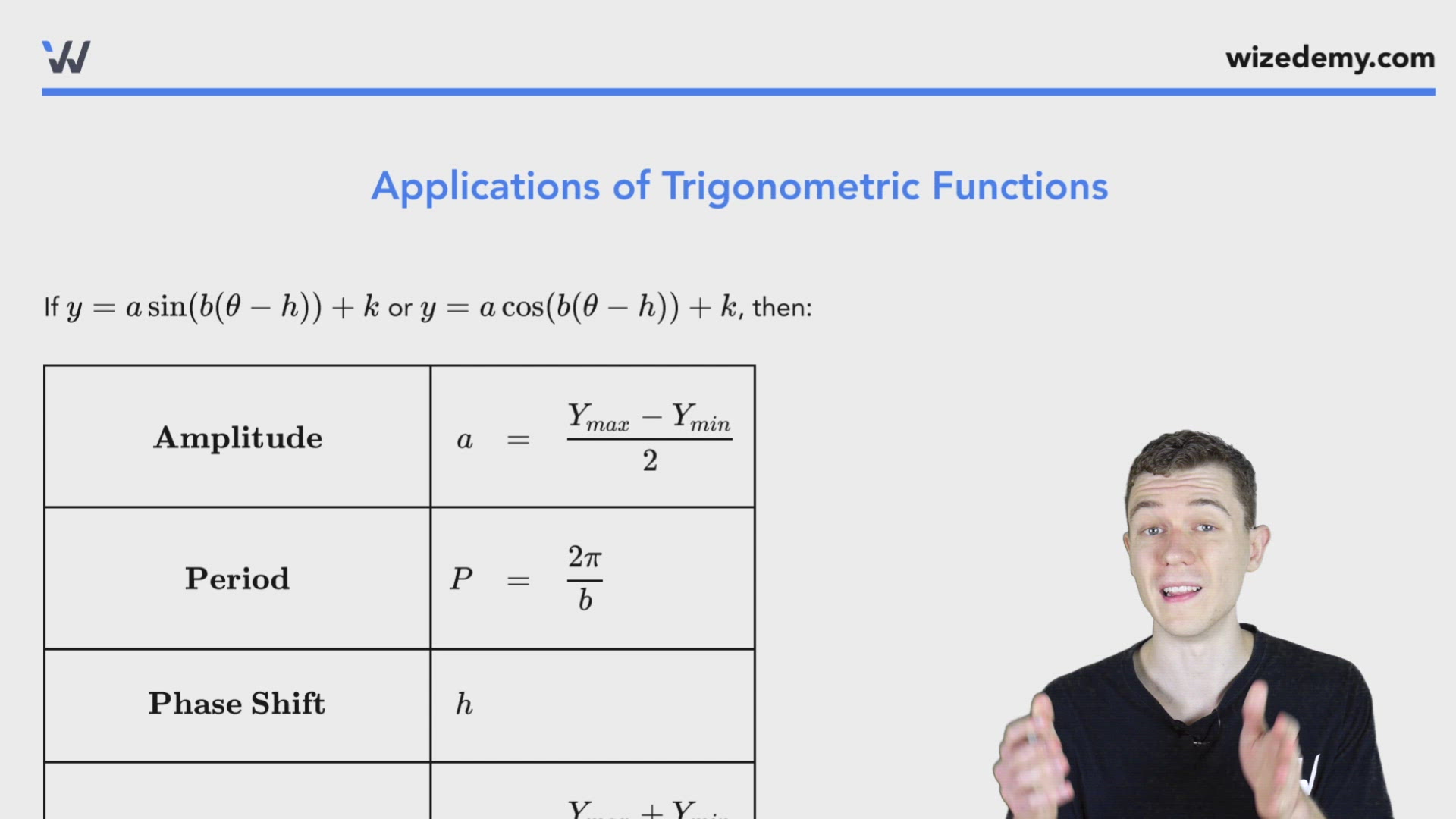
Applications of Trigonometric Functions
If or , then:
0:00 / 0:00
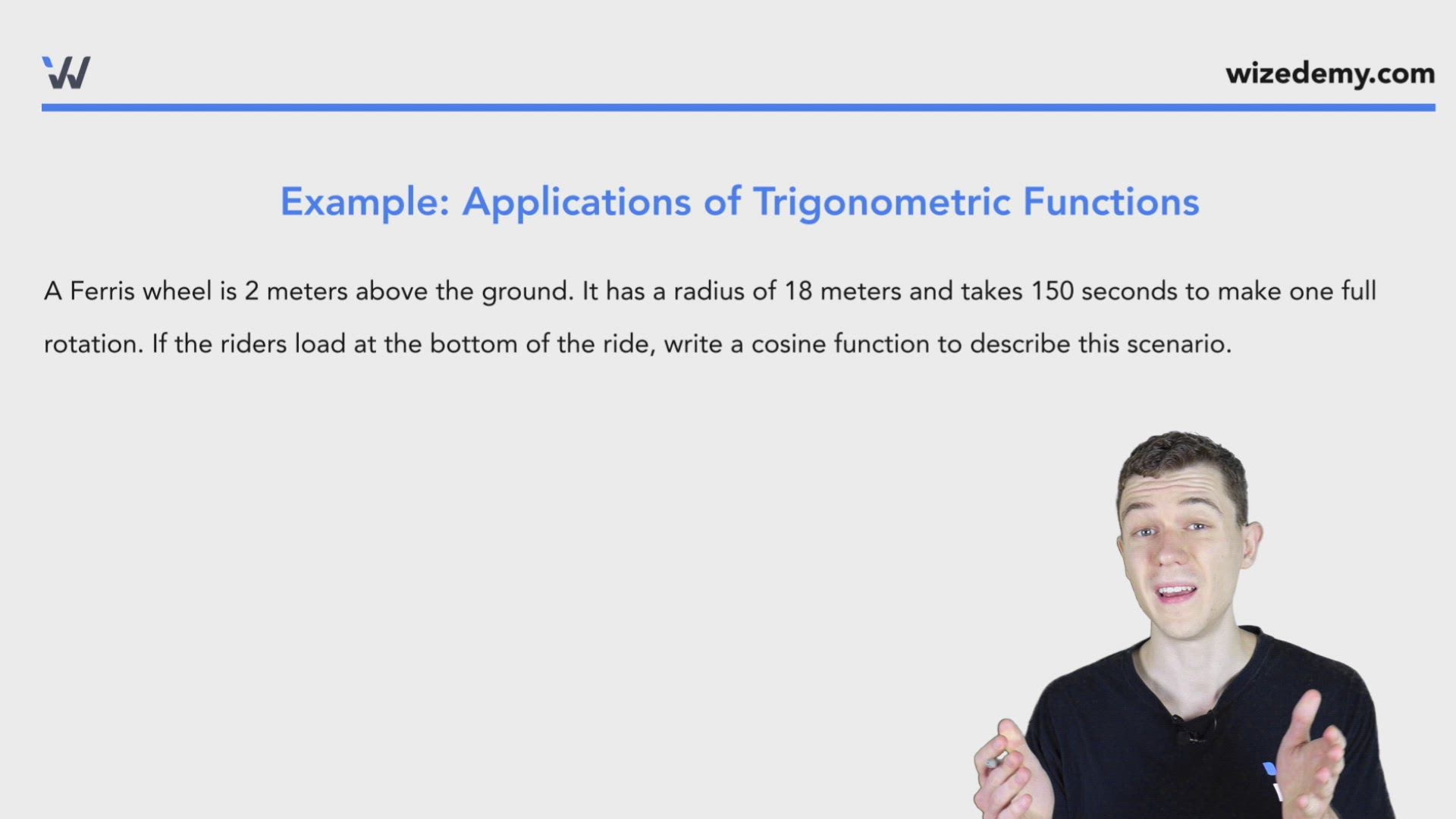
Example: Applications of Trigonometric Functions
A Ferris wheel is 2 meters above the ground. It has a radius of 18 meters and takes 150 seconds to make one full rotation. If the riders load at the bottom of the ride, write a cosine function to describe this scenario.
Let .
Therefore,
A particle travels along the x-axis according to the position where is in seconds and is the x-coordinate of the particle.
a. What is the x-coordinate of the particle at ?
b. What is the largest value for the x-coordinate?
Practice: Applications of Trigonometric Functions
Randy goes on a rollercoaster with his girlfriend, Mira. Randy and Mira reach the top of the first hill, 12 meters above the ground, 13.2 seconds after the ride began. They reach the bottom of the hill, 4 meters above the ground, 3.2 seconds later.
How high are Randy and Mira 21.3 seconds into the ride?
The average depth of water at the end of a dock is 5 feet that varies 3 feet in both directions. The first high tide is at 3:30 AM and goes from high to low tide every 4 hours. At what times is the tide at a depth of 7 feet?