Wize High School Grade 11 Math Textbook > Sequences & Series
Geometric Series
Popular Courses
Grade 11 Functions
Ontario High School
Grade 11 Math
Canada High School
Math 20-1
Alberta High School
Pre-Calculus 11
British Columbia High School
MAT133Y1
University of Toronto
MATH*1030
University of Guelph
QMS 110
Toronto Metropolitan University
MATH 1314
Tarrant County College District
MATH 16B
University of California - Berkeley
MTH 116
Michigan State University
MATH 1302
University of Texas at Arlington

0:00 / 0:00
Geometric Series
A geometric series is the sum of the terms of a geometric sequence.
Wize Concept
Recall, for a geometric sequence:
- is the first term (also called )
- is the common ratio (found by dividing any term by the term that comes before it)
The sum of the first terms of a geometric series (called the partial sum) is given by:
Note: an equivalent formula can be written using the first term, , and the th term, :
Example
Consider the geometric sequence
What is the associated geometric series?
2+6+18+54+...
What is the common ratio?
3
What is the sum of the first 4 terms of this series?
The first term is , and we want to find the sum of the first terms:
When is small, we can easily check:
0:00 / 0:00
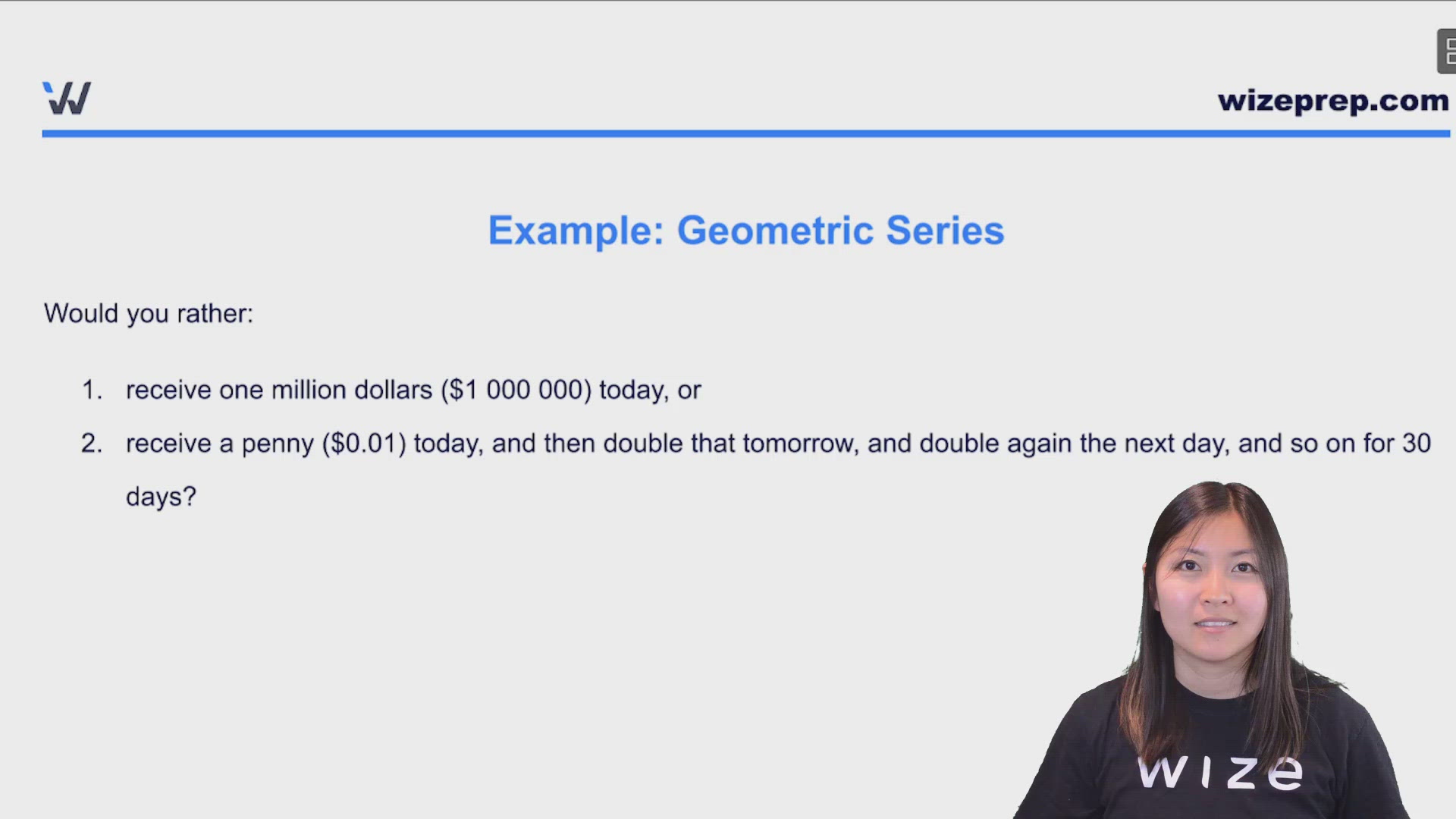
Example: Geometric Series
Would you rather:
- receive one million dollars ($1 000 000) today, or
- receive a penny ($0.01) today, and then double that tomorrow, and double again the next day, and so on for 30 days?
Let's use geometric series to calculate the total amount of money received in the second scenario, where days.
In this scenario, the geometric series is:
The first term of the series corresponds to the amount on the first day:
The common ratio is how much we multiply the amount by every day:
Therefore, by waiting 30 days, the second scenario allows you to receive more than 10 times what is offered in the first scenario!
This is the power of geometric growth, which is the same exponential growth but with discrete steps (not continuous).
Practice: Geometric Series
Select all of the options that are geometric series.
Practice: Geometric Series
a) Determine the sum of the geometric series .
b) Determine the number of terms in the geometric series whose sum is 3280.
Practice: Geometric Series

A diver wants to practice holding her breath once per day. On her first day of training, she holds her breath for 30 seconds. Every day, she manages to hold her breath 10% longer than the day before.
Over these two weeks, what was the average amount of time she managed to hold her breath every day?
Summary - Geometric Series
A geometric series is when we sum up (add up) all the terms in a geometric sequence.
The nth partial sum of a geometric series is when we add up the first n numbers in the geometric sequence. There are two formulas that calculate the nth partial sum.
Formula #1
where,
- is the nth partial sum
- is the first term in the geometric sequence
- is the common ratio between terms in the geometric sequence (we get this by dividing any number in the geometric sequence by the previous number)
Formula #2
where,
- is the nth partial sum
- (or ) is the n+1 term in the geometric sequence
- (or ) is the first term in the geometric sequence
- is the common ratio between terms in the geometric sequence (we get this by dividing any number in the geometric sequence by the previous number)